GS Paper I — Q7
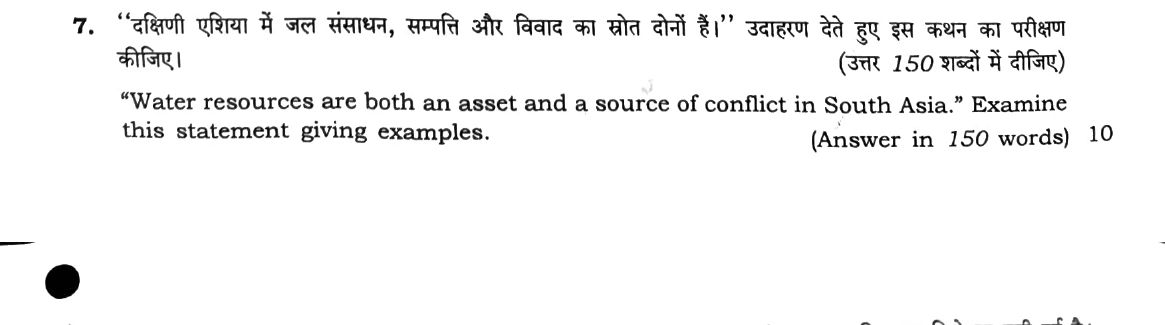
"Water resources are both an asset and a source of conflict in South Asia." Examine this statement giving examples. (Answer in…
"Water resources are both an asset and a source of conflict in South Asia." Examine this statement giving examples. (Answer in 150 words) 10 marks
हिंदी में प्रश्न पढ़ें
“दक्षिणी एशिया में जल संसाधन, सम्पत्ति और विवाद का स्रोत दोनों हैं।” उदाहरण देते हुए इस कथन का परीक्षण कीजिए। (उत्तर 150 शब्दों में दीजिए)
Model answer
Written by UPSC Answer Check against this question's marking rubric, to the 150-word length. UPSC does not publish answers for Mains — this is one way to score well, not an official key.
South Asia’s river systems serve as the bedrock of regional agrarian and energy security. The Indus and Ganga-Brahmaputra basins irrigate vast swathes of fertile land, sustaining hundreds of millions, while Bhutan effectively harnesses its water resources for hydropower exports to India.
Drivers of Conflict and Depletion However, transboundary hydrology frequently sparks geopolitical friction. Under the Indus Waters Treaty (1960), India and Pakistan face persistent disputes over upstream projects such as Kishanganga and Ratle. In the east, water-sharing over the Teesta River remains contentious, alongside legacy tensions regarding the 1996 Farakka Barrage agreement with Bangladesh. Similarly, river management with Nepal via the Kosi and Gandak treaties faces recurring friction over flood control and benefit-sharing. Furthermore, severe groundwater depletion in Punjab, Haryana, and the wider Indo-Gangetic plain critically undermines the long-term sustainability of this asset.
Institutional Resilience Examination reveals that water acts as a flashpoint primarily due to competitive sovereignty; yet, institutions like the Permanent Indus Commission demonstrate that enduring, treaty-based cooperation can mitigate conflict even amidst political hostility. South Asia requires basin-wide, integrated management to secure its hydro-future.
What "Examine" is asking you to do
Test the proposition the question puts to you and return a finding on how far it holds. Examine stems carry a claim, or ask whether something has happened, and expect evidence weighed both ways before the extent is stated — often with remedial measures attached.
Structure that answers it
Restate the claim as the question frames it → evidence that supports it → evidence that undercuts it → the conditions under which it holds → verdict on how far it stands
Where marks are lost
Stopping at description. An examination has to reach a finding, and “examine with justification” means the extent must be stated, not implied.
How this answer will be evaluated
Approach
Framework: GS1 Geography: Physical-Human Linkage. examine: intro > how/why with reasoning > evidence > conclusion Full marks: Clear mechanism of conflict/asset with specific examples and map.
Key points expected
- Explain water as a source of conflict
- Explain water as a strategic asset
- Provide specific examples of regional disputes
- Provide specific examples of resource utilization
Evaluation rubric
Each sub-part is marked on its own, against the marks and word limit printed on the paper.
- The answer Analyze water as an asset and a source of conflict in South Asia with examples. 10 marks · 150 words
examine— intro → how/why with reasoning → evidence → conclusion
Must cover
- Explain water as a source of conflict
- Explain water as a strategic asset
- Provide specific examples of regional disputes
- Provide specific examples of resource utilization
Loses marks
- Narrating chronology without analysis
- Emotive words on social issues
- Where without why
Earns more
- Mention specific river basins (Indus, Ganga, Brahmaputra)
- Reference specific treaties (Indus Waters Treaty)
- Link physical geography to human outcomes
- Balanced conclusion on cooperation vs conflict
Extra mark
- 30-second sketch map of river basins
- One robust statistic on water usage
Practice this exact question
Write your answer and it is marked point by point against the model answer above — what you covered, what you missed, what you got wrong.
Evaluate my answer →More from General Studies 2026 GS Paper I
- Q4 What is the Fujiwhara effect? Explain its impact on the movement and intensity of tropica…
- Q5 "Tundra regions are ecologically fragile but economically important." Examine this statem…
- Q6 Discuss the role of aeolian processes in desertification and land degradation. (Answer in…
- Q7 "Water resources are both an asset and a source of conflict in South Asia." Examine this…
- Q8 Unity in diversity remains the defining feature of Indian society despite the challenges…
- Q9 How do you understand disability? Substantiate the need for inclusive policy framework in…
- Q10 Do you think digital technology promotes social empowerment? Explain with examples. (Answ…