Paper II — Q1
(a) (i) Draw the structures of three possible geometrical isomers of [10] annulene and explain the aromaticity. (5 marks) (ii)…
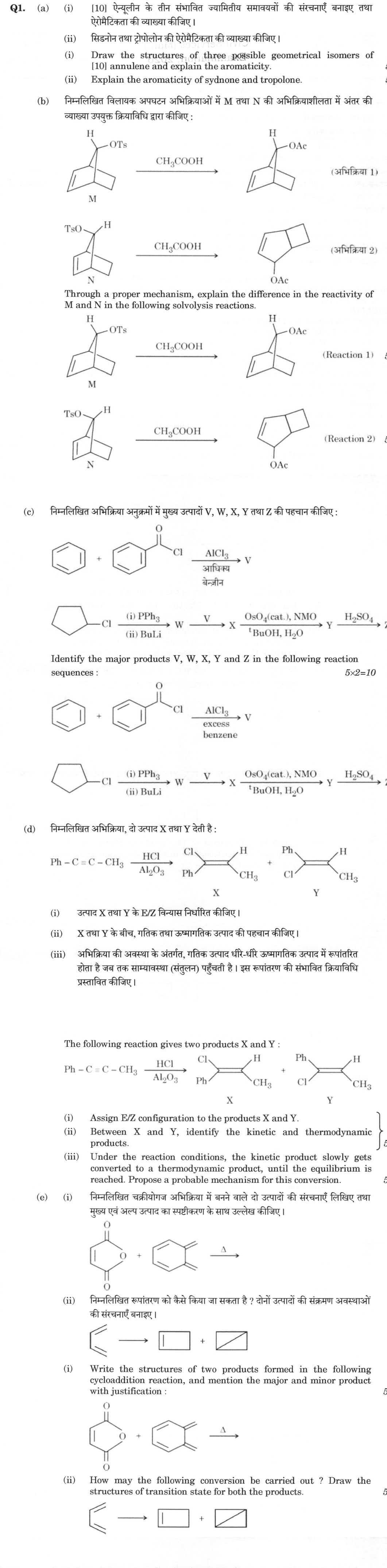
Draw the structures of three possible geometrical isomers of [10] annulene and explain the aromaticity. 5 marks
Explain the aromaticity of sydnone and tropolone. 5 marks
Through a proper mechanism, explain the difference in the reactivity of M and N in the following solvolysis reactions. [Structure M : bicyclic bridged structure with H and OTs] --CH₃COOH--> [product with OAc] (Reaction 1) 5 [Structure N : bicyclic bridged structure with TsO and H] --CH₃COOH--> [product with OAc] (Reaction 2) 5 10 marks
Identify the major products V, W, X, Y and Z in the following reaction sequences : 5×2=10
(1) Benzene + benzoyl chloride (C6H5COCl) → (AlCl3, excess benzene) → V
(2) Cyclopentyl chloride → (i) PPh3, (ii) BuLi → W; W → V → X; X → (OsO4 (cat.), NMO, tBuOH, H2O) → Y; Y → (H2SO4) → Z 10 marks
The following reaction gives two products X and Y :
Ph – C ≡ C – CH3 → (HCl, Al2O3) → X + Y
X : Cl and Ph on the same side, H and CH3 on the same side (geometrical isomer) Y : Ph and H on the same side, Cl and CH3 on the same side (geometrical isomer) Determine the E/Z configurations of the products X and Y. Identify, between X and Y, the kinetic and the thermodynamic product. Under the reaction conditions, the kinetic product is slowly converted into the thermodynamic product until equilibrium is attained. Suggest a possible mechanism of this transformation. 10 marks
Write the structures of two products formed in the following cycloaddition reaction, and mention the major and minor product with justification : [O=C(CH=CH–O–C(=O))-type cyclic anhydride] + [cyclohexadiene-type diene] → (Δ) 5 marks
How may the following conversion be carried out ? Draw the structures of transition state for both the products. [butadiene-type diene] → [cyclobutane-type ring] + [cyclobutene-type ring] 5 marks
हिंदी में प्रश्न पढ़ें
[10] ऐन्यूलीन के तीन संभावित ज्यामितीय समावयवों की संरचनाएँ बनाइए तथा एरोमैटिकता की व्याख्या कीजिए। (5 अंक)
सिडनोन तथा ट्रोपोलोन की एरोमैटिकता की व्याख्या कीजिए। (5 अंक)
निम्नलिखित विलायक अपघटन अभिक्रियाओं में M तथा N की अभिक्रियाशीलता में अंतर की व्याख्या उपयुक्त क्रियाविधि द्वारा कीजिए : [संरचना M : द्विचक्रीय सेतु-युक्त संरचना, H तथा OTs समूह युक्त] --CH₃COOH--> [उत्पाद : OAc समूह युक्त] (अभिक्रिया 1) [संरचना N : द्विचक्रीय सेतु-युक्त संरचना, TsO तथा H समूह युक्त] --CH₃COOH--> [उत्पाद : OAc समूह युक्त] (अभिक्रिया 2) (10 अंक)
निम्नलिखित अभिक्रिया अनुक्रमों में मुख्य उत्पादों V, W, X, Y तथा Z की पहचान कीजिए :
(1) बेन्जीन + बेन्ज़ोइल क्लोराइड (C6H5COCl) → (AlCl3, आधिक्य बेन्जीन) → V
(2) साइक्लोपेन्टिल क्लोराइड → (i) PPh3, (ii) BuLi → W; W → V → X; X → (OsO4 (उत्प्रेरक), NMO, tBuOH, H2O) → Y; Y → (H2SO4) → Z (10 अंक)
निम्नलिखित अभिक्रिया, दो उत्पाद X तथा Y देती है :
Ph – C ≡ C – CH3 → (HCl, Al2O3) → X + Y
X : Cl तथा Ph एक ही ओर, H तथा CH3 एक ही ओर (ज्यामितीय समावयवी) Y : Ph तथा H एक ही ओर, Cl तथा CH3 एक ही ओर (ज्यामितीय समावयवी) उत्पाद X तथा Y के E/Z विन्यास निर्धारित कीजिए। X तथा Y के बीच, गतिक तथा ऊष्मागतिक उत्पाद की पहचान कीजिए। अभिक्रिया की अवस्था के अंतर्गत, गतिक उत्पाद धीरे-धीरे ऊष्मागतिक उत्पाद में रूपांतरित होता है जब तक साम्यावस्था (संतुलन) पहुँचती है। इस रूपांतरण की संभावित क्रियाविधि प्रस्तावित कीजिए। (10 अंक)
निम्नलिखित चक्रीयोगज अभिक्रिया में बनने वाले दो उत्पादों की संरचनाएँ लिखिए तथा मुख्य एवं अल्प उत्पाद का स्पष्टीकरण के साथ उल्लेख कीजिए। [O=C(CH=CH–O–C(=O))-type cyclic anhydride] + [cyclohexadiene-type diene] → (Δ) (5 अंक)
निम्नलिखित रूपांतरण को कैसे किया जा सकता है ? दोनों उत्पादों की संक्रमण अवस्थाओं की संरचनाएँ बनाइए। [butadiene-type diene] → [cyclobutane-type ring] + [cyclobutene-type ring] (5 अंक)
Model answer
Drafted with AI by UPSC Answer Check against this question's marking rubric, to the expected length. UPSC does not publish answers for Mains — this is one way to score well, not an official key. How we build rubrics and answers.
(a)(i) Geometrical isomers and aromaticity of [10]annulene (5 marks)
[10]Annulene (cyclodeca-1,3,5,7,9-pentaene) has 10 π electrons, which fits Hückel's 4n + 2 rule (n = 2), but aromaticity also needs a planar, fully conjugated ring. Three geometrical isomers can be drawn: all-cis (Z,Z,Z,Z,Z); mono-trans (E,Z,Z,Z,Z); and di-trans (E,Z,Z,E,Z).

None can be planar. A planar all-cis ring is a regular decagon with internal angles of 144°, far from the 120° of sp² carbon, and the angle strain is severe. Each trans double bond puts two hydrogens inside the ring, where they collide (transannular H···H repulsion), which twists the ring out of plane. In these twisted forms the p orbitals overlap poorly, there is no cyclic delocalisation, and [10]annulene is non-aromatic (the isomers are unstable and reactive). Bridging the ring, as in 1,6-methano[10]annulene, removes the interference and gives an aromatic, almost planar molecule.
(a)(ii) Aromaticity of sydnone and tropolone (5 marks)
Sydnone is a mesoionic 1,2,3-oxadiazolium-5-olate (usually N3-aryl). It is a planar five-membered ring (O1, N2, N3, C4, C5) that can only be written as a resonance hybrid with charge separation, a positive charge in the ring and a negative charge on the exocyclic oxygen. The ring atoms provide six π electrons (2 from O1, 1 from each of N2, N3, C4 and C5), so Hückel's 4n + 2 rule is satisfied with n = 1. Evidence: it is planar with a large dipole moment, it undergoes electrophilic substitution at C4 (halogenation, nitration, acylation), and its exocyclic C=O stretches near 1740 cm⁻¹.
Tropolone (2-hydroxycyclohepta-2,4,6-trien-1-one) has a planar seven-membered ring. The polar carbonyl, C⁺–O⁻, places the ring in a tropylium-like state with 6 π electrons over the seven carbons (three C=C bonds and an empty p orbital, the oxygen carrying the negative charge). Aromatic character is supported by its stability, its electrophilic substitution (bromination, nitration, azo coupling), its acidity (pKa about 6.7, far more acidic than phenol), its strong intramolecular hydrogen bond, and its ability to chelate metals as an anion, which is delocalised.
(b) Solvolysis of the norbornenyl tosylates M and N (10 marks)
M is anti-7-norbornenyl tosylate, whose OTs is on the side opposite to the C2=C3 double bond, and N is the syn isomer, whose OTs lies over the double bond.
Reaction 1 (M). The π orbital of C2=C3 lies on the face opposite to the leaving group at C7, which is exactly the backside geometry needed for neighbouring-group participation. As OTs⁻ leaves, the π electrons assist (anchimeric assistance) and bridge to C7, giving a delocalised, non-classical bishomocyclopropenyl cation, in which the positive charge is spread over C7, C2 and C3. This lowers the transition state greatly, and the anti tosylate solvolyses about 10¹¹ times faster than the saturated 7-norbornyl tosylate. Acetic acid attacks C7 from the face opposite to the bridging π bond, which is the face the tosylate left, so anti-7-norbornenyl acetate is formed with retention of configuration and no skeletal rearrangement.
Reaction 2 (N). In the syn isomer the double bond is on the same side as OTs and cannot help from the back. Ionisation is therefore slow, with no π participation, and is at best a little faster than for the saturated tosylate. The bond antiperiplanar to the leaving group is the C1-C6 σ bond, so this σ bond participates: C6 migrates from C1 to C7 as OTs⁻ leaves, which gives a cyclopentenyl (allyl) cation, C1-C2-C3, in a bicyclo[3.2.0] skeleton (a cyclobutane fused to the five-membered ring). Acetic acid traps this stabilised allyl cation to give bicyclo[3.2.0]hept-2-en-4-yl acetate, a rearranged product.
Thus M reacts much faster, by π participation with retention, whereas N reacts slowly and by σ participation with rearrangement.
(c) Products V, W, X, Y and Z (10 marks)

- V: benzophenone, Ph₂C=O, by Friedel-Crafts acylation of benzene with benzoyl chloride and AlCl₃ (deactivated ketone, so no polyacylation).
- W: cyclopentylidenetriphenylphosphorane, (CH₂)₄C=PPh₃. Cyclopentyl chloride and PPh₃ give the phosphonium salt, and BuLi removes the α proton to give the ylide.
- X: (diphenylmethylene)cyclopentane, Ph₂C=C(CH₂)₄, by Wittig reaction of W with V (Ph₃P=O is the by-product).
- Y: 1-(hydroxydiphenylmethyl)cyclopentan-1-ol, Ph₂C(OH)–C(OH)(CH₂)₄, the syn (cis) diol from catalytic OsO₄ with NMO as the co-oxidant.
- Z: 2,2-diphenylcyclohexanone, from the pinacol rearrangement of Y in H₂SO₄. The OH on the diphenyl carbon leaves, since the resulting diphenylcarbocation is the most stable, and a ring C–C bond of the neighbouring carbinol carbon then migrates to it. This expands the five-membered ring to six, and loss of H⁺ from the remaining OH gives the ketone.
(d) HCl addition to 1-phenylpropyne (10 marks)
(i) In X, Cl and H are on the same side and Ph and CH₃ on the same side. At C1, Cl outranks Ph (Cl > C); at C2, CH₃ outranks H. In X, Cl and CH₃ are on opposite sides, so X is E. In Y, Cl and CH₃ are on the same side, so Y is Z.
(ii) X is the syn addition product (H and Cl added to the same side, by collapse of a tight ion pair on the Al₂O₃ surface), and it forms fastest, so X is the kinetic product. Y has Cl cis to CH₃ and Ph cis to H, so it avoids the strain of the bulky phenyl and methyl being cis, as in X. Y is therefore the more stable thermodynamic product.
(iii) Under the acidic conditions the double bond of X is protonated reversibly at C2, giving the benzylic α-chlorocarbocation PhC⁺(Cl)–CH₂CH₃, stabilised by phenyl and by lone-pair donation from Cl. The C1-C2 bond now has single-bond character and rotates freely to the less crowded conformer. Loss of H⁺ from C2 gives Y (or reforms X). Because Y is more stable, the equilibrium moves to Y, and X slowly converts into it.
(e)(i) Cycloadducts of maleic anhydride with o-quinodimethane (5 marks)
The diene can react by two routes. The major adduct is formed when maleic anhydride adds across the two exocyclic CH₂ termini, giving cis-1,2,3,4-tetrahydronaphthalene-2,3-dicarboxylic anhydride, with the anhydride ring cis-fused (endo preferred). The original six-membered ring becomes an aromatic benzene ring, so the transition state gains aromatic stabilisation and the reaction is strongly exothermic. The minor adduct is formed by addition across the ring diene, C1 and C4, giving a bicyclo[2.2.2]octene with two exocyclic methylene groups and the fused anhydride. It retains no aromatic stabilisation and loses the conjugation of the o-quinodimethane, so it has a higher barrier and forms in smaller amount.
(e)(ii) Buta-1,3-diene to cyclobutene and bicyclo[1.1.0]butane (5 marks)
The conversion is carried out photochemically, by irradiating buta-1,3-diene with UV light (about 254 nm). By the Woodward-Hoffmann rules, the thermal four-electron closure is conrotatory, but the photochemical closure of the excited diene (from the s-cis conformer) is disrotatory, and gives cyclobutene as the main product. In the transition state, C1 and C4 rotate in opposite senses, the p-lobes at both ends overlap on the same face, and a σ bond forms between C1 and C4 (Cs symmetry). The minor product, bicyclo[1.1.0]butane, is formed by cross-bonding of the termini to the internal carbons (C1 to C3 and C4 to C2) in the s-cis (gauche) excited diene, with the necessary hydrogen shifts.

How this answer will be evaluated
Evaluation rubric
Each sub-part is marked on its own, against the marks and word limit printed on the paper.
- (a)(i) (a)(i) Draw three geometrical isomers of [10]annulene and explain its aromaticity (5 marks). 5 marks
Must cover
- Three isomers drawn: all-Z, mono-E, di-E
- 10 π electrons satisfy 4n + 2 but the ring cannot be planar
- All-cis planar needs 144° angles (angle strain); trans forms have internal H···H clash
- Non-aromatic; contrast with 1,6-methano[10]annulene
Loses marks
- Calling [10]annulene aromatic because 4n + 2.
- Only one isomer drawn.
Earns more
- Structures with internal H drawn.
Extra mark
- Vogel's bridged aromatic
- (a)(ii) (a)(ii) Explain the aromaticity of sydnone and tropolone (5 marks). 5 marks
Must cover
- Sydnone: planar mesoionic ring with six π electrons, charge-separated
- Sydnone evidence: electrophilic substitution at C4, dipole moment
- Tropolone: seven-membered ring, tropylium-like 6 π electrons
- Tropolone evidence: acidity, substitution, chelation
Loses marks
- Counting eight π electrons for sydnone.
- Treating tropolone as antiaromatic.
Earns more
- Electron count shown.
Extra mark
- Hydrogen-bonding in tropolone
- (b) (b) Explain the different solvolysis reactivity of M and N by mechanism (10 marks). 10 marks
Must cover
- M (anti): backside π participation, non-classical bishomocyclopropenyl cation, rate about 10¹¹ faster
- M: attack anti to the bridging π bond gives retained product
- N (syn): no π assistance, slow; C1–C6 σ participation with rearrangement
- N: allyl cation in bicyclo[3.2.0] skeleton trapped to give bicyclo[3.2.0]hept-2-en-4-yl acetate
Loses marks
- Reversing syn and anti.
- Giving the same product for both.
Earns more
- Rate comparison with reason.
Extra mark
- Antiperiplanar requirement
- (c) (c) Identify V, W, X, Y and Z (5 × 2 = 10 marks). 10 marks
Must cover
- V = benzophenone
- W = cyclopentylidene triphenylphosphorane and X = (diphenylmethylene)cyclopentane by Wittig reaction
- Y = cis diol, 1-(hydroxydiphenylmethyl)cyclopentanol
- Z = 2,2-diphenylcyclohexanone via pinacol ring expansion
Loses marks
- Giving Z as a phenyl-migration ketone without reasoning.
- Naming without structures.
Earns more
- Reagent role explained (AlCl₃, BuLi, NMO).
Extra mark
- Justification of migration (diphenyl cation)
- (d) (d) HCl addition to 1-phenylpropyne: E/Z, kinetic and thermodynamic products, and conversion mechanism (5 + 5 marks). 10 marks
Must cover
- X = E, Y = Z with CIP reasoning
- X kinetic (syn addition), Y thermodynamic (less strain)
- Mechanism: reversible protonation to the α-chlorobenzyl cation
- C–C rotation then loss of H⁺ gives Y
Loses marks
- Assigning X as Z.
- Reversing kinetic and thermodynamic.
Earns more
- Reason for syn addition on Al₂O₃.
Extra mark
- Steric argument Ph versus CH₃ cis
- (e)(i) (e)(i) Cycloadducts of maleic anhydride with o-quinodimethane, major and minor (5 marks). 5 marks
Must cover
- Major: adduct across exocyclic CH₂ termini, tetrahydronaphthalene anhydride
- Minor: adduct across the ring diene, bicyclo[2.2.2]octene with two exocyclic methylenes
- Justification: aromatisation gain versus loss of conjugation
- Endo or cis stereochemistry
Loses marks
- Giving only one adduct.
- Reversing major and minor.
Earns more
- Structures described clearly.
Extra mark
- Named products
- (e)(ii) (e)(ii) How butadiene is converted to cyclobutene and bicyclo[1.1.0]butane, with transition states (5 marks). 5 marks
Must cover
- Photochemical (UV) conversion
- Cyclobutene: disrotatory closure of s-cis diene, C1–C4 bond
- Bicyclobutane: cross-bonding C1–C3 and C2–C4
- Transition-state structures drawn
Loses marks
- Stating thermal disrotatory closure.
- No transition state drawn.
Earns more
- Woodward–Hoffmann reasoning.
Extra mark
- Thermal conrotatory contrast
What "Explain" is asking you to do
Make the working of something clear — what sets it off, what follows from what, and what it produces. Explain is the Commission's mechanism word: it dominates the technical papers and the “explain why” stems, where the marks sit in the causal chain and not in the label.
Structure that answers it
State what it is → the initiating condition → the chain of cause, step by step → an instance where it plays out → what the chain produces
Where marks are lost
Describing what something looks like instead of why it works that way. Naming the stages without linking them reads as description too.
Practice this exact question
Write your answer and it is marked point by point against the model answer above — what you covered, what you missed, what you got wrong.
Evaluate my answer →More from Chemistry 2026 Paper II
- Q1 (a) (i) Draw the structures of three possible geometrical isomers of [10] annulene and ex…
- Q2 In the following reaction, intermediate [A] is formed : CHCl₃ + ᵗBuOK ——> [A] (a) Write t…
- Q3 (a) (i) Write the structure of the major products of the following reaction and write the…
- Q4 (a) (i) Write the structure of the stereochemical product formed in the reaction of (2E,…