Paper II — Q4
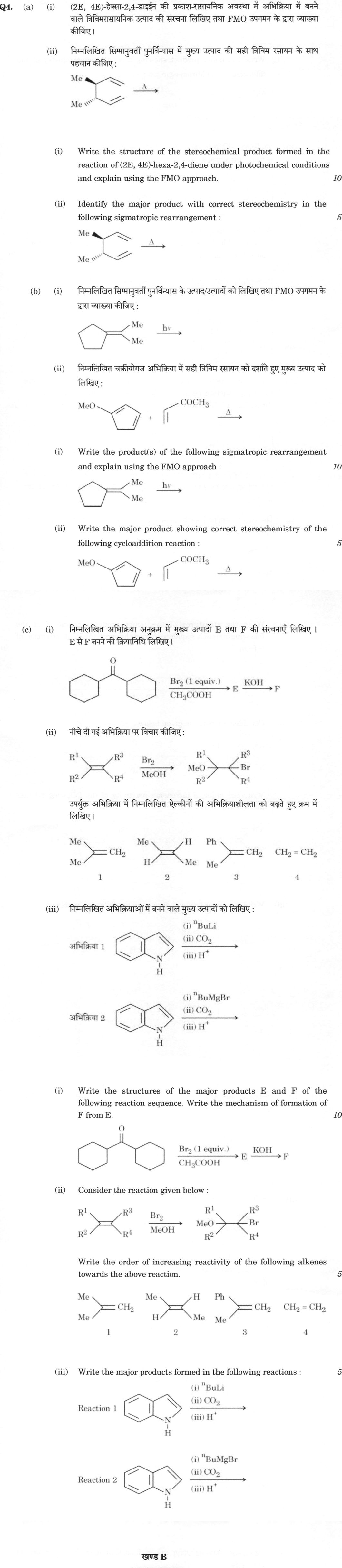
(a) (i) Write the structure of the stereochemical product formed in the reaction of (2E, 4E)-hexa-2,4-diene under photochemical…
Write the structure of the stereochemical product formed in the reaction of (2E, 4E)-hexa-2,4-diene under photochemical conditions and explain using the FMO approach. 10 marks
Identify the major product with correct stereochemistry in the following sigmatropic rearrangement : 5 marks
Write the product(s) of the following sigmatropic rearrangement and explain using the FMO approach : 10 marks
Write the major product showing correct stereochemistry of the following cycloaddition reaction : 5 marks
Write the structures of the major products E and F of the following reaction sequence. Write the mechanism of formation of F from E. [Reaction scheme: dicyclohexyl ketone (cyclohexyl-C(=O)-cyclohexyl) —Br₂ (1 equiv.) / CH₃COOH→ E —KOH→ F] 10 marks
Consider the reaction given below : [R¹R²C=CR³R⁴ —Br₂ / MeOH→ R¹R²C(OMe)-C(Br)R³R⁴] Write the order of increasing reactivity of the following alkenes towards the above reaction. 1 Me₂C=CH₂ 2 Me(H)C=C(H)Me 3 Ph(Me)C=CH₂ 4 CH₂ = CH₂ 5 marks
Write the major products formed in the following reactions : Reaction 1 [indole] —(i) ⁿBuLi (ii) CO₂ (iii) H⁺→ Reaction 2 [indole] —(i) ⁿBuMgBr (ii) CO₂ (iii) H⁺→ 5 marks
हिंदी में प्रश्न पढ़ें
(2E, 4E)-हेक्सा-2,4-डाईईन की प्रकाश-रासायनिक अवस्था में अभिक्रिया में बनने वाले त्रिविमरासायनिक उत्पाद की संरचना लिखिए तथा FMO उपगमन के द्वारा व्याख्या कीजिए। (10 अंक)
निम्नलिखित सिग्मानुवर्ती पुनर्विन्यास में मुख्य उत्पाद की सही त्रिविम रसायन के साथ पहचान कीजिए : (5 अंक)
निम्नलिखित सिग्मानुवर्ती पुनर्विन्यास के उत्पाद/उत्पादों को लिखिए तथा FMO उपगमन के द्वारा व्याख्या कीजिए : (10 अंक)
निम्नलिखित चक्रीयोजन अभिक्रिया में सही त्रिविम रसायन को दर्शाते हुए मुख्य उत्पाद को लिखिए : (5 अंक)
निम्नलिखित अभिक्रिया अनुक्रम में मुख्य उत्पादों E तथा F की संरचनाएँ लिखिए । E से F बनने की क्रियाविधि लिखिए । [संरचना: डाइसाइक्लोहेक्सिल कीटोन] —— Br₂ (1 equiv.) / CH₃COOH ——> E —— KOH ——> F (10 अंक)
नीचे दी गई अभिक्रिया पर विचार कीजिए : R¹R²C=CR³R⁴ —— Br₂ / MeOH ——> MeO–C(R¹)(R²)–C(Br)(R³)(R⁴) उपर्युक्त अभिक्रिया में निम्नलिखित ऐल्कीनों की अभिक्रियाशीलता को बढ़ते हुए क्रम में लिखिए । Me₂C=CH₂ (1) ; cis-Me(H)C=C(H)Me (2) ; Ph(Me)C=CH₂ (3) ; CH₂=CH₂ (4) (5 अंक)
निम्नलिखित अभिक्रियाओं में बनने वाले मुख्य उत्पादों को लिखिए : अभिक्रिया 1 : [इंडोल] —— (i) ⁿBuLi, (ii) CO₂, (iii) H⁺ ——> अभिक्रिया 2 : [इंडोल] —— (i) ⁿBuMgBr, (ii) CO₂, (iii) H⁺ ——> (5 अंक)
Model answer
Drafted with AI by UPSC Answer Check against this question's marking rubric, to the expected length. UPSC does not publish answers for Mains — this is one way to score well, not an official key. How we build rubrics and answers.
(a)(i) Photochemical reaction of (2E,4E)-hexa-2,4-diene (10 marks)
Irradiation of the diene causes a 4π-electron electrocyclic ring closure to a cyclobutene. The stereochemistry is decided by the symmetry of the frontier orbital that controls the closure, the HOMO.
In the ground state the four π electrons occupy ψ₁ and ψ₂, and the HOMO is ψ₂, whose terminal lobes at C1 and C4 have opposite phase. To form the σ bond, the termini must rotate so that lobes of the same phase overlap, which needs rotation in the same sense (conrotatory). This is the thermal path.
On photoexcitation an electron is promoted from ψ₂ to ψ₃, so the HOMO of the excited state is ψ₃. Its terminal lobes have the same phase, so bonding overlap needs the termini to turn in opposite senses (disrotatory).

Disrotatory closure of the (2E,4E) isomer, which has both methyl groups pointing outward, turns them both to the same face of the new ring. The product is therefore cis-3,4-dimethylcyclobut-1-ene, the meso compound (3R,4S). (The thermal conrotatory closure of the same diene would instead give the trans, racemic cyclobutene.)
(a)(ii) Thermal rearrangement of 3,4-dimethylhexa-1,5-diene (5 marks)
Heating a 1,5-diene brings about the Cope rearrangement, a [3,3]-sigmatropic shift. The C3-C4 σ bond breaks, a new bond forms between C1 and C6, and the double bonds move to C2=C3 and C4=C5, giving octa-2,6-diene.
The reaction goes through a chair-like six-membered transition state in which the bulkiest groups are equatorial. For the chiral (racemic, R*,R*) diastereomer, both methyl groups can be equatorial in the chair, which places them so that both new double bonds are E. The major product is therefore (2E,6E)-octa-2,6-diene. (The meso diastereomer would give (2E,6Z) instead.)
(b)(i) Photochemical rearrangement of isopropylidenecyclopentane (10 marks)
Irradiation causes a suprafacial [1,3]-hydrogen shift. The hydrogen moves from an allylic carbon to the other end of the C=C bond, and the double bond shifts. Two products are possible:
- H from a methyl group moves to the ring carbon, giving isopropenylcyclopentane (2-cyclopentylprop-1-ene, an exocyclic terminal alkene).
- H from a ring CH₂ next to the double bond moves to the CMe₂ carbon, giving the more substituted 1-isopropylcyclopent-1-ene.
FMO explanation. The [1,3] shift treats the system as an allyl fragment (C=C-C) plus a migrating hydrogen, with four electrons in total (two π electrons and the two σ-bond electrons), so it is a [σ2s + π2s] change. For the thermal reaction the HOMO of the allyl fragment is ψ₂, with a node at the central carbon and opposite phases at the termini. The H 1s orbital can overlap with both termini on the same face (suprafacial) only if they have the same phase, so it cannot bond to both, and the shift is thermally forbidden (it would need an antarafacial shift, geometrically impossible for H over a short three-carbon span). On photoexcitation an electron enters ψ₃, whose termini are in phase, so the suprafacial shift becomes allowed.
(b)(ii) Diels-Alder reaction of 1-methoxycyclopentadiene with methyl vinyl ketone (5 marks)
The reaction is a thermal [4+2] cycloaddition, which is suprafacial on both partners, and gives a bicyclo[2.2.1]hept-5-ene (norbornene).
Regiochemistry: the methoxy group on C1 of the diene makes C4 the largest HOMO coefficient (the terminus far from OMe) which bonds to the β-carbon (CH₂) of the dienophile (largest LUMO coefficient), so the acetyl-bearing carbon bonds to C1. This is the "ortho" product: the acetyl group ends up on the carbon adjacent to the bridgehead carrying OMe.
Stereochemistry: the endo orientation of the acetyl group (below the C5=C6 double bond, away from the CH₂ bridge) is favoured by secondary orbital overlap in the transition state.
Major product: racemic endo-2-acetyl-1-methoxybicyclo[2.2.1]hept-5-ene, 1-(1-methoxybicyclo[2.2.1]hept-5-en-2-yl)ethanone.
(c)(i) Bromination and Favorskii rearrangement of dicyclohexyl ketone (10 marks)
E: with one equivalent of Br₂ in acetic acid, the ketone brominates at an α-carbon through its enol, giving the α-bromo ketone (1-bromocyclohexyl)(cyclohexyl)ketone.
F: with KOH, this α-halo ketone, which has an enolisable hydrogen on the other α-carbon (the other cyclohexyl ring), undergoes the Favorskii rearrangement to give the carboxylic acid, [1,1′-bi(cyclohexane)]-1-carboxylic acid (1,1′-bicyclohexyl-1-carboxylic acid), isolated after acidification.
Mechanism:
- (1) KOH removes the α′-hydrogen (on the other cyclohexyl ring) to give an enolate.
- (2) The enolate carbon attacks the bromine-bearing carbon in an intramolecular SN2 displacement of Br⁻, closing a cyclopropanone (a spiro-fused, dispiro cyclopropanone).
- (3) OH⁻ adds to the strained cyclopropanone C=O to give a tetrahedral alkoxide.
- (4) The three-membered ring opens by cleavage of a C-C bond, giving the more stable carbanion (tertiary here, the same either way by symmetry); this is protonated by the solvent.
- (5) The carboxylate is protonated by acid to give F. Because the ring carbons join at a quaternary centre, the product has the two rings directly bonded at a carbon that also bears the CO₂H group.
(c)(ii) Reactivity of alkenes towards Br₂ in methanol (5 marks)
Order of increasing reactivity: CH₂=CH₂ (4) < trans-MeCH=CHMe (2) < Me₂C=CH₂ (1) < PhC(Me)=CH₂ (3).
The rate-determining step is the formation of the bromonium ion, which has substantial carbocation character at the more substituted carbon (the site attacked by MeO⁻/MeOH). Alkyl groups stabilise this positive charge by hyperconjugation and induction. Ethene gives only a primary-like, unstabilised ion and is the slowest. trans-2-Butene has two alkyl groups but the charge is secondary. Isobutene (Me₂C=CH₂) generates a tertiary centre and is much faster. α-Methylstyrene (3) generates a tertiary benzylic centre that is stabilised by resonance with the phenyl ring as well as by the methyl group, so it is the most reactive.
(c)(iii) Carboxylation of indole with n-BuLi and with n-BuMgBr (5 marks)
Indole is deprotonated at N-H by both organometallics to give an ambident indolyl anion, which can react at N or at C-3. The metal-nitrogen bond determines the site.
Reaction 1 (n-BuLi, then CO₂, then H⁺): the lithium-nitrogen bond is largely ionic, so the anion is essentially free at nitrogen, which reacts with CO₂ (the kinetic, hard site). The product is the N-carboxylate, indole-1-carboxylic acid (N-CO₂H), which on acidification is a labile carbamic acid that readily loses CO₂.
Reaction 2 (n-BuMgBr, then CO₂, then H⁺): the magnesium-nitrogen bond is much more covalent, which blocks nitrogen and leaves the enamine-like C-3 nucleophilic. CO₂ therefore reacts at C-3, and after acidification and rearomatisation the product is indole-3-carboxylic acid.
How this answer will be evaluated
Evaluation rubric
Each sub-part is marked on its own, against the marks and word limit printed on the paper.
- (a)(i) Predict the product of the photochemical electrocyclisation of (2E,4E)-hexa-2,4-diene and explain the stereochemistry with the HOMO of the excited state. 10 marks
Must cover
- Photochemical 4π electrocyclisation is disrotatory
- Excited-state HOMO is ψ3, with termini of the same phase
- Product is cis-3,4-dimethylcyclobutene (meso, 3R,4S)
- Diagram of ψ2 (thermal, conrotatory) versus ψ3 (photochemical, disrotatory)
Loses marks
- Giving the trans-cyclobutene or a conrotatory mode for the photoreaction.
- Naming the ground-state HOMO (ψ2) as the controlling orbital.
Earns more
- Stating that the thermal reaction would be conrotatory and give the trans product.
- Correct link between the phases of the termini and the sense of rotation.
Extra mark
- Noting that the (2E,4E) diene has both methyls outward, so disrotation puts them cis
- (a)(ii) Give the product of heating 3,4-dimethylhexa-1,5-diene, with its stereochemistry. 5 marks
Must cover
- Cope rearrangement, a thermal [3,3]-sigmatropic shift via a chair transition state
- Both methyls equatorial in the chair for the chiral (R*,R*) isomer
- Product (2E,6E)-octa-2,6-diene
- Bond broken C3-C4, bond formed C1-C6
Loses marks
- Naming a Claisen or a [1,3] shift.
- Giving Z,Z or an unspecified alkene geometry.
Earns more
- Mention that the meso isomer would give the (2E,6Z) product.
Extra mark
- Boat-transition-state discussion
- (b)(i) Give the photochemical products from isopropylidenecyclopentane and explain the allowed/forbidden nature of the [1,3]-H shift by FMO analysis. 10 marks
Must cover
- Suprafacial [1,3]-hydrogen shift, photochemically allowed
- Products isopropenylcyclopentane and 1-isopropylcyclopentene
- Allyl fragment: thermal HOMO ψ2 has opposite-phase termini, so the suprafacial shift is forbidden
- Photoexcited HOMO ψ3 has same-phase termini, so the shift is allowed
Loses marks
- Calling the [1,3]-H shift thermally allowed.
- Giving only one of the two products with no reasoning.
Earns more
- Statement that the thermal path would need an antarafacial shift, which is geometrically impossible.
- Correct description as a [σ2s + π2s] change with four electrons.
Extra mark
- Mention that the more substituted alkene is the thermodynamic product
- (b)(ii) Give the major product of the Diels-Alder reaction of 1-methoxycyclopenta-1,3-diene and methyl vinyl ketone, with regiochemistry and stereochemistry. 5 marks
Must cover
- Thermal [4+2] cycloaddition giving a norbornene
- Ortho regiochemistry: acetyl on C2 adjacent to the C1-OMe bridgehead, by HOMO/LUMO coefficients
- Endo selectivity by secondary orbital overlap
- Product endo-2-acetyl-1-methoxybicyclo[2.2.1]hept-5-ene (racemic)
Loses marks
- Giving the exo isomer or the meta regioisomer without justification.
Earns more
- Explaining the regiochemistry from the largest coefficients at C4 of the diene and the β-carbon of the dienophile.
Extra mark
- Noting that the product is racemic because the reaction is not asymmetric
- (c)(i) Identify E and F in the bromination/Favorskii sequence on dicyclohexyl ketone and give the mechanism of the second step. 10 marks
Must cover
- E is (1-bromocyclohexyl)(cyclohexyl)ketone, by acid-catalysed α-bromination through the enol
- F is 1,1′-bicyclohexyl-1-carboxylic acid (Favorskii rearrangement)
- Enolate on the other α-carbon, intramolecular SN2 to a dispiro cyclopropanone
- OH⁻ addition, ring opening to the more stable carbanion, protonation
Loses marks
- Giving a simple substitution (α-hydroxy ketone) as F.
- Missing the cyclopropanone intermediate.
Earns more
- Explaining why ring opening gives a tertiary carbanion.
- Noting that the rings end up joined at a carbon bearing CO₂H.
Extra mark
- Semibenzilic mechanism contrasted for non-enolisable halides
- (c)(ii) Arrange CH2=CH2, trans-MeCH=CHMe, Me2C=CH2 and PhC(Me)=CH2 in increasing reactivity towards Br2/MeOH and justify. 5 marks
Must cover
- Order: CH2=CH2 < trans-MeCH=CHMe < Me2C=CH2 < PhC(Me)=CH2
- Rate-determining bromonium ion with carbocation character
- Alkyl groups stabilise by hyperconjugation and induction
- Tertiary benzylic cation is stabilised by resonance, so it is fastest
Loses marks
- Any order that places the phenyl-substituted alkene below the isobutene.
Earns more
- Naming each cation type: primary, secondary, tertiary, tertiary benzylic.
- (c)(iii) Give the products of indole with (1) n-BuLi then CO2 and (2) n-BuMgBr then CO2, and explain the difference. 5 marks
Must cover
- Both reagents deprotonate N-H to give an ambident indolyl anion
- Reaction 1: ionic N-Li, N-carboxylation gives indole-1-carboxylic acid (labile)
- Reaction 2: covalent N-Mg blocks N, C-3 attacks CO2 to give indole-3-carboxylic acid
- Site selectivity governed by the ionic versus covalent character of the metal-N bond
Loses marks
- Giving the same product for both reagents.
- Attack at C-2 instead of C-3.
Earns more
- Mention that the N-carboxylate readily loses CO2 on acidification.
What "Explain" is asking you to do
Make the working of something clear — what sets it off, what follows from what, and what it produces. Explain is the Commission's mechanism word: it dominates the technical papers and the “explain why” stems, where the marks sit in the causal chain and not in the label.
Structure that answers it
State what it is → the initiating condition → the chain of cause, step by step → an instance where it plays out → what the chain produces
Where marks are lost
Describing what something looks like instead of why it works that way. Naming the stages without linking them reads as description too.
Practice this exact question
Write your answer and it is marked point by point against the model answer above — what you covered, what you missed, what you got wrong.
Evaluate my answer →More from Chemistry 2026 Paper II
- Q1 (a) (i) Draw the structures of three possible geometrical isomers of [10] annulene and ex…
- Q2 In the following reaction, intermediate [A] is formed : CHCl₃ + ᵗBuOK ——> [A] (a) Write t…
- Q3 (a) (i) Write the structure of the major products of the following reaction and write the…
- Q4 (a) (i) Write the structure of the stereochemical product formed in the reaction of (2E,…
- Q5 (a) Proteins are dynamic molecules rather than static structures. Explain this phenomenon…
- Q6 (a) Write the structures of the products formed in the following reactions : 2×5=10 (i) (…
- Q7 (a) (i) What are the phenomena that result in the emission wavelength being longer than t…