Paper II — Q7
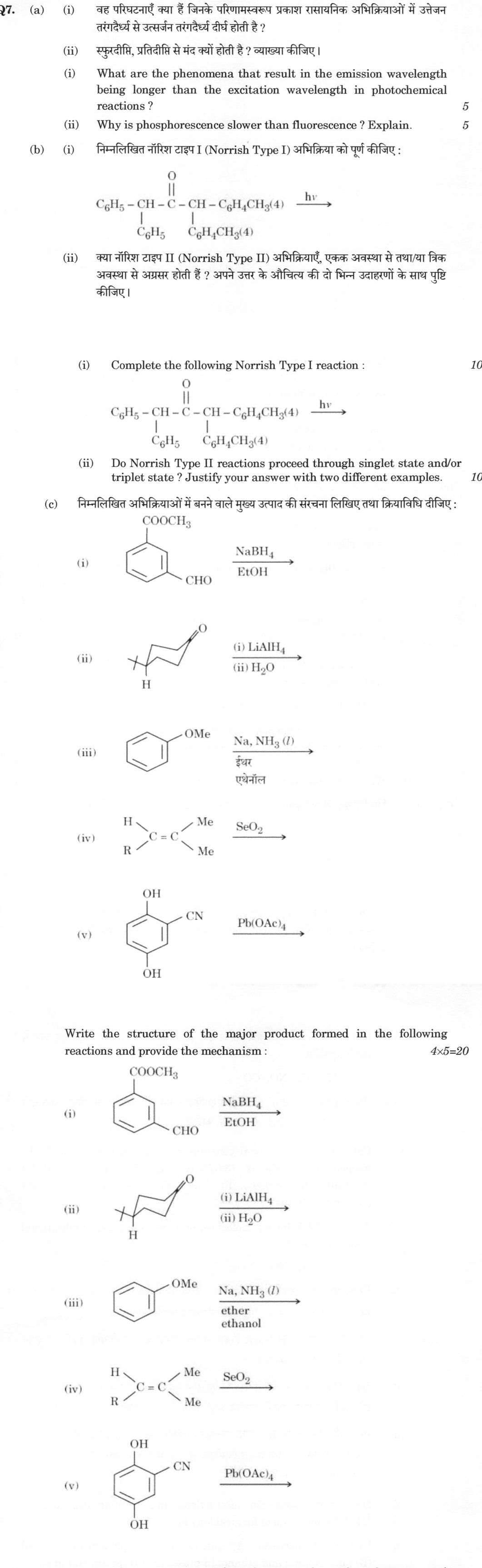
(a) (i) What are the phenomena that result in the emission wavelength being longer than the excitation wavelength in…
What are the phenomena that result in the emission wavelength being longer than the excitation wavelength in photochemical reactions ? 5 marks
Why is phosphorescence slower than fluorescence ? Explain. 5 marks
Complete the following Norrish Type I reaction :
O
C6H5 – CH – C – CH – C6H4CH3(4) —(hν)→
C6H5 C6H4CH3(4) 10 marks
Do Norrish Type II reactions proceed through singlet state and/or triplet state ? Justify your answer with two different examples. 10 marks
Write the structure of the major product formed and give the reaction mechanism in the following reactions : Benzene ring bearing COOCH3 and CHO groups (methyl benzoate aldehyde) → NaBH4 / EtOH
4-tert-Butylcyclohexanone (with H) → (i) LiAlH4 (ii) H2O
Benzene ring with OMe (anisole) → Na, NH3 (l) / ether ethanol
H – C(R) = C(Me)Me → SeO2
Benzene ring bearing OH and CN (2-cyano-1,4-dihydroxybenzene, OH on top and CN at ortho position) → Pb(OAc)4 20 marks
हिंदी में प्रश्न पढ़ें
वह परिघटनाएँ क्या हैं जिनके परिणामस्वरूप प्रकाश रासायनिक अभिक्रियाओं में उत्तेजन तरंगदैर्ध्य से उत्सर्जन तरंगदैर्ध्य दीर्घ होती है ? (5 अंक)
स्फुरदीप्ति, प्रतिदीप्ति से मंद क्यों होती है ? व्याख्या कीजिए । (5 अंक)
निम्नलिखित नॉरिश टाइप I अभिक्रिया को पूर्ण कीजिए :
O
C6H5 – CH – C – CH – C6H4CH3(4) —(hν)→
C6H5 C6H4CH3(4) (10 अंक)
क्या नॉरिश टाइप II अभिक्रियाएँ सिंगलेट अवस्था तथा/अथवा ट्रिपलेट अवस्था से होकर संपन्न होती हैं ? दो भिन्न उदाहरणों के साथ अपने उत्तर की पुष्टि कीजिए। (10 अंक)
निम्नलिखित अभिक्रियाओं में बनने वाले मुख्य उत्पाद की संरचना लिखिए तथा क्रियाविधि दीजिए : COOCH3 तथा CHO समूह युक्त बेंजीन वलय (मेथिल बेंज़ोएट ऐल्डिहाइड) → NaBH4 / EtOH
4-टर्शियरी-ब्यूटिलसाइक्लोहेक्सेनोन (H सहित) → (i) LiAlH4 (ii) H2O
बेंजीन वलय पर OMe (ऐनिसोल) → Na, NH3 (l) / ईथर एथेनॉल
H – C(R) = C(Me)Me → SeO2
OH तथा CN समूह युक्त बेंजीन वलय (2-सायनो-1,4-डाइहाइड्रॉक्सी बेंजीन, OH ऊपर तथा CN ऑर्थो स्थिति में) → Pb(OAc)4 (20 अंक)
Model answer
Drafted with AI by UPSC Answer Check against this question's marking rubric, to the expected length. UPSC does not publish answers for Mains — this is one way to score well, not an official key. How we build rubrics and answers.
(a)(i) Why emission is at a longer wavelength than excitation (5 marks)
The emitted light has lower energy than the absorbed light. This shift to longer wavelength is the Stokes shift, and it arises because energy is lost non-radiatively between absorption and emission.
- Vibrational relaxation and internal conversion. Absorption takes S₀ (v = 0) to a higher vibrational level of S₁ (a Franck-Condon transition). The molecule loses the excess vibrational energy to the surroundings in picoseconds and reaches S₁ (v = 0), and emission (Kasha's rule) starts only from there. It ends in a vibrationally excited level of S₀, which then relaxes. Emitted photon energy is smaller than the absorbed photon energy by the sum of these two losses.
- Solvent reorganisation and geometry change. The excited state often has a different dipole moment and geometry, and the solvent shells reorient around it before emission, which lowers its energy further, so polar solvents give a larger shift.
- Intersystem crossing. Where S₁ crosses to the triplet T₁, which lies lower, the emission from T₁ (phosphorescence) is at a still longer wavelength.
- Excimer and exciplex formation gives broad emission at longer wavelength than the monomer.
(a)(ii) Why phosphorescence is slower than fluorescence (5 marks)
Fluorescence is S₁ → S₀, a spin-allowed transition (both singlet, ΔS = 0). It is fast: the radiative rate constant is about 10⁶-10⁹ s⁻¹ and the lifetime is nanoseconds.
Phosphorescence is T₁ → S₀, which changes the spin multiplicity (ΔS ≠ 0) and is forbidden by the spin selection rule. It occurs only because of weak spin-orbit coupling, which mixes a little singlet character into the triplet (strong with heavy atoms such as Br, I or Pb, weak in light-atom molecules). The transition probability, and therefore the radiative rate constant, is small (about 10⁻² to 10³ s⁻¹), so the triplet lives for milliseconds to seconds. In addition, the triplet is usually lost by non-radiative deactivation and collisional quenching in fluid solution, so phosphorescence is seen mainly in rigid glasses at 77 K or in solids. The emitting state is also lower in energy than S₁ (Hund's rule), which further lengthens the wavelength.
(b)(i) Norrish Type I reaction of (C₆H₅)₂CH-CO-CH(C₆H₄CH₃-4)₂ (10 marks)
On irradiation the ketone is excited (n → π*) and undergoes α-cleavage, homolysis of a C-CO bond next to the carbonyl (Norrish Type I). The bond is weak because both radicals formed are stabilised. The reaction goes by a radical pathway:
- (1) α-Cleavage on either side gives an acyl radical and a diarylmethyl radical: Ph₂CH-CO• + •CH(Tol)₂ (Tol = 4-CH₃C₆H₄), or Tol₂CH-CO• + •CHPh₂.
- (2) Each acyl radical loses CO (decarbonylation) very rapidly, because it forms a stable diarylmethyl radical: Ph₂CH-CO• → Ph₂CH• + CO, and Tol₂CH-CO• → Tol₂CH• + CO.
- (3) The result is a pair of radicals, Ph₂CH• and Tol₂CH•, together with carbon monoxide. Recombination of the two radicals gives the products.
Products. Cross-coupling of the pair formed in the same solvent cage gives 1,1-diphenyl-2,2-di(p-tolyl)ethane, Ph₂CH-CH(Tol)₂, as the main product. Radicals that escape the cage combine randomly with each other, giving in addition 1,1,2,2-tetraphenylethane (Ph₂CH-CHPh₂) and 1,1,2,2-tetra(p-tolyl)ethane (Tol₂CH-CHTol₂); a statistical mixture would be about 1:2:1 of homo, cross and homo, and the in-cage cross product raises the proportion of the middle one. Carbon monoxide is also released.
(b)(ii) Norrish Type II: singlet or triplet? (10 marks)
Both, depending on the ketone. The reaction is intramolecular γ-hydrogen abstraction by the excited carbonyl oxygen through a six-membered transition state. This gives a 1,4-biradical, which either fragments to an enol (which tautomerises to a ketone) plus an alkene (Norrish Type II cleavage), or closes to a cyclobutanol (Yang cyclisation), or reverts to the ketone.
The state involved is tested with a triplet quencher such as a conjugated diene (1,3-pentadiene or piperylene), whose triplet energy is lower than that of the ketone, so it removes the ketone triplet at nearly the diffusion-controlled rate. The Stern-Volmer plot, Φ₀/Φ = 1 + kqτ[Q], shows how much of the reaction is from the triplet.
Example 1, aliphatic ketones (2-pentanone or 2-hexanone). Intersystem crossing is slow (about 10⁸ s⁻¹) and is comparable with the rate of γ-H abstraction from S₁, so reaction occurs from both S₁ and T₁. Diene quenching removes only the triplet part: the quantum yield falls but levels off at a non-zero value, and a plot against the diene concentration curves, showing that a fraction of the product comes from S₁ and is not quenched.
Example 2, aryl alkyl ketones (valerophenone, butyrophenone). Intersystem crossing in these is extremely fast (about 10¹⁰-10¹¹ s⁻¹), much faster than any singlet reaction, so S₁ is depleted before it can react, and the n,π* triplet is the reacting state. Diene quenches the product formation completely (linear Stern-Volmer plot to zero), and the triplet lifetime deduced is about 10⁻⁸-10⁻⁷ s.
So the multiplicity is not fixed by the reaction type but by the competition between intersystem crossing and hydrogen transfer in the particular ketone.
(c) Products and mechanisms (20 marks)

(i) NaBH₄ in EtOH on methyl 3-formylbenzoate (4 marks). Sodium borohydride is a mild hydride donor. It reduces the aldehyde much faster than the ester (the ester carbonyl is stabilised by the OMe lone pair), so the product is methyl 3-(hydroxymethyl)benzoate. Mechanism: hydride from BH₄⁻ adds to the carbonyl carbon of CHO through a four-centre transition state, giving an alkoxide-borane; this is protonated by the ethanol solvent (or during work-up) to give the primary alcohol, and each BH₄⁻ can deliver up to four hydrides. The ester is unchanged.
(ii) LiAlH₄ then H₂O on 4-tert-butylcyclohexanone (4 marks). The tert-butyl group is locked equatorial. A small hydride such as AlH₄⁻ attacks from the axial direction. This path avoids the torsional strain (eclipsing with the adjacent C-H bonds) that equatorial attack would incur, and a small nucleophile is not troubled by the axial hydrogens at C3 and C5. Hydride delivered axially pushes the oxygen to the equatorial position, so the major product (about 90%) is trans-4-tert-butylcyclohexanol, with the OH equatorial, and about 10% is the cis (axial OH) isomer. Water then protonates the aluminium alkoxide.
(iii) Na, NH₃(l), ether, ethanol on anisole (4 marks). This is the Birch reduction. The product is 1-methoxycyclohexa-1,4-diene, in which the methoxy group stays on a double-bond carbon. Mechanism: (1) an electron from sodium (solvated in liquid ammonia) adds to the ring to give a radical anion; (2) ethanol protonates it, at a carbon ortho to OMe, to give a cyclohexadienyl radical; (3) a second electron gives the cyclohexadienyl anion, in which the electron-donating OMe destabilises the negative charge on the carbon that carries it; (4) ethanol protonates the anion at the central carbon of the pentadienyl system (para to OMe), which gives the non-conjugated 1,4-diene rather than the 1,3-diene. The substituent stays on an sp² carbon because a donor group disfavours negative charge at its own carbon.
(iv) SeO₂ on RCH=C(CH₃)₂ (4 marks). This is the Riley allylic oxidation. The oxidation occurs at the more substituted end of the double bond, at an allylic methyl group, and it prefers the methyl group trans to R (the E-methyl), giving the (E)-allylic alcohol RCH=C(CH₃)CH₂OH. Mechanism: (1) an ene reaction of the alkene with SeO₂: an allylic hydrogen from the CH₃ is transferred to selenium oxygen while Se bonds to the carbon RCH, in a cyclic six-membered transition state, shifting the double bond to give an allylic seleninic acid, R-CH(SeO₂H)-C(CH₃)=CH₂; (2) a [2,3]-sigmatropic rearrangement moves oxygen to the terminal carbon, giving the selenite ester RCH=C(CH₃)-CH₂-O-Se-OH; (3) hydrolysis releases the allylic alcohol and Se(II). With excess reagent the alcohol can be oxidised further to the enal.
(v) Pb(OAc)₄ on 2-cyanohydroquinone (4 marks). Lead tetra-acetate oxidises the hydroquinone to the quinone, 2-cyano-1,4-benzoquinone. Mechanism: (1) one OH exchanges with an acetate ligand, giving the aryloxy-lead(IV) species ArO-Pb(OAc)₃ and AcOH; (2) the para OH loses its proton and its electrons flow through the ring, forming the second C=O, while the O-Pb bond and a second ligand leave, so that Pb(IV) is reduced to Pb(II); (3) the products are the quinone, Pb(OAc)₂ and two molecules of acetic acid. HQ + Pb(OAc)₄ → Q + Pb(OAc)₂ + 2AcOH. The electron-withdrawing CN makes the quinone a strong oxidising agent, so it is best isolated quickly.
How this answer will be evaluated
Evaluation rubric
Each sub-part is marked on its own, against the marks and word limit printed on the paper.
- (a)(i) Name and briefly explain the photophysical phenomena that make the emitted light longer in wavelength than the exciting light (Stokes shift). 5 marks
Must cover
- Stokes shift: emission at lower energy than absorption
- Vibrational relaxation and internal conversion within S₁ before emission (Kasha's rule)
- Solvent reorganisation and excited-state geometry change
- Intersystem crossing to T₁ giving phosphorescence at longer wavelength; excimer/exciplex emission
Loses marks
- Describing the shift as a change of the absorbing molecule's identity.
- Confusing Stokes and anti-Stokes shifts.
Earns more
- Franck-Condon absorption into an upper vibrational level of S₁ and emission into a vibrationally excited level of S₀.
- Polar solvents give a larger shift.
- (a)(ii) Explain why phosphorescence is slower than fluorescence, on the basis of the spin selection rule. 5 marks
Must cover
- Fluorescence S₁ → S₀ is spin-allowed, k about 10⁶-10⁹ s⁻¹, ns lifetime
- Phosphorescence T₁ → S₀ is spin-forbidden (ΔS ≠ 0)
- It occurs only by weak spin-orbit coupling, enhanced by heavy atoms
- Radiative rate constant is small, lifetime ms to s; observed mainly at 77 K in rigid media
Loses marks
- Saying phosphorescence is slower because the triplet is higher in energy.
- Giving no reference to the spin selection rule.
Earns more
- T₁ lies below S₁ (Hund's rule), so the emission is also of longer wavelength.
- Non-radiative loss competes in fluid solution.
- (b)(i) Complete the Norrish Type I reaction of (C6H5)2CH-CO-CH(C6H4CH3-4)2: products and radical pathway. 10 marks
Must cover
- α-Cleavage of the C-CO bond gives an acyl radical and a diarylmethyl radical
- Decarbonylation of the acyl radical to a diarylmethyl radical and CO
- Radical pair Ph₂CH• and Tol₂CH• recombines
- Products: Ph₂CH-CH(Tol)₂ (cross), Ph₂CH-CHPh₂ and Tol₂CH-CHTol₂, about 1:2:1 statistically; CO released
Loses marks
- Giving a cyclobutanol or Norrish Type II products.
- Stating that CO is retained in the product.
Earns more
- Explanation that decarbonylation is fast because a stabilised radical results.
- Cage effect favouring the cross product.
Extra mark
- Mention of n → π* excitation and the reason why the weak C-CO bond breaks
- (b)(ii) Do Norrish Type II reactions proceed from the singlet state, the triplet state or both? Justify with two different examples. 10 marks
Must cover
- Both, depending on the ketone
- Mechanism: six-membered γ-H abstraction, 1,4-biradical, cleavage (enol + alkene) or Yang cyclisation
- Aliphatic ketone (2-pentanone/2-hexanone): S₁ and T₁ both react; diene quenching is incomplete
- Aryl alkyl ketone (valerophenone): only T₁ because of very fast ISC; diene quenches completely (Stern-Volmer)
Loses marks
- Stating that only the triplet reacts in every case.
- Two examples of the same class of ketone.
Earns more
- Use of the Stern-Volmer relation with a diene quencher of lower triplet energy.
- Lifetime or rate constants quoted for either example.
Extra mark
- Statement that quenching data give the triplet lifetime
- (c) For each of five printed reactions give the major product and the mechanism (4 marks each): (i) NaBH4/EtOH on methyl 3-formylbenzoate, (ii) LiAlH4 then H2O on 4-tert-butylcyclohexanone, (iii) Na/NH3(l)/ether/EtOH on anisole, (iv) SeO2 on RCH=C(CH3)2, (v) Pb(OAc)4 on 2-cyanohydroquinone. 20 marks
Must cover
- (i) methyl 3-(hydroxymethyl)benzoate, hydride on CHO, ester untouched; (ii) trans-4-tert-butylcyclohexanol by axial hydride attack, OH equatorial (about 90%)
- (iii) 1-methoxycyclohexa-1,4-diene by the Birch mechanism: radical anion, protonation ortho, second electron, protonation para
- (iv) (E)-RCH=C(CH₃)CH₂OH by ene reaction, [2,3]-sigmatropic shift, hydrolysis; attack at the E-methyl
- (v) 2-cyano-1,4-benzoquinone; ArO-Pb(OAc)₃, then electron flow with Pb(IV) → Pb(II) and 2 AcOH
Loses marks
- Reducing the ester in (i).
- Giving the cis-alcohol as the major product of (ii).
- Giving the conjugated 1,3-diene or the 1,4-diene with OMe on sp³ carbon in (iii).
- Any allylic alcohol other than the E-methyl one for (iv).
Earns more
- Product and mechanism both given for each part (either alone earns part marks only).
- Reason for the selectivity: aldehyde against ester; axial versus equatorial attack; donor group stays on an sp² carbon.
Extra mark
- Over-oxidation of the SeO₂ allylic alcohol to the enal
What "Explain" is asking you to do
Make the working of something clear — what sets it off, what follows from what, and what it produces. Explain is the Commission's mechanism word: it dominates the technical papers and the “explain why” stems, where the marks sit in the causal chain and not in the label.
Structure that answers it
State what it is → the initiating condition → the chain of cause, step by step → an instance where it plays out → what the chain produces
Where marks are lost
Describing what something looks like instead of why it works that way. Naming the stages without linking them reads as description too.
Practice this exact question
Write your answer and it is marked point by point against the model answer above — what you covered, what you missed, what you got wrong.
Evaluate my answer →More from Chemistry 2026 Paper II
- Q4 (a) (i) Write the structure of the stereochemical product formed in the reaction of (2E,…
- Q5 (a) Proteins are dynamic molecules rather than static structures. Explain this phenomenon…
- Q6 (a) Write the structures of the products formed in the following reactions : 2×5=10 (i) (…
- Q7 (a) (i) What are the phenomena that result in the emission wavelength being longer than t…
- Q8 (a) (i) Calculate the rotational constant of a diatomic molecule if the moment of inertia…