Paper II — Q8
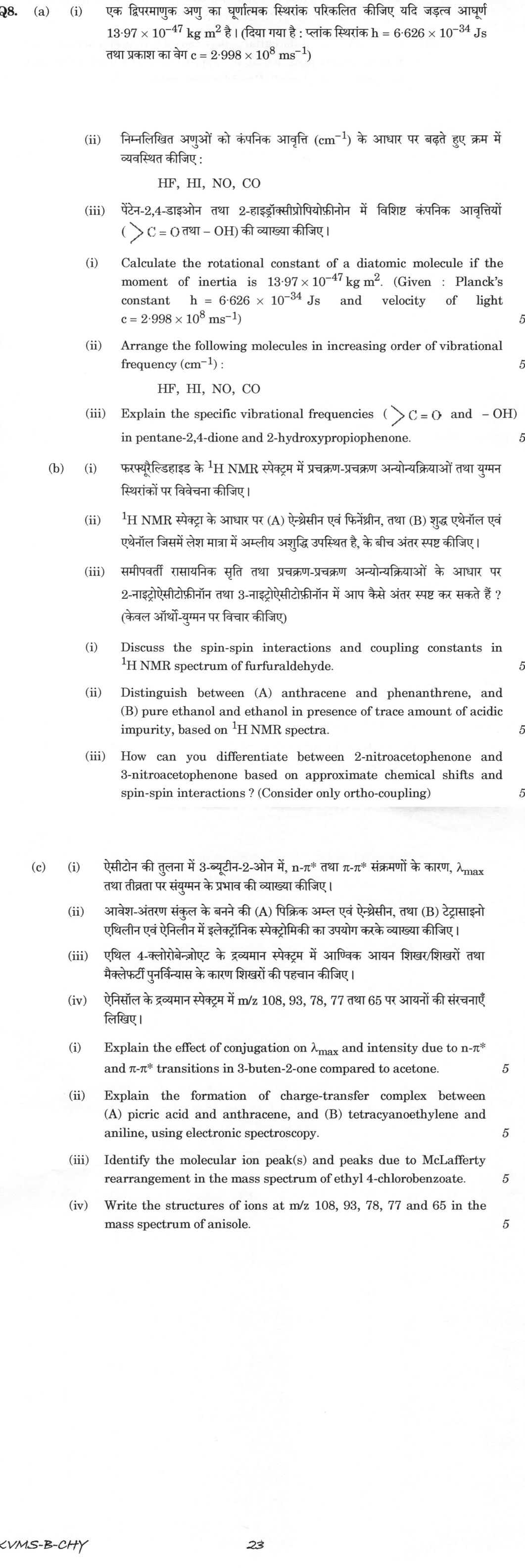
(a) (i) Calculate the rotational constant of a diatomic molecule if the moment of inertia is 13·97 × 10⁻⁴⁷ kg m². (Given …
Calculate the rotational constant of a diatomic molecule if the moment of inertia is 13·97 × 10⁻⁴⁷ kg m². (Given : Planck's constant h = 6·626 × 10⁻³⁴ Js and velocity of light c = 2·998 × 10⁸ ms⁻¹) 5 marks
Arrange the following molecules in increasing order of vibrational frequency (cm⁻¹) : HF, HI, NO, CO 5
Explain the specific vibrational frequencies ( >C = O and – OH) in pentane-2,4-dione and 2-hydroxypropiophenone. 5 15 marks
Discuss the spin-spin interactions and coupling constants in ¹H NMR spectrum of furfuraldehyde. 5 marks
Distinguish between (A) anthracene and phenanthrene, and (B) pure ethanol and ethanol in presence of trace amount of acidic impurity, based on ¹H NMR spectra. 5 marks
How can you differentiate between 2-nitroacetophenone and 3-nitroacetophenone based on approximate chemical shifts and spin-spin interactions ? (Consider only ortho-coupling) 5 marks
Explain the effect of conjugation on λmax and intensity due to n-π* and π-π* transitions in 3-buten-2-one compared to acetone. 5 marks
Explain the formation of charge-transfer complex between (A) picric acid and anthracene, and (B) tetracyanoethylene and aniline, using electronic spectroscopy. 5 marks
Identify the molecular ion peak(s) and peaks due to McLafferty rearrangement in the mass spectrum of ethyl 4-chlorobenzoate. 5 marks
Write the structures of ions at m/z 108, 93, 78, 77 and 65 in the mass spectrum of anisole. 5 marks
हिंदी में प्रश्न पढ़ें
एक द्विपरमाणुक अणु का घूर्णात्मक स्थिरांक परिकलित कीजिए यदि जड़त्व आघूर्ण 13·97 × 10⁻⁴⁷ kg m² है । (दिया गया है : प्लांक स्थिरांक h = 6·626 × 10⁻³⁴ Js तथा प्रकाश का वेग c = 2·998 × 10⁸ ms⁻¹) निम्नलिखित अणुओं को कंपनिक आवृत्ति (cm⁻¹) के आधार पर बढ़ते हुए क्रम में व्यवस्थित कीजिए : HF, HI, NO, CO
पेंटेन-2,4-डाइओन तथा 2-हाइड्रॉक्सीप्रोपियोफ़ीनोन में विशिष्ट कंपनिक आवृत्तियों ( >C = O तथा – OH) की व्याख्या कीजिए । (15 अंक)
फरफ्यूरैल्डिहाइड के ¹H NMR स्पेक्ट्रम में प्रचक्रण-प्रचक्रण अन्योन्यक्रियाओं तथा युग्मन स्थिरांकों पर विवेचना कीजिए । (5 अंक)
¹H NMR स्पेक्ट्रा के आधार पर (A) ऐन्थ्रैसीन एवं फिनैन्थ्रीन, तथा (B) शुद्ध एथेनॉल एवं एथेनॉल जिसमें लेश मात्रा में अम्लीय अशुद्धि उपस्थित है, के बीच अंतर स्पष्ट कीजिए । (5 अंक)
समीपवर्ती रासायनिक स्मृति तथा प्रचक्रण-प्रचक्रण अन्योन्यक्रियाओं के आधार पर 2-नाइट्रोएसीटोफीनोन तथा 3-नाइट्रोएसीटोफीनोन में आप कैसे अंतर स्पष्ट कर सकते हैं ? (केवल ऑर्थो-युग्मन पर विचार कीजिए) (5 अंक)
ऐसीटोन की तुलना में 3-ब्यूटीन-2-ओन में, n-π* तथा π-π* संक्रमणों के कारण, λmax तथा तीव्रता पर संयुग्मन के प्रभाव की व्याख्या कीजिए। (5 अंक)
आवेश-अंतरण संकुल के बनने की (A) पिक्रिक अम्ल एवं ऐन्थ्रैसीन, तथा (B) टेट्रासाइनो एथिलीन एवं ऐनिलीन में इलेक्ट्रॉनिक स्पेक्ट्रोमिकी का उपयोग करके व्याख्या कीजिए। (5 अंक)
एथिल 4-क्लोरोबेन्ज़ोएट के द्रव्यमान स्पेक्ट्रम में आण्विक आयन शिखर/शिखरों तथा मैक्लेफर्टी पुनर्विन्यास के कारण शिखरों की पहचान कीजिए। (5 अंक)
ऐनिसॉल के द्रव्यमान स्पेक्ट्रम में m/z 108, 93, 78, 77 तथा 65 पर आयनों की संरचनाएँ लिखिए। (5 अंक)
Model answer
Drafted with AI by UPSC Answer Check against this question's marking rubric, to the expected length. UPSC does not publish answers for Mains — this is one way to score well, not an official key. How we build rubrics and answers.
(a) Three spectroscopic parts (15 marks)
(i) Rotational constant (5 marks). The rotational constant in wavenumber units is B = h / (8π²cI).
B = 6.626 × 10⁻³⁴ / (8 × 9.8696 × 2.998 × 10⁸ × 13.97 × 10⁻⁴⁷)
The denominator is 78.957 × 2.998 × 10⁸ × 13.97 × 10⁻⁴⁷ = 3.307 × 10⁻³⁶, so
B = 6.626 × 10⁻³⁴ / 3.307 × 10⁻³⁶ = 200.4 m⁻¹ = 2.00 cm⁻¹.
In other units this is h²/8π²I = 3.98 × 10⁻²³ J, or 6.01 × 10¹⁰ Hz.
(ii) Order of vibrational frequency (5 marks). The frequency is ν̃ = (1/2πc)√(k/μ), where k is the force constant and μ the reduced mass. The increasing order is NO < CO < HI < HF.
- NO: ν̃ about 1904 cm⁻¹ (k about 1600 N/m, bond order 2.5, and a large μ of about 7.5 u).
- CO: about 2143 cm⁻¹ (k about 1860 N/m, a triple bond, μ about 6.9 u). The stiffer bond gives a higher value than NO.
- HI: about 2309 cm⁻¹ (k about 314 N/m, but μ is only about 1.0 u because the iodine is heavy and the hydrogen moves almost alone).
- HF: about 4138 cm⁻¹ (k about 966 N/m, a very strong H-F bond, and μ about 0.96 u).
The two hydrides are above the two heavy diatomics because of their small reduced mass, and HF is the highest because its bond is much stiffer than HI.
(iii) C=O and O-H frequencies in two chelated carbonyl compounds (5 marks). Pentane-2,4-dione exists as a keto-enol mixture. The keto form shows two coupled C=O stretches at about 1725 and 1707 cm⁻¹ and no O-H. In the enol form, the OH forms a strong intramolecular hydrogen bond to the second carbonyl, in a six-membered chelate ring with a conjugated O=C-C=C-OH unit. The C=O stretch is lowered to about 1600-1640 cm⁻¹ (mixed with C=C, and weakened by conjugation and hydrogen bonding), and the O-H stretch appears as a very broad, weak band centred near 2700 cm⁻¹ (spread over 2500-3200), far below the free-OH position at about 3600. The bands do not change on dilution because the bond is intramolecular.
2-Hydroxypropiophenone (taken here as the ortho-hydroxy ketone, 1-(2-hydroxyphenyl)propan-1-one, in which the phenolic OH sits next to the C=O): the same chelation occurs, through a six-membered ring. The C=O stretch falls from about 1685 cm⁻¹ in propiophenone to about 1630-1640 cm⁻¹, and the O-H stretch is broad at about 3000-3200 cm⁻¹ and independent of concentration. (If the alpha-hydroxy ketone, 2-hydroxy-1-phenylpropan-1-one, is meant, the five-membered hydrogen bond is weak: C=O about 1685-1690 cm⁻¹ and O-H about 3450 cm⁻¹.)
(b)(i) ¹H NMR of furfuraldehyde (5 marks)
Furfuraldehyde has four protons: the aldehyde H and three ring protons, H3, H4 and H5. Spin-spin coupling between neighbouring protons splits each signal. The ring couplings are J₃,₄ about 3.6 Hz, J₄,₅ about 1.7 Hz and a small four-bond coupling J₃,₅ about 0.8 Hz (the coupling to the aldehyde H is also about 0.8 Hz).
- CHO, δ about 9.65: a narrow doublet or singlet (small coupling to H3).
- H5 (next to O), δ about 7.70: a doublet of doublets, J₄,₅ = 1.7 and J₃,₅ = 0.8 Hz; it is the most deshielded ring proton because it is α to oxygen.
- H3 (next to the CHO-bearing carbon), δ about 7.26: a doublet, J₃,₄ = 3.6 Hz (with small additional splitting); it is deshielded by the carbonyl.
- H4, δ about 6.62: a doublet of doublets, J₃,₄ = 3.6 and J₄,₅ = 1.7 Hz.
J₃,₄ (the β-β coupling) is the largest ring coupling; the α-β couplings such as J₄,₅ are small in furan (about 1.7 Hz), a characteristic of five-membered heteroaromatic rings, so the three ring protons are easily assigned from their splittings.
(b)(ii) Distinctions by ¹H NMR (5 marks)
(A) Anthracene and phenanthrene. Anthracene is highly symmetric (D₂h) and has only three sets of protons: H9/H10 (2H, a singlet, δ about 8.4), H1/H4/H5/H8 (4H, δ about 8.0) and H2/H3/H6/H7 (4H, δ about 7.45), in the ratio 2:4:4. Phenanthrene (C₂ᵥ) has five sets, each of 2H: H4/H5 (δ about 8.7), H1/H8 (7.9), H9/H10 (a singlet, about 7.75), H3/H6 (about 7.65) and H2/H7 (about 7.6). Thus five signals of equal intensity, including the lowest-field one (H4/H5, the bay-region protons deshielded by the neighbouring ring), distinguish phenanthrene from anthracene's three signals at 2:4:4.
(B) Pure ethanol and ethanol with acid. In carefully purified ethanol the OH proton exchanges slowly and couples to the CH₂ protons: OH is a triplet (J about 5 Hz), the CH₂ is a doublet of quartets (eight lines) and CH₃ is a triplet. A trace of acid (or base) catalyses fast intermolecular proton exchange. If the exchange rate is much greater than the coupling (in Hz), the OH proton sees an average of the spin states of the CH₂ protons and the coupling is lost: OH becomes a broad singlet, CH₂ a simple quartet and CH₃ a triplet. This exchange averaging is why the OH signal in most samples of ethanol is a singlet.
(b)(iii) 2-Nitroacetophenone and 3-nitroacetophenone (5 marks)
Considering only ortho coupling (J about 8 Hz):
2-Nitroacetophenone has four adjacent aromatic protons (H3, H4, H5, H6) in a row. H3 (next to NO₂) is a doublet at δ about 8.1; H4 and H5 are each a triplet (each has two ortho neighbours), at about 7.7 and 7.6; H6 (next to the acyl group) is a doublet at about 7.4. Pattern: d, t, t, d. The acetyl CH₃ is at δ about 2.55, slightly lower than in the meta isomer because the ortho nitro group twists the acetyl out of the ring plane and it is less deshielded.
3-Nitroacetophenone has three adjacent protons and one isolated proton. H2, between the two substituents, has no ortho neighbour and is a singlet (a fine meta splitting is ignored here) at the lowest field, δ about 8.75; H4 (next to NO₂) is a doublet at about 8.4; H6 (next to acyl) is a doublet at about 8.25; and H5 is a triplet at about 7.7. Pattern: s, d, d, t. The CH₃ is at δ about 2.68.
The meta isomer therefore has a singlet near 8.75 and only one triplet; the ortho isomer has two triplets, no singlet, and nothing above 8.1.
(c)(i) Conjugation in 3-buten-2-one and acetone (5 marks)
Acetone (isolated C=O): n → π* at about 279 nm (ε about 15, weak because it is symmetry-forbidden), and π → π* at about 187-190 nm (ε about 900).
3-Buten-2-one (methyl vinyl ketone, conjugated C=C-C=O): n → π* at about 324 nm (ε about 25) and π → π* at about 219 nm (ε about 3,600).
The reason is that conjugation of C=C with C=O produces four π molecular orbitals (like butadiene), with a raised HOMO and a lowered LUMO, so the π → π* gap narrows. The band moves by about 30 nm to longer wavelength (bathochromic shift) and is several times more intense (hyperchromic), because the transition is now more allowed (a larger transition dipole over the extended system). The non-bonding orbital n on oxygen is almost unaffected, while the π* level is lowered, so the n → π* band also moves to longer wavelength, by about 45 nm, and its intensity increases only slightly because it remains a forbidden transition.
(c)(ii) Charge-transfer complexes (5 marks)
A charge-transfer (CT) complex forms between an electron-rich donor (D) and an electron-poor acceptor (A). In the ground state there is only a weak association, but light can transfer an electron from the HOMO of D to the LUMO of A. This gives a new, broad, intense absorption band, the CT band, that belongs to neither component and usually lies in the visible region, so the complex is coloured. The energy is given by Mulliken's relation, hν_CT ≈ I_D - E_A - C, so a donor of lower ionisation energy or an acceptor of higher electron affinity moves the band to longer wavelength. Its intensity increases with the concentration of the complex (Benesi-Hildebrand analysis gives K and ε), and it is solvent-dependent.
(A) Picric acid and anthracene. Picric acid (2,4,6-trinitrophenol) is the π-acceptor, since three nitro groups make the ring electron-poor. Anthracene, a large polycyclic aromatic hydrocarbon with a high-lying π HOMO, is the π-donor. They stack face to face and form a red-orange 1:1 complex (a π-π CT complex), whose CT band appears in the visible region (at about 450 nm) where neither component absorbs.
(B) Tetracyanoethylene (TCNE) and aniline. TCNE is a very strong π-acceptor (four CN groups, very low LUMO); aniline is the donor through its nitrogen lone pair conjugated with the ring, a stronger donor than benzene. The solution becomes strongly coloured, with a CT band well into the visible region (far to the red of the benzene-TCNE complex at 384 nm). Aniline is so electron-rich that it can also undergo an irreversible substitution with TCNE, so spectra must be recorded quickly.
(c)(iii) Mass spectrum of ethyl 4-chlorobenzoate (5 marks)
The formula is C₉H₉ClO₂. Chlorine has two isotopes, ³⁵Cl and ³⁷Cl, in a ratio of about 3:1, so the molecular ion appears as a pair: M⁺• at m/z 184 (³⁵Cl) and M+2 at m/z 186 (³⁷Cl), with relative intensity about 3:1.
McLafferty rearrangement. The ester has γ-hydrogens on the ethyl group, in a six-membered arrangement O=C-O-CH₂-CH₃. The carbonyl oxygen abstracts a hydrogen from the CH₃ through a six-membered transition state, and ethene (28) is lost. The rearranged ion is the radical cation of 4-chlorobenzoic acid, [4-Cl-C₆H₄-C(OH)₂]⁺• ↔ 4-ClC₆H₄-COOH⁺•, at m/z 156 (³⁵Cl) and 158 (³⁷Cl), again 3:1.
Other prominent ions are m/z 139/141, 4-ClC₆H₄-C≡O⁺, from loss of •OCH₂CH₃ (the base peak, formed by α-cleavage), and m/z 111/113, the chlorophenyl cation, from loss of CO.
(c)(iv) Mass spectrum of anisole (5 marks)
Anisole (methoxybenzene, C₆H₅-O-CH₃) has M⁺• at m/z 108, the radical cation C₆H₅-O⁺•-CH₃. Its fragments are as follows.
- m/z 93, C₆H₅O⁺ (the phenoxy cation): loss of •CH₃ (15) from M⁺• by cleavage of the O-CH₃ bond.
- m/z 78, C₆H₆⁺• (the benzene radical cation): loss of formaldehyde, CH₂=O (30), from M⁺• after transfer of a hydrogen from the methyl group to the ring.
- m/z 77, C₆H₅⁺ (the phenyl cation): loss of the methoxy radical, •OCH₃ (31), by cleavage of the C-O bond.
- m/z 65, C₅H₅⁺ (the cyclopentadienyl cation): loss of CO (28) from the m/z 93 phenoxy ion, with ring contraction.
Pathway: M⁺• (108) → 93 → 65; M⁺• → 78; M⁺• → 77 (which may lose C₂H₂ to give m/z 51).
How this answer will be evaluated
Evaluation rubric
Each sub-part is marked on its own, against the marks and word limit printed on the paper.
- (a) Three independent 5-mark parts: (i) calculate the rotational constant of a diatomic with I = 13.97 × 10⁻⁴⁷ kg m² using the given h and c; (ii) arrange HF, HI, NO and CO in increasing vibrational frequency with reasons; (iii) explain the C=O and O-H frequencies of pentane-2,4-dione and 2-hydroxypropiophenone. 15 marks
Must cover
- (i) B = h/8π²cI = 200.4 m⁻¹ = 2.00 cm⁻¹, with the substitution shown
- (ii) NO < CO < HI < HF, from ν̃ = (1/2πc)√(k/μ), with k and μ compared
- (iii) pentane-2,4-dione enol: intramolecular chelated H-bond, C=O about 1600-1640, very broad O-H about 2500-3200; keto form 1725/1707
- (iii) 2-hydroxypropiophenone: chelated, C=O lowered to about 1630-1640, O-H broad about 3000-3200 and concentration-independent
Loses marks
- Using the wrong units for B or dropping the 2π factors.
- Placing HI above HF or CO below NO without a reason.
- Assigning a sharp free O-H to a chelated compound.
Earns more
- Values quoted for the frequencies of all four diatomics.
- Mention that the free-OH and unchelated C=O positions are higher.
Extra mark
- Both possible readings of 2-hydroxypropiophenone (ortho-hydroxy and α-hydroxy) covered
- (b)(i) Discuss the spin-spin interactions and coupling constants in the ¹H NMR spectrum of furfuraldehyde: assign the four protons with multiplicities and the three ring couplings. 5 marks
Must cover
- Four protons: CHO δ about 9.65, H5 about 7.70, H3 about 7.26, H4 about 6.62
- Ring couplings J₃,₄ about 3.6, J₄,₅ about 1.7 and J₃,₅ about 0.8 Hz
- Multiplicities: H5 dd, H3 d (fine splitting), H4 dd, CHO small doublet or singlet
- Assignment logic: α-H to oxygen most downfield; H4 most upfield
Loses marks
- Swapping the assignments of H3 and H4.
- Giving one coupling constant only.
Earns more
- Small coupling of CHO to H3 mentioned.
- Reason that H3 is deshielded by the carbonyl.
- (b)(ii) Distinguish (A) anthracene from phenanthrene and (B) pure ethanol from ethanol with a trace of acid, using ¹H NMR. 5 marks
Must cover
- (A) Anthracene: three signals (H9/10 singlet about 8.4, 4H about 8.0, 4H about 7.45), ratio 2:4:4
- (A) Phenanthrene: five signals of 2H each, H4/H5 about 8.7 (bay region)
- (B) Pure ethanol: OH triplet, CH₂ doublet of quartets, CH₃ triplet
- (B) Trace acid: fast proton exchange removes the OH coupling; OH singlet, CH₂ quartet, CH₃ triplet
Loses marks
- Answering only one of the two parts.
- Explaining the ethanol change by chemical shift rather than exchange.
Earns more
- Symmetry (D₂h against C₂ᵥ) used to count the sets.
- Condition for averaging: exchange rate much greater than J in Hz.
- (b)(iii) Differentiate 2-nitroacetophenone from 3-nitroacetophenone by approximate ¹H shifts and aromatic splitting, considering only ortho coupling. 5 marks
Must cover
- 2-Nitro: d, t, t, d at about 8.1, 7.7, 7.6 and 7.4
- 3-Nitro: s (H2 about 8.75), d (about 8.4), d (about 8.25), t (about 7.7)
- Acetyl CH₃ about 2.55 (ortho, twisted) against about 2.68 (meta)
- Decisive test: singlet near 8.75 and a single triplet in the meta isomer; two triplets and no singlet in the ortho
Loses marks
- Giving the same splitting pattern for both isomers.
- Using meta coupling despite the instruction.
Earns more
- Explanation of the twist of the acetyl group by an ortho nitro group.
- (c)(i) Explain how conjugation in 3-buten-2-one changes the λmax and intensity of the n-π* and π-π* bands relative to acetone, with values. 5 marks
Must cover
- Acetone: n-π* about 279 nm (ε about 15), π-π* about 187-190 nm (ε about 900)
- 3-Buten-2-one: n-π* about 324 nm (ε about 25), π-π* about 219 nm (ε about 3,600)
- Conjugation narrows the π-π* gap: raised HOMO, lowered LUMO, shifts to longer wavelength and hyperchromic
- n level nearly unchanged, π* lowered, so n-π* also red-shifts, with only slight intensity gain (still forbidden)
Loses marks
- Stating a blue shift for either band.
- Quoting values for only one compound.
Earns more
- Comparison to butadiene-type four-orbital picture.
- (c)(ii) Explain charge-transfer complex formation from UV-visible spectroscopy in (A) picric acid with anthracene and (B) TCNE with aniline; identify the signature and the donor and acceptor. 5 marks
Must cover
- CT band: new, broad, intense visible absorption, belonging to neither component
- (A) Picric acid is the π-acceptor, anthracene the π-donor; coloured (red-orange) complex
- (B) TCNE is the acceptor, aniline the donor (n/π); coloured complex, CT band in the visible
- Mulliken relation hν_CT ≈ I_D - E_A - C: lower donor ionisation energy gives longer wavelength
Loses marks
- Interchanging donor and acceptor.
- Describing the complex as a covalent compound with a normal σ bond.
Earns more
- Benesi-Hildebrand determination of K, and solvent dependence of the band.
Extra mark
- Possible further reaction of aniline with TCNE
- (c)(iii) For ethyl 4-chlorobenzoate identify the molecular ion peaks and the peaks from McLafferty rearrangement, with the structure of the rearranged ion. 5 marks
Must cover
- M⁺• at m/z 184 (³⁵Cl) and M+2 at 186 (³⁷Cl), intensity about 3:1
- McLafferty: γ-H transfer through a six-membered state with loss of ethene (28)
- Rearranged ion 4-chlorobenzoic acid radical cation at m/z 156/158
- Other ions: 139/141 (ArCO⁺) and 111/113 (ClC₆H₄⁺)
Loses marks
- Giving M at 156 or a 1:1 isotope ratio.
- Attributing the McLafferty ion to loss of •OEt.
Earns more
- Structure of the rearranged ion drawn or written out.
- (c)(iv) Write the structures of the ions at m/z 108, 93, 78, 77 and 65 in the mass spectrum of anisole, with the fragmentation pathway. 5 marks
Must cover
- 108: C₆H₅-O⁺•-CH₃ (molecular ion)
- 93: C₆H₅O⁺ (phenoxy cation) by loss of •CH₃; 65: C₅H₅⁺ by loss of CO from 93
- 78: C₆H₆⁺• by loss of CH₂O with H transfer
- 77: C₆H₅⁺ (phenyl cation) by loss of •OCH₃
Loses marks
- Giving formulae only without structures.
- Assigning 93 to loss of OH or 65 to a different route.
Earns more
- Neutral losses quoted (15, 30, 31, 28).
Extra mark
- 77 → 51 by loss of C₂H₂
What "Calculate" is asking you to do
Apply the standard formula or schedule to data the question has already supplied — a table of readings, cost records, a balance sheet — and produce the number. The method is rarely in doubt; the marks sit in the named intermediate quantities, each of which has to appear as a labelled line.
Structure that answers it
Data as given → formula or standard treatment, named → substitution → each intermediate, labelled → result with units
Where marks are lost
Omitting an intermediate the marking scheme pays for separately, or rounding at an intermediate line so the final figure drifts. In commerce and accountancy, any figure in a statement that no numbered working note supports is treated as unearned.
Practice this exact question
Write your answer and it is marked point by point against the model answer above — what you covered, what you missed, what you got wrong.
Evaluate my answer →More from Chemistry 2026 Paper II
- Q5 (a) Proteins are dynamic molecules rather than static structures. Explain this phenomenon…
- Q6 (a) Write the structures of the products formed in the following reactions : 2×5=10 (i) (…
- Q7 (a) (i) What are the phenomena that result in the emission wavelength being longer than t…
- Q8 (a) (i) Calculate the rotational constant of a diatomic molecule if the moment of inertia…