Paper II — Q6
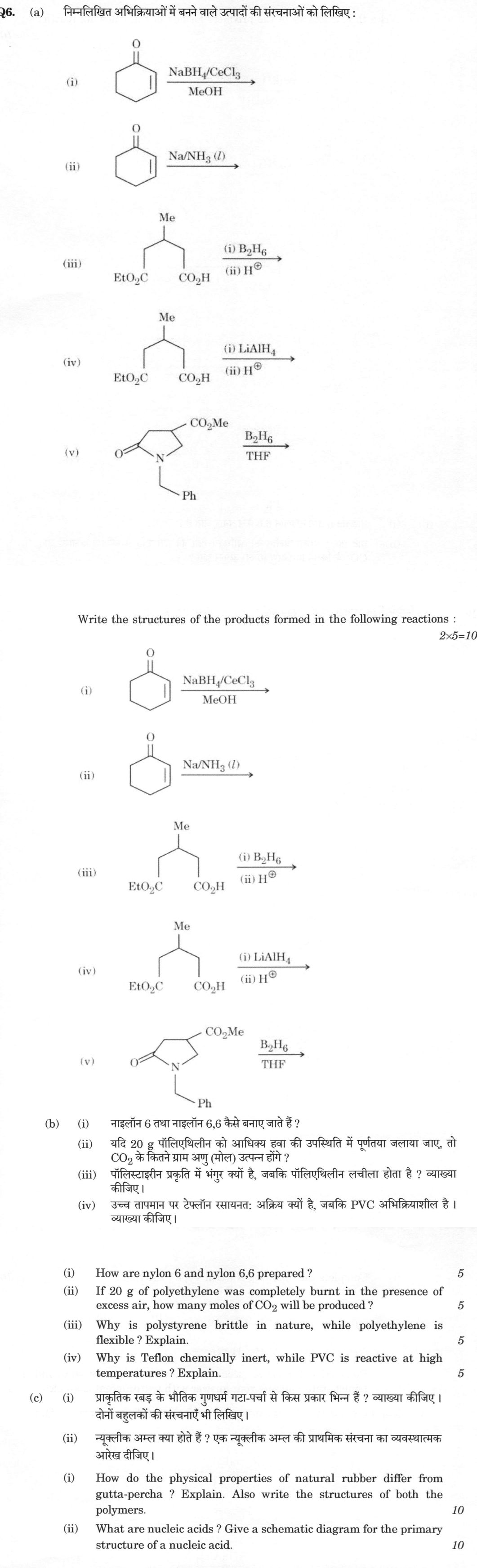
(a) Write the structures of the products formed in the following reactions : 2×5=10 (i) (Cyclohex-2-en-1-one) —NaBH4/CeCl3…
Write the structures of the products formed in the following reactions : 2×5=10 (Cyclohex-2-en-1-one) —NaBH4/CeCl3, MeOH→
(Cyclohex-2-en-1-one) —Na/NH3 (l)→
Me–CH(CH2CO2Et)(CH2CO2H) —(i) B2H6 (ii) H⊕→
Me–CH(CH2CO2Et)(CH2CO2H) —(i) LiAlH4 (ii) H⊕→
1-benzyl-5-oxopyrrolidine-3-carboxylic acid methyl ester (N–CH2Ph, 3–CO2Me, 5–oxo) —B2H6/THF→ 10 marks
How are nylon 6 and nylon 6,6 prepared? 5 marks
If 20 g of polyethylene is completely burnt in the presence of excess air, how many gram molecules (moles) of CO2 will be produced? 5 marks
Why is polystyrene brittle in nature, whereas polyethylene is flexible? Explain. 5 marks
Why is Teflon chemically inert at high temperature, whereas PVC is reactive? Explain. 5 marks
How do the physical properties of natural rubber differ from gutta-percha ? Explain. Also write the structures of both the polymers. 10 marks
What are nucleic acids ? Give a schematic diagram for the primary structure of a nucleic acid. 10 marks
हिंदी में प्रश्न पढ़ें
निम्नलिखित अभिक्रियाओं में बनने वाले उत्पादों की संरचनाएँ लिखिए : 2×5=10 (साइक्लोहेक्स-2-ईन-1-ओन) —NaBH4/CeCl3, MeOH→
(साइक्लोहेक्स-2-ईन-1-ओन) —Na/NH3 (l)→
Me–CH(CH2CO2Et)(CH2CO2H) —(i) B2H6 (ii) H⊕→
Me–CH(CH2CO2Et)(CH2CO2H) —(i) LiAlH4 (ii) H⊕→
1-बेन्जिल-5-ऑक्सो-पाइरोलिडीन-3-कार्बोक्सिलिक अम्ल मेथिल एस्टर (N–CH2Ph, 3–CO2Me, 5–ओक्सो) —B2H6/THF→ (10 अंक)
नाइलॉन 6 तथा नाइलॉन 6,6 कैसे बनाए जाते हैं ? (5 अंक)
यदि 20 g पॉलिएथिलीन को आधिक्य हवा की उपस्थिति में पूर्णतया जलाया जाए, तो CO2 के कितने ग्राम अणु (मोल) उत्पन्न होंगे ? (5 अंक)
पॉलिस्टाइरीन प्रकृति में भंगुर क्यों है, जबकि पॉलिएथिलीन लचीला होता है ? व्याख्या कीजिए । (5 अंक)
उच्च तापमान पर टेफ्लॉन रसायनतः अक्रिय क्यों है, जबकि PVC अभिक्रियाशील है । व्याख्या कीजिए । (5 अंक)
प्राकृतिक रबड़ के भौतिक गुणधर्म गटा-पर्चा से किस प्रकार भिन्न हैं ? व्याख्या कीजिए । दोनों बहुलकों की संरचनाएँ भी लिखिए । (10 अंक)
न्यूक्लीक अम्ल क्या होते हैं ? एक न्यूक्लीक अम्ल की प्राथमिक संरचना का व्यवस्थात्मक आरेख दीजिए । (10 अंक)
Model answer
Drafted with AI by UPSC Answer Check against this question's marking rubric, to the expected length. UPSC does not publish answers for Mains — this is one way to score well, not an official key. How we build rubrics and answers.
(a) Products of five reductions (10 marks)
Each reagent reduces a different functional group, which is the point of the question. The structures are drawn below.

(i) NaBH₄/CeCl₃ in MeOH (Luche reduction): the cerium salt makes the carbonyl a harder, more electrophilic centre, so hydride adds 1,2 to the C=O rather than 1,4. The product is the allylic alcohol, cyclohex-2-en-1-ol, and the C=C survives. (2 marks)
(ii) Na/NH₃(l): the enone accepts an electron to give a radical anion; a second electron and protonation reduce the C=C bond (the carbonyl carbon is not reduced), giving an enolate that on work-up gives the saturated ketone, cyclohexanone. (2 marks)
(iii) B₂H₆ then H⁺: borane reduces a carboxylic acid faster than an ester, because it coordinates the electron-rich carbonyl of the acid and forms a triacyloxyborane. The CO₂H becomes CH₂OH and the ester is untouched: ethyl 5-hydroxy-3-methylpentanoate, EtO₂C-CH₂-CH(CH₃)-CH₂-CH₂OH. (On acid work-up it can cyclise to 4-methyltetrahydropyran-2-one.) (2 marks)
(iv) LiAlH₄ then H⁺: this hydride reduces both acid and ester, so both become primary alcohols: 3-methylpentane-1,5-diol, HOCH₂-CH₂-CH(CH₃)-CH₂-CH₂OH, plus ethanol from the ester. (2 marks)
(v) BH₃-THF: borane reduces the amide (lactam) faster than the ester, because the amide oxygen is the most basic and coordinates borane best. The lactam C=O becomes CH₂, giving the pyrrolidine, methyl 1-benzylpyrrolidine-3-carboxylate, with the ester intact. (2 marks)
(b)(i) Preparation of nylon 6 and nylon 6,6 (5 marks)
Nylon 6 is made from a single monomer, caprolactam (ε-caprolactam, the cyclic amide of 6-aminohexanoic acid), by ring-opening polymerisation. The lactam is heated at about 250-270 °C with a little water, which hydrolyses some rings to 6-aminohexanoic acid; its amine group then attacks other lactam rings and opens them, chain after chain, without loss of water. Repeat unit: -[NH-(CH₂)₅-CO]-.
Nylon 6,6 is made from two six-carbon monomers, adipic acid (hexanedioic acid) and hexamethylenediamine (hexane-1,6-diamine), by condensation polymerisation with loss of water. They are first combined into the 1:1 salt (nylon salt) to fix the stoichiometry, which is then heated to about 250-280 °C under pressure, and the water is removed. Repeat unit: -[NH-(CH₂)₆-NH-CO-(CH₂)₄-CO]-.
(b)(ii) Combustion of polyethylene (5 marks)
Polyethylene is (C₂H₄)ₙ, and the repeat unit -CH₂CH₂- has a mass of 28 g/mol.
Moles of repeat units in 20 g = 20/28 = 0.714 mol.
C₂H₄ + 3O₂ → 2CO₂ + 2H₂O
Each repeat unit gives 2 CO₂, so the moles of CO₂ = 2 × 0.714 = 1.43 mol (about 63 g). The check by carbon: 20 g of CH₂ units at 14 g/mol is 1.43 mol of C, and each C gives one CO₂.
(b)(iii) Polystyrene versus polyethylene (5 marks)
Polyethylene has a bare -CH₂-CH₂- chain with no bulky groups. The chains are flexible, they pack closely, and the polymer is partly crystalline. Its glass transition temperature (about -100 °C or lower) is far below room temperature, so at room temperature the amorphous regions are rubbery, and the crystalline regions act as tie points, so it bends and stretches.
Polystyrene has a bulky pendant phenyl group on every second carbon. These groups hinder rotation about the backbone bonds, which stiffens the chains, and they interlock through π-π interactions but also prevent regular packing, so the usual atactic polymer is completely amorphous. The glass transition temperature is about 100 °C, well above room temperature, so at room temperature the chains are frozen in a glassy state. Under stress they cannot slide past each other, so the material cracks instead of deforming: it is hard but brittle.
(b)(iv) Teflon versus PVC (5 marks)
PTFE, -(CF₂-CF₂)ₙ-, is inert for three reasons. The C-F bond is one of the strongest single bonds (about 485 kJ/mol), much stronger than C-Cl (about 330 kJ/mol), and the C-C backbone is also strengthened. The fluorine atoms are larger than hydrogen and form a tight, uniform sheath round the carbon chain, which blocks the approach of reagents, and the high electronegativity of fluorine makes the sheath non-polarisable and unreactive. There is no hydrogen at all, so there is no route for elimination.
PVC, -(CH₂-CHCl)ₙ-, has weaker C-Cl bonds and hydrogens on the carbon next to the C-Cl carbon (β-hydrogens). On heating (from about 100-150 °C), HCl is eliminated (dehydrochlorination), and the reaction, once started, proceeds along the chain (a zip reaction), leaving conjugated polyene sequences that discolour the polymer. The HCl released catalyses further loss, which is why PVC needs heat stabilisers.
(c)(i) Natural rubber versus gutta-percha (10 marks)
Natural rubber (from Hevea latex) is soft, sticky and highly elastic: it stretches several hundred per cent and springs back. It is amorphous, with a low glass transition temperature (about -70 °C), and dissolves or swells in hydrocarbon solvents. Gutta-percha (from Palaquium) is hard, tough and inelastic. It is crystalline (about 60 °C melting point, softening in warm water), and is used for golf-ball covers and root-canal fillings.
Both polymers are 1,4-polyisoprene, made of isoprene (2-methylbuta-1,3-diene) units joined head to tail, and they differ only in the geometry of the double bond in each repeat unit. In natural rubber it is cis (Z): the two CH₂ groups are on the same side of the double bond, so the chain has a bend at each unit. The kinked chains coil, pack poorly and cannot crystallise, and the weak intermolecular forces let them uncoil under stress and return, giving elasticity. In gutta-percha the double bond is trans (E): the chain is nearly straight and regular, so chains line up and pack closely and crystallise. The stronger intermolecular attraction makes the material hard, rigid and non-elastic.

(c)(ii) Nucleic acids (10 marks)
Nucleic acids are linear biopolymers of nucleotides that store and transfer genetic information. Each nucleotide has three parts: a pentose sugar, a nitrogen base and a phosphate group. Sugar plus base, joined by an N-glycosidic bond at C1′ of the sugar, is a nucleoside (for example adenosine); a nucleoside with a phosphate ester on its 5′-OH is a nucleotide (for example AMP). The bases are the purines adenine and guanine, and the pyrimidines cytosine, thymine (DNA) and uracil (RNA).
There are two classes. DNA contains 2′-deoxyribose and the bases A, G, C and T; it is usually a double-stranded helix that carries the genetic information. RNA contains ribose and the bases A, G, C and U; it is generally single-stranded (mRNA, tRNA, rRNA) and is involved in protein synthesis.
The primary structure is the sequence of bases along the polynucleotide chain. Nucleotides are joined by phosphodiester bonds: the phosphate group links the 3′-OH of one sugar to the 5′-OH of the next, giving an alternating sugar-phosphate backbone with a free 5′ end at one end and a free 3′-OH at the other. The bases hang from the backbone and the sequence is written from the 5′ to the 3′ end.

How this answer will be evaluated
Evaluation rubric
Each sub-part is marked on its own, against the marks and word limit printed on the paper.
- (a) Draw only the structures of the products of five reductions (2 marks each): (i) Luche reduction of cyclohexenone, (ii) Na/NH3 on the same enone, (iii) B2H6 on the acid-ester, (iv) LiAlH4 on the acid-ester, (v) BH3-THF on the lactam ester. 10 marks
Must cover
- (i) cyclohex-2-en-1-ol (1,2-reduction); (ii) cyclohexanone (C=C reduced)
- (iii) ethyl 5-hydroxy-3-methylpentanoate (acid reduced, ester intact)
- (iv) 3-methylpentane-1,5-diol (both reduced)
- (v) methyl 1-benzylpyrrolidine-3-carboxylate (lactam C=O reduced to CH2, ester intact)
Loses marks
- Giving the allylic alcohol for (ii) or the saturated alcohol for (i).
- Reducing the ester in (iii) or (v), or the lactam in (v) left intact.
Earns more
- One-line reason for each selectivity: Ce³⁺ hardens the C=O, BH₃ binds the most basic carbonyl (acid, amide), LiAlH₄ is non-selective.
- Structures drawn correctly, not only named.
Extra mark
- Possible lactonisation of the hydroxy ester in (iii) on acid work-up
- (b)(i) State the preparation of nylon 6 and nylon 6,6: monomers, type of reaction and conditions, with the repeat unit of each. 5 marks
Must cover
- Nylon 6: caprolactam, ring-opening polymerisation, about 250-270 °C with a little water
- Repeat unit -[NH-(CH₂)₅-CO]-
- Nylon 6,6: adipic acid and hexamethylenediamine, condensation with loss of water, via the nylon salt, about 250-280 °C under pressure
- Repeat unit -[NH-(CH₂)₆-NH-CO-(CH₂)₄-CO]-
Loses marks
- Covering only one of the two polymers (capped at half marks).
- Calling nylon 6 a condensation polymer of two monomers.
Earns more
- Nylon salt used to fix the 1:1 stoichiometry.
- (b)(ii) Calculate the number of moles of CO2 formed on complete combustion of 20 g of polyethylene in excess air. 5 marks
Must cover
- Repeat unit -CH₂CH₂- = 28 g/mol (or CH₂ = 14 g/mol)
- Balanced equation C₂H₄ + 3O₂ → 2CO₂ + 2H₂O
- 20/28 = 0.714 mol of repeat units
- CO₂ = 2 × 0.714 = 1.43 mol
Loses marks
- Answer 0.71 mol (forgetting the factor of 2).
- Unbalanced equation.
Earns more
- Cross-check via 20/14 = 1.43 mol C.
Extra mark
- Mass of CO₂ about 63 g
- (b)(iii) Explain why polystyrene is brittle whereas polyethylene is flexible, in terms of chain structure, glass transition temperature and crystallinity. 5 marks
Must cover
- Polyethylene: bare -CH₂- chain, flexible, packs closely, partly crystalline
- Polyethylene Tg far below room temperature, so amorphous regions are rubbery
- Polystyrene: pendant phenyl groups restrict rotation and stiffen chains; atactic, so amorphous
- Polystyrene Tg about 100 °C, above room temperature, so glassy and brittle
Loses marks
- Explaining it only by molecular mass.
- Placing Tg of polystyrene below room temperature.
Earns more
- Explanation that chains cannot slide under stress, so the polymer cracks.
- (b)(iv) Explain why Teflon is chemically inert at high temperature while PVC is reactive, comparing C-F and C-Cl bond strengths, fluorine shielding, and β-hydrogen availability. 5 marks
Must cover
- C-F about 485 kJ/mol against C-Cl about 330 kJ/mol
- Fluorine sheath shields the carbon backbone and is non-polarisable
- PTFE has no hydrogen, so there is no elimination route
- PVC has β-hydrogens; dehydrochlorination (HCl loss, zip reaction) gives polyenes above about 100-150 °C
Loses marks
- Attributing PTFE inertness only to high molecular mass.
- Reversing the C-F and C-Cl bond strengths.
Earns more
- HCl autocatalysis and the need for heat stabilisers in PVC.
- (c)(i) Compare the physical properties of natural rubber and gutta-percha, explain the difference by cis versus trans 1,4-polyisoprene geometry and chain packing, and draw both repeat units. 10 marks
Must cover
- Rubber: soft, elastic, amorphous, low Tg (about -70 °C); gutta-percha: hard, tough, inelastic, crystalline (about 60 °C melting point)
- Both are 1,4-polyisoprene; rubber is cis (Z), gutta-percha is trans (E)
- Cis gives kinked, poorly packed chains, so elasticity; trans gives straight, closely packed, crystalline chains
- Repeat units -[CH₂-C(CH₃)=CH-CH₂]- drawn correctly with the cis and trans geometries
Loses marks
- Drawing the same geometry for both polymers.
- Describing gutta-percha as elastic.
Earns more
- Both structures drawn correctly with the geometry made clear.
- Uses named (golf-ball covers, dental filling, tyres).
Extra mark
- Vulcanisation as the way to give rubber strength
- (c)(ii) Define nucleic acids (composition, nucleoside and nucleotide, DNA and RNA) and draw a schematic of the primary structure showing the 3′-5′ phosphodiester backbone. 10 marks
Must cover
- Nucleic acids are polymers of nucleotides; nucleotide = sugar + base + phosphate; nucleoside = sugar + base
- DNA: deoxyribose, A G C T; RNA: ribose, A G C U; purines and pyrimidines named
- Diagram: alternating sugar-phosphate backbone with bases at C1′
- Phosphodiester bond links 3′-OH of one sugar to 5′-OH of the next; 5′ and 3′ ends labelled
Loses marks
- Diagram without the 3′-5′ linkage, or with the linkage 5′-5′.
- Mixing thymine into RNA or uracil into DNA.
Earns more
- Sequence written 5′ → 3′.
- N-glycosidic bond at C1′.
Extra mark
- Double-stranded DNA and base pairing, briefly
What "Describe" is asking you to do
Give a full, ordered account of the thing named — its parts, stages or mechanism — in the sequence in which it actually exists or occurs. Most describe questions come from the science optionals, where the marks sit in correct technical detail and, where the stem says so, a labelled diagram.
Structure that answers it
One-line identification of the subject → the parts or stages in their real order, each with its defining detail → labelled diagram where the subject is structural → closing line on function or significance
Where marks are lost
Loose general prose where the examiner is ticking named parts, correct terminology and their sequence; and in the General Studies papers, turning to evaluation before the description is finished.
Practice this exact question
Write your answer and it is marked point by point against the model answer above — what you covered, what you missed, what you got wrong.
Evaluate my answer →More from Chemistry 2026 Paper II
- Q3 (a) (i) Write the structure of the major products of the following reaction and write the…
- Q4 (a) (i) Write the structure of the stereochemical product formed in the reaction of (2E,…
- Q5 (a) Proteins are dynamic molecules rather than static structures. Explain this phenomenon…
- Q6 (a) Write the structures of the products formed in the following reactions : 2×5=10 (i) (…
- Q7 (a) (i) What are the phenomena that result in the emission wavelength being longer than t…
- Q8 (a) (i) Calculate the rotational constant of a diatomic molecule if the moment of inertia…