Paper II — Q5
(a) Proteins are dynamic molecules rather than static structures. Explain this phenomenon using hemoglobin as an example. (10…
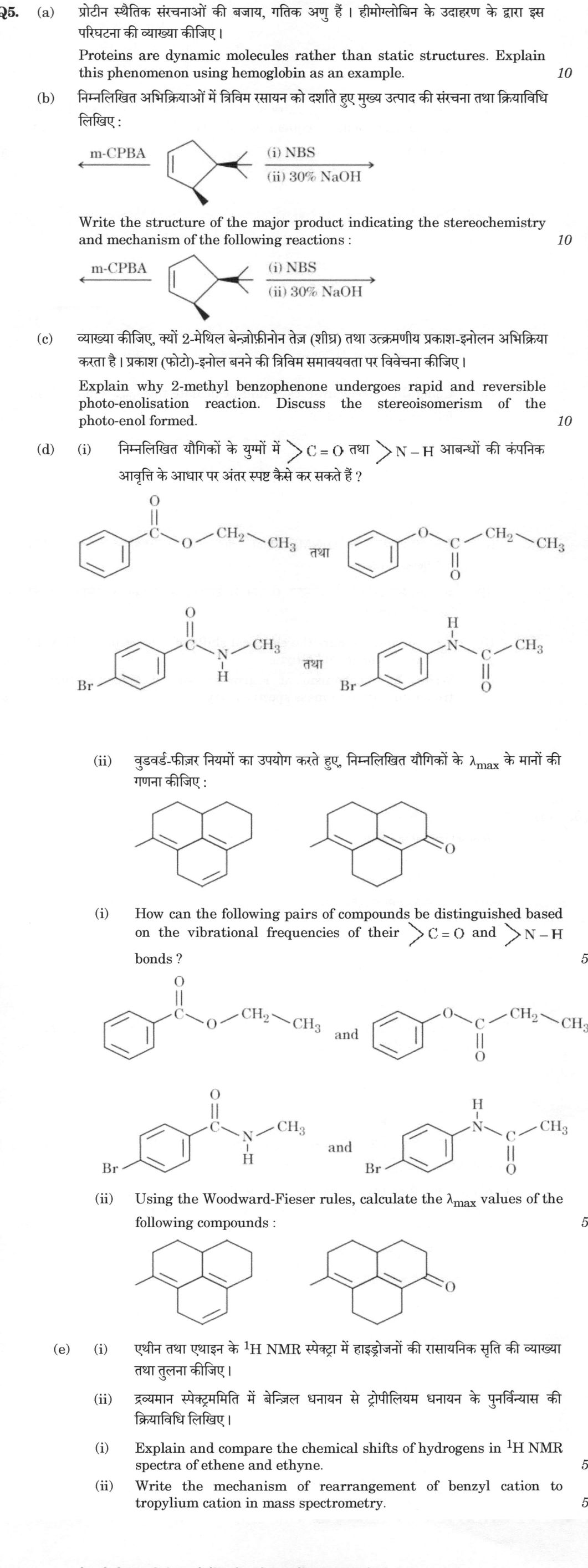
Proteins are dynamic molecules rather than static structures. Explain this phenomenon using hemoglobin as an example. 10 marks
Write the structure of the major product indicating the stereochemistry and mechanism of the following reactions : m-CPBA ; (i) NBS (ii) 30% NaOH 10 marks
Explain why 2-methyl benzophenone undergoes rapid and reversible photo-enolisation reaction. Discuss the stereoisomerism of the photo-enol formed. 10 marks
How can the following pairs of compounds be distinguished based on the vibrational frequencies of their >C = O and >N – H bonds ? C6H5–C(=O)–O–CH2–CH3 and C6H5–O–C(=O)–CH2–CH3 4-Br–C6H4–C(=O)–NH–CH3 and 4-Br–C6H4–N(H)–C(=O)–CH3 5 marks
Using the Woodward-Fieser rules, calculate the λmax values of the following compounds : 5 marks
Explain and compare the chemical shifts of hydrogens in 1H NMR spectra of ethene and ethyne. 5 marks
Write the mechanism of rearrangement of benzyl cation to tropylium cation in mass spectrometry. 5 marks
हिंदी में प्रश्न पढ़ें
प्रोटीन स्थैतिक संरचनाओं की बजाय, गतिक अणु हैं । हीमोग्लोबिन के उदाहरण के द्वारा इस परिघटना की व्याख्या कीजिए। (10 अंक)
निम्नलिखित अभिक्रियाओं में त्रिविम रसायन को दर्शाते हुए मुख्य उत्पाद की संरचना तथा क्रियाविधि लिखिए : m-CPBA ; (i) NBS (ii) 30% NaOH (10 अंक)
व्याख्या कीजिए, क्यों 2-मेथिल बेन्ज़ोफीनोन तेज (शीघ्र) तथा उत्क्रमणीय प्रकाश-इनोलन अभिक्रिया करता है । प्रकाश (फोटो)-इनोल बनने की त्रिविम समावयवता पर विवेचना कीजिए। (10 अंक)
निम्नलिखित यौगिकों के युग्मों में >C = O तथा >N – H आबन्धों की कंपनिक आवृत्ति के आधार पर अंतर स्पष्ट कैसे कर सकते हैं ? C6H5–C(=O)–O–CH2–CH3 तथा C6H5–O–C(=O)–CH2–CH3 4-Br–C6H4–C(=O)–NH–CH3 तथा 4-Br–C6H4–N(H)–C(=O)–CH3 (5 अंक)
बुडवर्ड-फ़ीज़र नियमों का उपयोग करते हुए, निम्नलिखित यौगिकों के λmax के मानों की गणना कीजिए : (5 अंक)
एथीन तथा एथाइन के 1H NMR स्पेक्ट्रा में हाइड्रोजनों की रासायनिक सृति की व्याख्या तथा तुलना कीजिए। (5 अंक)
द्रव्यमान स्पेक्ट्रममिति में बेन्ज़िल धनायन से ट्रॉपीलियम धनायन के पुनर्विन्यास की क्रियाविधि लिखिए। (5 अंक)
Model answer
Drafted with AI by UPSC Answer Check against this question's marking rubric, to the expected length. UPSC does not publish answers for Mains — this is one way to score well, not an official key. How we build rubrics and answers.
(a) Proteins as dynamic molecules: haemoglobin (10 marks)
A crystal structure gives one time-averaged picture, but a protein in solution is an ensemble of interconverting conformations. Motions span femtoseconds (bond vibrations) to milliseconds and longer (loop and domain movements, subunit rearrangement), and the energy differences between conformers are only a few kJ/mol, so ligands, pH and temperature can shift the populations. Function often depends on this flexibility: binding sites open and close, and a ligand at one site can change the shape and affinity of a distant one (allostery).
Haemoglobin (Hb, α₂β₂, four haems) shows this at three levels.
Quaternary switch. Deoxy-Hb exists in the tense (T) state, with low O₂ affinity and stabilised by salt bridges between the subunits (for example the C-terminal His146 of each β chain with Asp94, and the C-terminal Arg141 of each α chain with the opposite subunit). Oxy-Hb is in the relaxed (R) state, with high affinity. Binding of O₂ moves Fe²⁺ from about 0.6 Å out of the porphyrin plane into it; this pulls the proximal His F8 and the F helix, breaks the salt bridges, and rotates one αβ dimer by about 15° relative to the other, narrowing the central cavity.
Cooperativity. Because each bound O₂ favours the T → R change, the next O₂ binds more easily. The result is a sigmoidal saturation curve (Hill coefficient about 2.8, P₅₀ about 26 torr) against the hyperbolic curve of monomeric myoglobin (P₅₀ about 3 torr). This allows nearly full loading in the lungs and efficient unloading in tissues. It is described by the concerted (MWC) model, in which T and R pre-exist in equilibrium and O₂ shifts the balance towards R, and by the sequential (KNF) model, in which subunits change one at a time.
Allosteric effectors. H⁺ and CO₂ (the Bohr effect) and Cl⁻ stabilise T, reducing affinity where tissues are acidic. 2,3-Bisphosphoglycerate binds in the central cavity of T Hb, between the β chains (with His2, Lys82 and His143), and shifts the curve right. Fetal Hb (γ chains, where His143 is replaced by Ser) binds it less and so has a higher O₂ affinity.
Local breathing motions. In myoglobin and Hb the haem pocket is buried, and the static structure shows no open path for O₂. Ligand entry and exit require transient opening of channels and movement of the distal His E7 gate, on picosecond to nanosecond time scales (seen in flash photolysis and molecular dynamics). Together these show that the function of Hb is a property of a moving structure, not a rigid one.
(b) Stereochemistry and mechanism: m-CPBA and NBS/NaOH (10 marks)
The substrate is a cyclopentene carrying a methyl group on the allylic carbon (C3) and a tert-butyl group on C4, both on the same face (cis, drawn as wedges). Call this the top face; the bottom face is free. Both reagents deliver oxygen to the double bond, but by different routes.
Route (a), m-CPBA. The peracid transfers its terminal oxygen in a single concerted "butterfly" transition state, syn to the double bond, and it approaches the less hindered face. The face opposite the allylic methyl (the bottom) is preferred. The product is the epoxide anti (trans) to both the methyl and the tert-butyl group: 3-tert-butyl-2-methyl-6-oxabicyclo[3.1.0]hexane with the epoxide oxygen on the face opposite the substituents. The by-product is m-chlorobenzoic acid.
Route (b), NBS then NaOH. In water-containing solvent NBS supplies Br⁺, which forms a bromonium ion on the less hindered bottom face. Water opens it by anti (backside) attack from the top face, at the carbon that is less hindered (the alkene carbon away from the methyl), giving the trans-bromohydrin: Br down, OH up. Then NaOH removes the O-H proton, and the alkoxide attacks the adjacent C-Br carbon from the back in an intramolecular SN2 (a Williamson closure) which needs the trans, anti-periplanar arrangement. This displaces Br⁻ from below and puts the ring oxygen on the top face. The product is the epoxide cis (syn) to the methyl and tert-butyl groups. The regiochemistry of water attack does not matter for the final epoxide, because either trans-bromohydrin closes to the same top-face epoxide.
Net result: the two epoxides are diastereomers. m-CPBA gives the epoxide on the face opposite to the substituents; NBS/NaOH gives it on the same face, because two inversions (anti-addition of Br⁺/H₂O, then SN2 closure) reverse the facial selectivity of the first step.
(c) 2-Methylbenzophenone: photoenolisation (10 marks)
Why the reaction is rapid. On absorbing light the ketone reaches the n,π* singlet, and intersystem crossing to the triplet is almost complete within picoseconds, as in benzophenone. In this triplet the carbonyl oxygen is electron-deficient and behaves like an alkoxy radical. In the conformation with the o-methyl group syn to the C=O, one hydrogen of the methyl group lies about 2.5 Å from the oxygen, in a six-membered (1,5) arrangement. Intramolecular γ-hydrogen abstraction is therefore very fast (about 10⁸ s⁻¹ or more) and gives a 1,4-triplet biradical, a ketyl radical and a benzylic radical, which is stabilised because the two centres are joined through the ring as an o-quinodimethane. Intersystem crossing of the biradical gives the closed-shell photoenol.
Why it is reversible. The photoenol is a high-energy o-quinodimethane that has lost the aromaticity of one ring, and it also reverts by reverse proton transfer. It returns to the ketone by a thermally allowed suprafacial [1,5]-hydrogen shift (or by acid/base-catalysed proton transfer). Since nothing net is formed, 2-methylbenzophenone is photostable, a property used in photoprotective UV absorbers and photo-removable protecting groups.
Stereoisomerism of the photoenol. The photoenol has a new enol double bond, C(OH)Ph=C(ring), which can be of two geometries, Z and E. In the Z-enol (kinetic, formed directly), the OH group lies close to the exocyclic CH₂, so the H can be handed back at once by the [1,5] shift: lifetime about tens of nanoseconds to a microsecond, and it is not observed by ordinary product analysis. The E-enol, formed by the other rotamer, has its OH pointing away from the CH₂ and cannot return by that intramolecular route; it reverts only by slow, intermolecular (solvent, trace acid or base) proton transfer and lives for milliseconds to seconds. This long-lived E-enol is the one trapped by dienophiles (Diels-Alder, as an o-quinodimethane) or seen by flash photolysis. Its lifetime falls sharply in protic or basic solvents.
(d)(i) Distinguishing pairs by IR (5 marks)
(a) Ethyl benzoate and phenyl propanoate are isomeric esters, told apart by ν(C=O).
- Ethyl benzoate, an alkyl benzoate: the C=O is conjugated with the ring, which lowers its frequency to about 1720 cm⁻¹ (an aliphatic ester absorbs near 1740).
- Phenyl propanoate, an aryl alkanoate: the C=O is not conjugated with the ring, and the oxygen lone pair is drawn into the phenyl ring, so it donates less to the C=O, which stays strong and at higher frequency, about 1760 cm⁻¹.
(b) 4-Bromo-N-methylbenzamide and 4′-bromoacetanilide are both secondary amides, told apart by amide I (C=O) and N-H.
- 4-Bromo-N-methylbenzamide: the C=O is conjugated with the ring, and the N lone pair donates fully into C=O, giving about 1640 cm⁻¹; N-H stretch about 3300 cm⁻¹ (H-bonded solid, about 3450 in dilute solution).
- 4′-Bromoacetanilide: the N lone pair is shared with the aryl ring, so it donates less to C=O, and the amide I band appears higher, about 1665 cm⁻¹; N-H stretch is about 3300-3320 cm⁻¹ (slightly higher and sharper than in the benzamide).
(d)(ii) Woodward-Fieser calculation (5 marks)
Structure A (triene): C(Me)=C-C=C-C=C, a linear conjugated triene in which two of the double bonds lie in one ring (homoannular diene).
- Base value, homoannular diene: 253 nm
- One extra conjugated C=C: +30
- Exocyclic C=C, two: +10
- Alkyl substituents and ring residues on the chromophore, six: +30 (the methyl and five ring CH₂/CH residues)
- λmax = 253 + 30 + 10 + 30 = 323 nm
Structure B (cross-ring dienone), O=C-Cα=Cβ-Cγ=Cδ in a six-membered ring ketone:
- Base value, six-ring enone: 215 nm
- One extra conjugated C=C: +30
- Exocyclic C=C, two: +10
- α ring residue: +10
- β ring residue: +12
- γ ring residue: +18
- δ substituents, methyl and ring residue: +18 + 18 = +36
- λmax = 215 + 30 + 10 + 10 + 12 + 18 + 36 = 331 nm
(e)(i) ¹H NMR of ethene and ethyne (5 marks)
Ethene absorbs at δ about 5.3 and ethyne at δ about 1.8-1.9 (for comparison, ethane is at 0.9). Judging by hybridisation alone, the sp C-H of ethyne (50% s-character, more electronegative carbon) should be more deshielded than the sp² C-H of ethene, so the observed order is the reverse of the prediction.
The reversal is explained by magnetic anisotropy. In the field B₀ the π electrons circulate, and the induced field is what matters at the proton. In ethene, with the molecular plane perpendicular to B₀, the π electrons circulate above and below the plane and the induced field lines close round the in-plane hydrogens in the same direction as B₀, so these hydrogens are deshielded. Ethyne tends to align along B₀, and the π electrons circulate around the molecular axis; the induced field along the axis opposes B₀ where the hydrogens lie (the shielding cone), so they are shielded, and this outweighs the hybridisation effect. The same effect deshields aromatic protons (δ about 7.3) and shields the terminal alkyne proton.
(e)(ii) Benzyl cation to tropylium cation (5 marks)
The benzyl cation (m/z 91) arises when an alkylbenzene molecular ion loses the alkyl radical by benzylic cleavage. It then ring-expands to the seven-membered tropylium ion, C₇H₇⁺, also m/z 91.
Mechanism:
- (1) The exocyclic CH₂⁺ is attacked by a ring C-C σ bond (the ipso-ortho bond), so that a ring carbon migrates to the CH₂ carbon, giving a bicyclic cyclopropyl-type cation (the norcaradienyl-type cation, bicyclo[4.1.0]heptadienyl) in which the CH₂ carbon is now part of a three-membered ring.
- (2) The cyclopropane bond common to the two rings breaks (electrocyclic opening), expanding the ring to seven carbons and delocalising the charge to give the tropylium ion, C₇H₇⁺.
Driving force: tropylium is a planar, cyclic, fully conjugated system with 6 π electrons in a ring of seven p orbitals, obeying Hückel's 4n + 2 rule (n = 1), so all seven CH groups are equivalent and the ion is much more stable than benzyl and forms the base peak of many toluene and alkylbenzene spectra.
Evidence: ¹³C and deuterium labelling of toluene shows that the CH₂ carbon and the ring carbons become equivalent in the m/z 91 ion, and the ion goes on to lose C₂H₂ to give m/z 65 (C₅H₅⁺) in the same way whether it comes from toluene or from cycloheptatriene.
How this answer will be evaluated
Evaluation rubric
Each sub-part is marked on its own, against the marks and word limit printed on the paper.
- (a) Explain that a protein is a dynamic ensemble rather than a rigid structure, and demonstrate it through haemoglobin. The general statement and the haemoglobin case study must both be present. 10 marks
Must cover
- General statement: proteins sample interconnected conformations over fs to ms, with small energy gaps shifted by ligands, pH and temperature
- T to R quaternary switch: salt bridges broken, Fe moves into the porphyrin plane (about 0.6 Å), about 15° rotation of one αβ dimer
- Cooperativity: sigmoidal curve (Hill n about 2.8) against hyperbolic myoglobin; MWC and KNF models
- Allosteric effectors (H⁺/CO₂ Bohr effect, Cl⁻, 2,3-BPG in the central cavity) stabilise T; local breathing motions let O₂ enter the haem pocket
Loses marks
- Describing Hb only as a static T/R structure with no dynamics or conformational-ensemble idea.
- Stating that Hb binds O₂ hyperbolically.
Earns more
- Naming the specific salt bridges (His146β-Asp94β, Arg141α).
- Fetal Hb having lower 2,3-BPG binding (γ chains, His143 replaced by Ser) and a higher O₂ affinity.
Extra mark
- Flash photolysis or molecular dynamics evidence for transient ligand channels and the distal His E7 gate
- (b) Draw the major product with stereochemistry and give the mechanism for (a) m-CPBA and (b) NBS then 30% NaOH on the cis-3-methyl-4-tert-butylcyclopentene. The two epoxides are diastereomers. 10 marks
Must cover
- m-CPBA: concerted syn delivery of O to the less hindered face, opposite to the allylic methyl, giving the epoxide trans to the substituents
- NBS: bromonium ion on the less hindered face, anti attack of water from the substituent face, giving the trans-bromohydrin
- NaOH: alkoxide intramolecular SN2 (Williamson) on the C-Br carbon, anti-periplanar, giving the epoxide cis to the substituents
- Clear statement that the two epoxides are diastereomers, with a labelled drawing of each
Loses marks
- Giving the same epoxide for both routes.
- Missing the bromohydrin intermediate or the inversion in the ring-closing step.
Earns more
- Explaining why the regiochemistry of water attack does not affect the final epoxide.
- Mechanism arrows drawn for each step.
Extra mark
- Naming the epoxide as a 3-tert-butyl-2-methyl-6-oxabicyclo[3.1.0]hexane
- (c) Explain why 2-methylbenzophenone photo-enolises rapidly and reversibly, and discuss the stereoisomerism of the photo-enol formed. 10 marks
Must cover
- n,π* triplet by fast intersystem crossing; syn o-methyl gives a 1,5 (six-membered) intramolecular γ-H abstraction
- 1,4-Biradical stabilised as an o-quinodimethane, closing to the photoenol
- Reversibility: [1,5]-H shift or proton transfer regenerates the ketone, so the compound is photostable
- Z-enol short-lived (ns to μs) by direct [1,5]-H return; E-enol long-lived (ms to s), trapped by dienophiles
Loses marks
- Describing the reaction as a Norrish type II cleavage.
- Swapping the lifetimes of the E and Z enols.
Earns more
- Explaining why the E-enol lives long: its OH points away from the CH₂ and it needs intermolecular proton transfer.
- Effect of protic or basic solvent on the E-enol lifetime.
Extra mark
- Applications: photoprotective UV absorbers and photo-removable protecting groups
- (d)(i) Distinguish two printed pairs using IR: (a) ethyl benzoate and phenyl propanoate by ν(C=O); (b) 4-bromo-N-methylbenzamide and 4′-bromoacetanilide by ν(C=O) and ν(N-H). Give values for all four with reasons. 5 marks
Must cover
- Ethyl benzoate about 1720 cm⁻¹, lowered by conjugation with the ring
- Phenyl propanoate about 1760 cm⁻¹, higher because the O lone pair is drawn into the phenyl ring and there is no conjugation of C=O
- 4-Bromo-N-methylbenzamide C=O about 1640 cm⁻¹ (conjugated, full N donation); 4′-bromoacetanilide about 1665 cm⁻¹ (N lone pair shared with ring)
- N-H stretch about 3300 cm⁻¹ for both (about 3450 in dilute solution), so the pair is told apart mainly by amide I
Loses marks
- Assigning the higher C=O frequency to ethyl benzoate.
- Giving no numerical frequency for one or more compounds.
Earns more
- Comparison with aliphatic ester (about 1740).
- Noting the slightly higher and sharper N-H of the anilide.
- (d)(ii) Apply the Woodward-Fieser rules to the two printed tricyclic structures: (A) methyl-substituted triene with a homoannular diene, and (B) methyl-substituted cross-ring dienone. Give a stepwise calculation and a final λmax for each. 5 marks
Must cover
- A: base 253 (homoannular) + 30 (one extra conjugated C=C) + 10 (two exocyclic) + 30 (six alkyl/ring residues) = 323 nm
- B: base 215 + 30 (one extra conjugated C=C) + 10 (two exocyclic) = 255 before substituents
- B substituents: α ring residue +10, β +12, γ +18, δ two groups +36, total 331 nm
- Correct identification of the chromophore: homoannular diene plus one extra double bond in A; linear O=C-C=C-C=C in B
Loses marks
- Using the heteroannular base value (214) for A.
- Omitting the extra conjugated double bond or the δ substituents in B.
Earns more
- Every exocyclic double bond and every ring residue counted separately.
- A stated final value for each compound.
Extra mark
- Comparison with an observed λmax, and note that the value is the estimate for ethanol
- (e)(i) Give the ¹H chemical shifts of ethene and ethyne, note that the order is opposite to the hybridisation prediction, and explain it by magnetic anisotropy. 5 marks
Must cover
- Ethene δ about 5.3 and ethyne δ about 1.8-1.9
- Hybridisation alone (sp C-H more s-character) would predict ethyne downfield
- Ethene: in-plane H in the deshielding region of the π circulation
- Ethyne: aligned along B₀; π circulation about the axis gives a shielding cone at the H
Loses marks
- Explaining the difference only by electronegativity or hybridisation.
- Reversing the values for the two compounds.
Earns more
- Comparison with ethane (0.9) and benzene (7.3).
- Correct signs of the induced field at the H in each case.
Extra mark
- Note that the terminal alkyne H is shielded for the same reason
- (e)(ii) Write the stepwise mechanism by which the benzyl cation (m/z 91) ring-expands to the tropylium cation in the mass spectrometer, and justify the driving force and the supporting evidence. 5 marks
Must cover
- Benzyl cation formed by benzylic cleavage of an alkylbenzene molecular ion
- Ring C-C migration to CH₂⁺, giving a bicyclic norcaradienyl-type cation, then electrocyclic ring opening to the seven-membered ion
- Driving force: aromatic tropylium, 6 π electrons in seven p orbitals, Hückel 4n + 2
- Evidence: ¹³C/D labelling scrambling, loss of C₂H₂ to m/z 65, and the same ion from cycloheptatriene
Loses marks
- Showing no intermediate between benzyl and tropylium.
- Giving the driving force as anything other than aromatic stabilisation.
Earns more
- Statement that all seven CH groups are equivalent in tropylium.
- Drawn structures for each stage.
What "Explain" is asking you to do
Make the working of something clear — what sets it off, what follows from what, and what it produces. Explain is the Commission's mechanism word: it dominates the technical papers and the “explain why” stems, where the marks sit in the causal chain and not in the label.
Structure that answers it
State what it is → the initiating condition → the chain of cause, step by step → an instance where it plays out → what the chain produces
Where marks are lost
Describing what something looks like instead of why it works that way. Naming the stages without linking them reads as description too.
Practice this exact question
Write your answer and it is marked point by point against the model answer above — what you covered, what you missed, what you got wrong.
Evaluate my answer →More from Chemistry 2026 Paper II
- Q2 In the following reaction, intermediate [A] is formed : CHCl₃ + ᵗBuOK ——> [A] (a) Write t…
- Q3 (a) (i) Write the structure of the major products of the following reaction and write the…
- Q4 (a) (i) Write the structure of the stereochemical product formed in the reaction of (2E,…
- Q5 (a) Proteins are dynamic molecules rather than static structures. Explain this phenomenon…
- Q6 (a) Write the structures of the products formed in the following reactions : 2×5=10 (i) (…
- Q7 (a) (i) What are the phenomena that result in the emission wavelength being longer than t…
- Q8 (a) (i) Calculate the rotational constant of a diatomic molecule if the moment of inertia…