Paper II — Q3
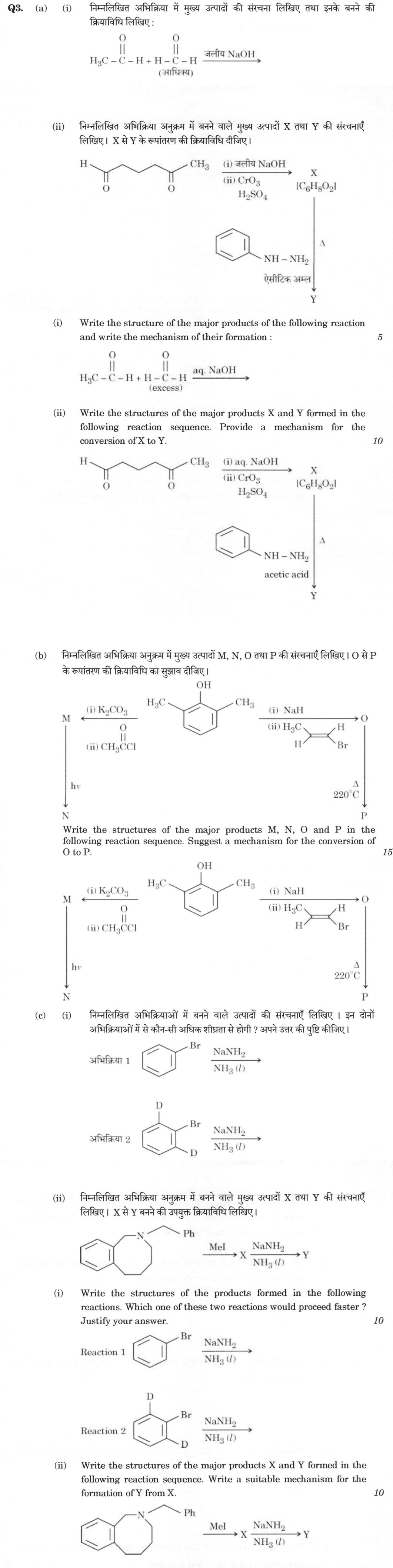
(a) (i) Write the structure of the major products of the following reaction and write the mechanism of their formation : O …
Write the structure of the major products of the following reaction and write the mechanism of their formation :
O O ‖ ‖ H₃C – C – H + H – C – H ──aq. NaOH──► (excess) 5 marks
Write the structures of the major products X and Y formed in the following reaction sequence. Provide a mechanism for the conversion of X to Y.
O O ‖ ‖ H – C – CH₂CH₂CH₂ – C – CH₃ ──(i) aq. NaOH
CrO₃ / H₂SO₄──► X [C₆H₈O₂] │ │ C₆H₅–NH–NH₂ │ acetic acid, Δ ▼ Y 10 marks
Write the structures of the major products M, N, O and P in the following reaction sequence. Suggest a mechanism for the conversion of O to P. [Scheme : H3C–C6H3(OH)–CH3 (2,6-dimethylphenol) —(i) K2CO3, (ii) CH3COCl→ M ; M —hv→ N ; H3C–C6H3(OH)–CH3 —(i) NaH, (ii) H3C–CH=CH–Br→ O ; O —Δ, 220°C→ P] 15 marks
Write the structures of the products formed in the following reactions. Which one of these two reactions would proceed faster ? Justify your answer. Reaction 1 : Bromobenzene (C6H5Br) —NaNH2 / NH3 (l)→ Reaction 2 : 2,6-Dideuteriobromobenzene —NaNH2 / NH3 (l)→ 10 marks
Write the structures of the major products X and Y formed in the following reaction sequence. Write a suitable mechanism for the formation of Y from X. 10 marks
हिंदी में प्रश्न पढ़ें
निम्नलिखित अभिक्रिया के मुख्य उत्पादों की संरचना लिखिए तथा उनके बनने की क्रियाविधि लिखिए :
O O ‖ ‖ H₃C – C – H + H – C – H ──aq. NaOH──► (आधिक्य) (5 अंक)
निम्नलिखित अभिक्रिया अनुक्रम में बनने वाले मुख्य उत्पादों X तथा Y की संरचनाएँ लिखिए। X से Y के रूपांतरण की क्रियाविधि दीजिए।
O O ‖ ‖ H – C – CH₂CH₂CH₂ – C – CH₃ ──(i) जलीय NaOH
CrO₃ / H₂SO₄──► X [C₆H₈O₂] │ │ C₆H₅–NH–NH₂ │ एसीटिक अम्ल, Δ ▼ Y (10 अंक)
निम्नलिखित अभिक्रिया अनुक्रम में मुख्य उत्पादों M, N, O तथा P की संरचनाएँ लिखिए । O से P के रूपांतरण की क्रियाविधि का सुझाव दीजिए । [आरेख : H3C–C6H3(OH)–CH3 (2,6-डाइमेथिलफ़िनॉल) —(i) K2CO3, (ii) CH3COCl→ M ; M —hv→ N ; H3C–C6H3(OH)–CH3 —(i) NaH, (ii) H3C–CH=CH–Br→ O ; O —Δ, 220°C→ P] (15 अंक)
निम्नलिखित अभिक्रियाओं में बनने वाले उत्पादों की संरचनाएँ लिखिए । इन दोनों अभिक्रियाओं में से कौन-सी अधिक शीघ्रता से होगी ? अपने उत्तर की पुष्टि कीजिए । अभिक्रिया 1 : ब्रोमोबेन्जीन (C6H5Br) —NaNH2 / NH3 (l)→ अभिक्रिया 2 : 2,6-डाइड्यूटेरियोब्रोमोबेन्जीन —NaNH2 / NH3 (l)→ (10 अंक)
निम्नलिखित अभिक्रिया अनुक्रम में बनने वाले मुख्य उत्पादों X तथा Y की संरचनाएँ लिखिए। X से Y बनने की उपयुक्त क्रियाविधि लिखिए। (10 अंक)
Model answer
Drafted with AI by UPSC Answer Check against this question's marking rubric, to the expected length. UPSC does not publish answers for Mains — this is one way to score well, not an official key. How we build rubrics and answers.
(a)(i) Acetaldehyde with excess formaldehyde in aqueous NaOH (5 marks)
Formaldehyde has no α-hydrogen and is more electrophilic than acetaldehyde, so it is attacked by the enolate of acetaldehyde. The three α-hydrogens of acetaldehyde are used up in three crossed aldol additions, and the resulting aldehyde is reduced in a crossed Cannizzaro reaction. The products are pentaerythritol, C(CH₂OH)₄, and sodium formate (HCO₂Na).
Mechanism:
- Step 1: OH⁻ removes an α-hydrogen of CH₃CHO to give the enolate ⁻CH₂CHO, which adds to HCHO to give HOCH₂CH₂CHO. Two more cycles of enolate formation and addition to HCHO give tris(hydroxymethyl)acetaldehyde, (HOCH₂)₃C-CHO. It has no α-hydrogen left and cannot dehydrate.
- Step 2 (crossed Cannizzaro): OH⁻ adds to the more reactive HCHO to give H₂C(OH)O⁻, which transfers a hydride to the carbonyl carbon of (HOCH₂)₃CCHO. This gives the alkoxide of pentaerythritol, C(CH₂OH)₄, while formaldehyde is oxidised to formate.
(a)(ii) Products X and Y from 5-oxohexanal (10 marks)
X. In aqueous NaOH the methyl ketone forms an enolate at its CH₃ group, which attacks the aldehyde carbonyl in an intramolecular aldol addition. The ring formed contains six carbons, so 3-hydroxycyclohexanone results. Jones reagent (CrO₃/H₂SO₄) oxidises this secondary alcohol to the ketone, giving X = cyclohexane-1,3-dione, C₆H₈O₂ (largely present as its enol).
Y. Phenylhydrazine in acetic acid on heating brings about a Fischer indole synthesis on X, giving Y = 1,2,3,9-tetrahydro-4H-carbazol-4-one (an indole fused to a cyclohexanone ring; C₁₂H₁₁NO).
Mechanism of X to Y:
- (1) Phenylhydrazine condenses with one C=O of the dione (via acid catalysis) to give the phenylhydrazone, which tautomerises to the enehydrazine, 3-(2-phenylhydrazinyl)cyclohex-2-en-1-one. This is stabilised by conjugation with the other C=O.
- (2) After N-protonation, a [3,3]-sigmatropic rearrangement breaks the N-N bond and makes a bond from the ortho carbon of the phenyl ring to C2 of the ring (the carbon between the two carbonyl groups). This gives an imine with a dearomatised ring.
- (3) Loss of a proton from the ortho carbon restores aromaticity and gives an aniline-type intermediate.
- (4) The NH₂ group attacks the iminium carbon to close the five-membered ring (an aminal).
- (5) Elimination of NH₃ makes the ring aromatic, and the indole Y forms.
(b) 2,6-Dimethylphenol: photo-Fries and para-Claisen (15 marks)
- M: 2,6-dimethylphenyl acetate, formed by O-acylation. K₂CO₃ makes the phenoxide, which attacks CH₃COCl by nucleophilic acyl substitution.
- N: on irradiation (photo-Fries rearrangement), the acetyl group migrates to the ring. Both ortho positions carry methyl groups, so it goes to the para position, giving 4-hydroxy-3,5-dimethylacetophenone (1-(4-hydroxy-3,5-dimethylphenyl)ethanone). Mechanism: the excited ester undergoes homolysis of the C(O)-O bond to a phenoxy radical and an acyl radical held in a solvent cage. The acyl radical recombines at the para carbon of the ring, and tautomerisation (loss of H) restores the phenol. Escape from the cage gives some 2,6-dimethylphenol as a by-product.
- O: NaH converts the phenol to the sodium phenoxide, which displaces bromide (SN2) from the three-carbon allylic bromide to give the aryl allyl ether, ArO-CH₂CH=CH₂ (a vinylic bromide as drawn would not alkylate the phenoxide directly, so the allylic halide is the alkylating agent).
- P: on heating at 220 °C the aryl allyl ether undergoes the Claisen rearrangement to give 4-allyl-2,6-dimethylphenol (para-Claisen).
Mechanism of O to P. (1) A concerted, chair-like [3,3]-sigmatropic shift breaks the O-CH₂ bond and forms a C-C bond between the terminal allyl carbon and the ortho carbon (C2 or C6). Since both ortho carbons carry methyl groups, the product is the non-aromatic 6-allyl-2,6-dimethylcyclohexa-2,4-dienone, and the allyl group has inverted. (2) It cannot tautomerise because the ortho carbon has no hydrogen, so a second [3,3]-shift, a Cope rearrangement, moves the allyl group from C6 to the para carbon (C4), again with inversion, giving 4-allyl-2,6-dimethylcyclohexa-2,5-dienone. (3) Tautomerisation (enolisation) of this dienone restores the aromatic ring and gives the phenol P. The two inversions mean the original allyl carbon attached to oxygen ends up as the CH₂ next to the ring.
(c)(i) Bromobenzene and 2,6-dideuteriobromobenzene with NaNH₂/NH₃(l) (10 marks)
Both reactions go by the elimination-addition (benzyne) mechanism.
Reaction 1: NH₂⁻ removes a hydrogen ortho to Br (E2-like or E1cb-like), and Br⁻ is lost to give benzyne (a strained triple bond formed by the in-plane sp² orbitals). NH₂⁻ adds to benzyne, and the aryl anion is protonated by NH₃ (solvent) to give aniline, C₆H₅NH₂.
Reaction 2: the ortho positions carry D, so NH₂⁻ must abstract a deuteron, giving 3-deuteriobenzyne. Addition of NH₂⁻ at either carbon of the triple bond, then protonation, gives a mixture of 2-deuterioaniline and 3-deuterioaniline in about equal amounts, because the amide ion can add at either end of the deuterated benzyne.
Faster reaction: Reaction 1 is faster. The rate-determining step is the abstraction of the ortho proton, so a C-H bond is broken in that step. A C-D bond is stronger, because of its lower zero-point energy, so its cleavage has a higher activation energy, a primary kinetic isotope effect (k_H/k_D about 5 to 7). Thus the deuterated compound reacts more slowly.
(c)(ii) Quaternisation and rearrangement of the benzazocine (10 marks)
X. Methyl iodide alkylates the tertiary amine nitrogen (SN2) to give the quaternary ammonium iodide: N-benzyl-N-methyl-benzazocinium iodide.
Y. Sodium amide in liquid ammonia removes a proton from the ammonium salt to give an ammonium ylide, which rearranges. These are the conditions of the Sommelet-Hauser rearrangement, a [2,3]-sigmatropic shift, as follows.
Mechanism: (1) NH₂⁻ removes a proton from the N-methyl group, giving the ylide ⁻CH₂-N⁺, whose carbanion is close to the ortho carbon of the N-benzyl ring. (2) In a five-membered cyclic transition state, [2,3]-sigmatropic shift forms a bond between the ylide carbon and the ortho carbon of the benzyl phenyl ring, and breaks the N-CH₂(benzyl) bond, giving a dearomatised isotoluene-type intermediate (an exocyclic methylene). (3) Proton transfer restores the aromatic ring, converting the exocyclic CH₂ to a methyl group. Y is the tertiary amine whose nitrogen (still in the eight-membered ring) now carries a 2-methylbenzyl group in place of the benzyl group, N-(2-methylbenzyl)-benzazocine; the former N-methyl carbon is now the CH₂ attached to the ring.
The alternative [1,2] Stevens shift (which would give a ring-expanded product) is favoured at higher temperatures in non-polar media, while low-temperature NaNH₂/NH₃(l) favours the Sommelet-Hauser path.
How this answer will be evaluated
Evaluation rubric
Each sub-part is marked on its own, against the marks and word limit printed on the paper.
- (a)(i) (a)(i) Products and mechanism for acetaldehyde with excess formaldehyde and aqueous NaOH (5 marks). 5 marks
Must cover
- Three crossed aldol additions at the three α-hydrogens
- Tris(hydroxymethyl)acetaldehyde intermediate (no α-H)
- Crossed Cannizzaro with HCHO as hydride donor
- Pentaerythritol and sodium formate
Loses marks
- Stopping at the aldol condensation product.
- Omitting formate.
Earns more
- Enolate formation and hydride transfer shown.
Extra mark
- Industrial use of pentaerythritol
- (a)(ii) (a)(ii) X and Y from 5-oxohexanal and the mechanism of X to Y (10 marks). 10 marks
Must cover
- Intramolecular aldol to 3-hydroxycyclohexanone; Jones oxidation to cyclohexane-1,3-dione (C₆H₈O₂)
- Y = 1,2,3,9-tetrahydro-4H-carbazol-4-one (Fischer indole)
- Mechanism: hydrazone or enehydrazine, [3,3] shift, rearomatisation, cyclisation, loss of NH₃
- Six-membered ring reasoning for the aldol
Loses marks
- Giving cyclohexenone as X.
- Omitting the [3,3] step.
Earns more
- Enol form of the dione noted.
Extra mark
- Acid catalysis role
- (b) (b) Products M, N, O, P and mechanism of O to P (15 marks). 15 marks
Must cover
- M = 2,6-dimethylphenyl acetate
- N = 4-hydroxy-3,5-dimethylacetophenone (photo-Fries, para since ortho blocked)
- O = aryl allyl ether by Williamson synthesis
- P = 4-allyl-2,6-dimethylphenol
- Mechanism: Claisen [3,3] to ortho dienone then Cope to para, tautomerisation
Loses marks
- Putting the acetyl at ortho.
- Giving ortho-allyl phenol as P.
Earns more
- Radical-pair explanation for photo-Fries.
Extra mark
- Allyl inversion twice
- (c)(i) (c)(i) Products and relative rate of bromobenzene and 2,6-dideuteriobromobenzene with NaNH₂/NH₃(l) (10 marks). 10 marks
Must cover
- Benzyne mechanism (elimination-addition)
- Reaction 1 gives aniline
- Reaction 2 gives 2- and 3-deuterioaniline mixture
- Reaction 1 faster: primary kinetic isotope effect for C–H versus C–D in the rate-determining step
Loses marks
- Predicting a direct SNAr.
- Saying Reaction 2 is faster.
Earns more
- Benzyne structure described.
Extra mark
- Value of k_H/k_D
- (c)(ii) (c)(ii) X and Y for the benzazocine and a mechanism for X to Y (10 marks). 10 marks
Must cover
- X = N-methyl quaternary ammonium iodide
- NaNH₂ forms the ammonium ylide
- [2,3] Sommelet–Hauser rearrangement via a five-membered transition state
- Y = tertiary amine with a 2-methylbenzyl group on N; ring retained
Loses marks
- Giving X as an N-oxide.
- Giving Hofmann elimination product.
Earns more
- Stevens [1,2] mentioned as alternative.
Extra mark
- Explanation of conditions
What "Describe" is asking you to do
Give a full, ordered account of the thing named — its parts, stages or mechanism — in the sequence in which it actually exists or occurs. Most describe questions come from the science optionals, where the marks sit in correct technical detail and, where the stem says so, a labelled diagram.
Structure that answers it
One-line identification of the subject → the parts or stages in their real order, each with its defining detail → labelled diagram where the subject is structural → closing line on function or significance
Where marks are lost
Loose general prose where the examiner is ticking named parts, correct terminology and their sequence; and in the General Studies papers, turning to evaluation before the description is finished.
Practice this exact question
Write your answer and it is marked point by point against the model answer above — what you covered, what you missed, what you got wrong.
Evaluate my answer →More from Chemistry 2026 Paper II
- Q1 (a) (i) Draw the structures of three possible geometrical isomers of [10] annulene and ex…
- Q2 In the following reaction, intermediate [A] is formed : CHCl₃ + ᵗBuOK ——> [A] (a) Write t…
- Q3 (a) (i) Write the structure of the major products of the following reaction and write the…
- Q4 (a) (i) Write the structure of the stereochemical product formed in the reaction of (2E,…
- Q5 (a) Proteins are dynamic molecules rather than static structures. Explain this phenomenon…
- Q6 (a) Write the structures of the products formed in the following reactions : 2×5=10 (i) (…