Paper I — Q1
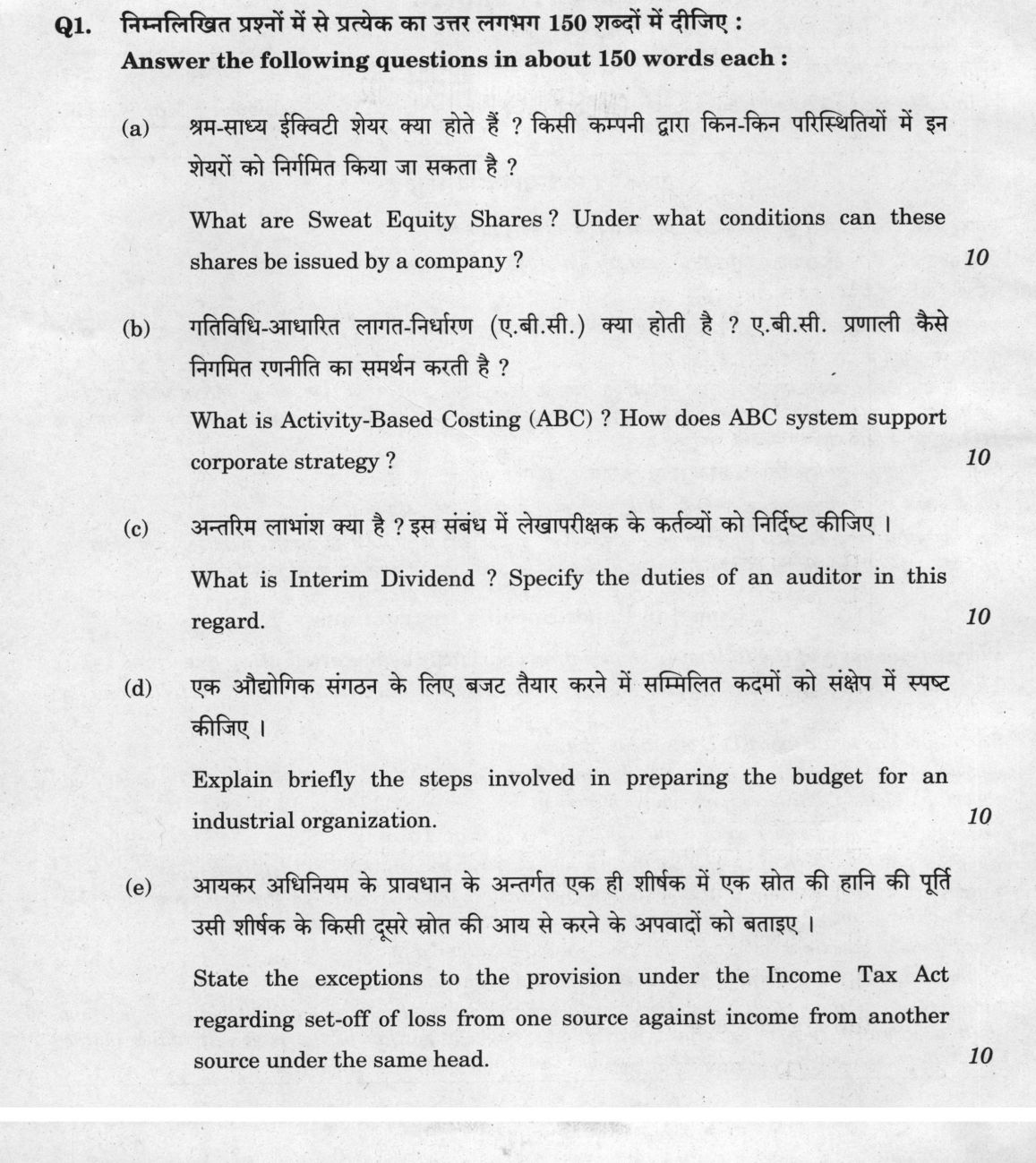
(a) What are Sweat Equity Shares ? Under what conditions can these shares be issued by a company ? (10 marks) (b) What is…
Answer the following questions in about 150 words each :
What are Sweat Equity Shares ? Under what conditions can these shares be issued by a company ? 10 marks
What is Activity-Based Costing (ABC) ? How does ABC system support corporate strategy ? 10 marks
What is Interim Dividend ? Specify the duties of an auditor in this regard. 10 marks
Explain briefly the steps involved in preparing the budget for an industrial organization. 10 marks
State the exceptions to the provision under the Income Tax Act regarding set-off of loss from one source against income from another source under the same head. 10 marks
हिंदी में प्रश्न पढ़ें
निम्नलिखित प्रश्नों में से प्रत्येक का उत्तर लगभग 150 शब्दों में दीजिए :
श्रम-साध्य इक्विटी शेयर क्या होते हैं ? किसी कंपनी द्वारा किन-किन परिस्थितियों में इन शेयरों को निर्गमित किया जा सकता है ? (10 अंक)
गतिविधि-आधारित लागत-निर्धारण (ए.बी.सी.) क्या होती है ? ए.बी.सी. प्रणाली कैसे निगमित रणनीति का समर्थन करती है ? (10 अंक)
अंतरिम लाभांश क्या है ? इस संबंध में लेखापरीक्षक के कर्तव्यों को निर्दिष्ट कीजिए । (10 अंक)
एक औद्योगिक संगठन के लिए बजट तैयार करने में सम्मिलित कदमों को संक्षेप में स्पष्ट कीजिए । (10 अंक)
आयकर अधिनियम के प्रावधान के अंतर्गत एक ही शीर्षक में एक स्रोत की हानि की पूर्ति उसी शीर्षक के किसी दूसरे स्रोत की आय से करने के अपवादों को बताइए । (10 अंक)
Model answer
Drafted with AI by UPSC Answer Check against this question's marking rubric, to the 150-word length. UPSC does not publish answers for Mains — this is one way to score well, not an official key. How we build rubrics and answers.
(a) Sweat Equity Shares
Sweat equity shares are equity shares issued to employees or directors for non-cash consideration such as intellectual property, know-how or expertise. Under section 54 of the Companies Act, 2013, they may be issued only to a class of shares already in issue, after a special resolution. An unlisted company must follow the Companies (Share Capital and Debentures) Rules, 2014; a listed company must follow the SEBI (Share Based Employee Benefits and Sweat Equity) Regulations, 2021. The special resolution must state the number of shares, their current market price, the consideration and the class of directors or employees. The shares are valued at a fair price by a registered valuer, who also values the intellectual property or know-how received. In a year the issue may not exceed 15 per cent of the existing paid-up equity capital or ₹5 crore, whichever is higher, and the total outstanding may not exceed 25 per cent of paid-up equity capital (50 per cent for a start-up for ten years from incorporation). The shares are locked in for three years from allotment. These conditions protect existing shareholders from dilution and ensure that equity is issued only for verifiable value.
(b) Activity-Based Costing
Activity-Based Costing (ABC) is a costing system that assigns overheads to products, services or customers through the activities that consume them, using cost drivers such as machine setups, inspections, orders or transactions. Traditional absorption costing spreads overheads on volume-based bases like labour hours, which can over-cost high-volume products and under-cost complex low-volume products. ABC first identifies activities, measures resource costs, and then allocates those costs to cost objects according to driver consumption. This gives a more accurate product and customer profitability picture. Strategically, ABC supports corporate strategy by revealing non-value-adding activities that can be eliminated or redesigned, guiding make-or-buy, outsourcing and process-improvement decisions, and enabling better pricing, product-mix and customer-segmentation choices. In an Indian manufacturing context, it helps firms distinguish between high-service customers and standard customers, so resources are directed toward profitable value creation rather than hidden overhead consumption.
(c) Interim Dividend
An interim dividend is a dividend declared by the Board between two annual general meetings. Under section 123(3) of the Companies Act, 2013, the Board may declare it from time to time, but the proviso provides that if the company has incurred a loss during the current financial year up to the end of the preceding quarter, the interim dividend cannot exceed the average rate declared in the immediately preceding three financial years. The auditor’s duties under SA 250 are to verify that the Board has validly passed the resolution, that the dividend is paid out of sufficient profits available after providing for depreciation, and that no impairment of capital is caused. The auditor must also check that the amount is within the limits permitted by the Articles and the Act, that the loss condition is not violated, and that the dividend is properly recorded. If the auditor finds non-compliance, he must report it, because an improper interim dividend may require recovery and may expose directors to liability.
(d) Budget Preparation
Budget preparation for an industrial organization is a sequential, causal process. It begins with the sales forecast, because expected sales determine the volume of output and the resources required. The production budget then translates sales into units to be produced, considering opening and closing stock. From this, the material, labour and overhead budgets estimate the inputs needed and their costs. These operating budgets feed into the cash budget, which shows expected receipts and payments and reveals financing needs. The budgeted financial statements, such as the budgeted profit and loss account and balance sheet, then consolidate the financial consequences. Finally, the master budget is coordinated, reviewed and approved by top management. This sequence ensures that every departmental plan is linked to the sales forecast, that resource constraints are visible, and that strategic objectives are translated into measurable financial targets.
(e) Exceptions to intra-head set-off
Section 70 of the Income-tax Act, 1961 allows a loss from one source to be set off against income from another source under the same head. The exceptions, where a loss can be absorbed only against income of the same kind, are:
- Speculation business (s. 73): a speculation loss can be set off only against speculation profit, though a non-speculation business loss may be set off against speculation income.
- Specified business under s. 35AD (s. 73A): a loss from such a business can be set off only against profits of another specified business.
- Long-term capital loss (s. 70(3)): it can be set off only against long-term capital gains, whereas a short-term capital loss can be set off against either.
- Owning and maintaining race horses (s. 74A): the loss can be set off only against income from that activity.
- Lotteries, crossword puzzles, card games, gambling and betting (ss. 58(4), 115BB): no loss or expense is allowed against such winnings, so no other loss can be set off against them.
- Virtual digital assets (s. 115BBH, from 1 April 2022): a loss on transfer of a VDA cannot be set off against any income, nor can any other loss be set off against VDA income.
- Exempt sources: a loss from a source whose income is exempt cannot be set off against taxable income.
From 1 April 2026 the Income-tax Act, 2025 replaces the 1961 Act, carrying these restrictions forward under renumbered provisions.
How this answer will be evaluated
Framework: null
What earns full marks: Precise definitions, correct statutory references, clear logical flow, and specific examples where relevant.
Evaluation rubric
Each sub-part is marked on its own, against the marks and word limit printed on the paper.
- (a) Definition of Sweat Equity Shares and conditions for their issue. 10 marks · 150 words
define— precise definition → the distinguishing feature → one example
Must cover
- Define Sweat Equity as shares issued for non-cash consideration
- Mention Section 54 of Companies Act, 2013
- State requirement of Special Resolution by shareholders
- Mention valuation by registered valuer
Loses marks
- Confusing with bonus shares
- Omitting the non-cash consideration aspect
Earns more
- Mentions the three-year lock-in
- Mentions the annual cap (15 % or ₹5 crore) and the 25 % overall cap (50 % for start-ups)
- Mentions that the special resolution must specify number, price, consideration and class of recipients
Extra mark
- Cites the SEBI (Share Based Employee Benefits and Sweat Equity) Regulations, 2021 for listed companies
- (b) Definition of ABC and its role in supporting corporate strategy. 10 marks · 150 words
explain— definition/context → points in order → small example → short close
Must cover
- Define ABC as costing based on activities
- Explain identification of cost drivers
- Link ABC to accurate product costing
- Mention support for pricing and product mix decisions
Loses marks
- Treating ABC as just a costing method without strategic link
- Confusing with standard costing
Earns more
- Mention identification of non-value-added activities
- Link to process improvement and efficiency
Extra mark
- Provide a specific example of activity-based cost driver
- (c) Definition of Interim Dividend and auditor's duties regarding it. 10 marks · 150 words
define— precise definition → the distinguishing feature → one example
Must cover
- Define Interim Dividend as paid before final accounts
- Mention Section 123 of Companies Act, 2013
- State auditor's duty to report on financial position
- Mention auditor's report on interim financials
Loses marks
- Confusing with final dividend
- Omitting auditor's specific reporting duty
Earns more
- Mention requirement of Board's recommendation
- Mentions deposit of the interim dividend in a separate bank account within five days (s. 123(4))
Extra mark
- Cite specific clause of Section 123
- (d) Steps involved in preparing the budget for an industrial organization. 10 marks · 150 words
describe— define → structure or process in order → labelled diagram → significance
Must cover
- Mention setting budgetary objectives
- Mention preparation of sales budget
- Mention preparation of production and cost budgets
- Mention preparation of cash budget
Loses marks
- Listing steps out of logical order
- Omitting sales budget as the starting point
Earns more
- Mention coordination and review process
- Mention final approval by top management
Extra mark
- Mention use of flexible budgeting
- (e) Exceptions to set-off of loss from one source against income from another source under same head. 10 marks · 150 words
enumerate— list the items in order → one line each → no commentary
Must cover
- Speculation loss only against speculation profit (s. 73)
- Loss of a s. 35AD specified business only against specified-business profit (s. 73A)
- Long-term capital loss only against long-term capital gains (s. 70(3))
- Race-horse loss only against race-horse income (s. 74A), and no set-off against lottery or betting winnings (s. 115BB)
Loses marks
- Confusing with set-off across different heads
- Treating house-property losses as an intra-head exception (house-property loss can be set off against other heads up to ₹2 lakh)
Earns more
- Mention Section 70 of Income Tax Act
- Mention carry forward of unabsorbed loss
Extra mark
- Mentions the VDA rule (s. 115BBH) and the Income-tax Act, 2025 from 1 April 2026
What "Explain" is asking you to do
Make the working of something clear — what sets it off, what follows from what, and what it produces. Explain is the Commission's mechanism word: it dominates the technical papers and the “explain why” stems, where the marks sit in the causal chain and not in the label.
Structure that answers it
State what it is → the initiating condition → the chain of cause, step by step → an instance where it plays out → what the chain produces
Where marks are lost
Describing what something looks like instead of why it works that way. Naming the stages without linking them reads as description too.
Practice this exact question
Write your answer and it is marked point by point against the model answer above — what you covered, what you missed, what you got wrong.
Evaluate my answer →More from Commerce & Accountancy 2022 Paper I
- Q1 Answer the following questions in about 150 words each : (a) What are Sweat Equity Shares…
- Q2 (a) Balance Sheets of A Ltd. and B Ltd. as on March 31, 2021 are as follows: | | A Ltd. (…
- Q3 (a) X, an employee of a firm, furnished the following particulars of his income for the y…
- Q4 (a) The following details have been extracted from the cost records of a company : Materi…