GS Paper I — Q16
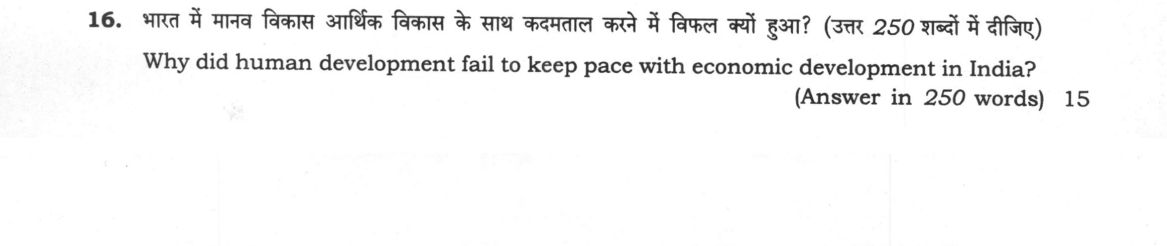
Why did human development fail to keep pace with economic development in India? (Answer in 250 words) 15
हिंदी में प्रश्न पढ़ें
भारत में मानव विकास आर्थिक विकास के साथ कदमताल करने में विफल क्यों हुआ? (उत्तर 250 शब्दों में दीजिए)
Model answer
Written by UPSC Answer Check against this question's marking rubric, to the 250-word length. UPSC does not publish answers for Mains — this is one way to score well, not an official key.
India presents a stark growth-development paradox: while emerging as the world’s fifth-largest economy, it ranks 134th on the UN Human Development Index (2022). This divergence stems from structural, institutional, and social bottlenecks.
Structural Economic Distortions: Post-1991 growth has been predominantly capital- and skill-intensive, centered in services rather than labor-absorptive manufacturing. This resulted in "jobless growth," leaving over 80% of the workforce trapped in the low-productivity informal sector without social security or adequate income growth to build human capabilities.
Fiscal and Policy Neglect: Macroeconomic policy prioritized aggregate output over social sector spending. Public health expenditure stagnated near 1.2% of GDP for decades, while education spending remained well below the 6% benchmark. This chronic underfunding shifted the burden of essential services onto households via crippling out-of-pocket expenses.
Spatial and Social Inequalities: Growth remained regionally skewed, producing sharp HDI divergences between advanced states like Kerala and lagging states like Bihar. Entrenched caste hierarchies, the rural-urban divide, and low female labor force participation further prevented the equitable diffusion of economic gains.
Institutional Weaknesses: Weak state capacity at the local level caused chronic implementation bottlenecks, resulting in leakages in safety nets like the Public Distribution System (PDS) and poor delivery of primary healthcare and schooling.
Persistent Demographic and Health Burdens: High disease burdens, legacy deficits in sanitation, and severe malnutrition—reflected in 35.5% child stunting (NFHS-5)—have permanently impaired cognitive and productive potential across generations.
To align human development with economic growth, India must transition to Amartya Sen's capability approach, anchoring public policy around universal healthcare, quality foundational education, and formal employment generation.
What "Explain" is asking you to do
Make the working of something clear — what sets it off, what follows from what, and what it produces. Explain is the Commission's mechanism word: it dominates the technical papers and the “explain why” stems, where the marks sit in the causal chain and not in the label.
Structure that answers it
State what it is → the initiating condition → the chain of cause, step by step → an instance where it plays out → what the chain produces
Where marks are lost
Describing what something looks like instead of why it works that way. Naming the stages without linking them reads as description too.
How this answer will be evaluated
Approach
Framework: GS1 Society: Continuity, Data, Intersectionality, Solution. explain: definition/context > points in order > small example > short close Full marks: Identifies structural causes (employment, inequality) and links them to specific policy failures with data.
Key points expected
- Link high growth to low employment elasticity
- Identify structural inequality (caste, gender, region)
- Critique public spending on health and education
- Mention the 'growth without development' paradox
Evaluation rubric
Each sub-part is marked on its own, against the marks and word limit printed on the paper.
- The answer Analytical explanation of the structural and policy reasons for the divergence between GDP growth and human development indices. 15 marks · 250 words
explain— definition/context → points in order → small example → short close
Must cover
- Link high growth to low employment elasticity
- Identify structural inequality (caste, gender, region)
- Critique public spending on health and education
- Mention the 'growth without development' paradox
Loses marks
- Narrating economic history without social analysis
- Using emotive language instead of structural critique
- Focusing only on GDP figures without social context
Earns more
- Reference to Human Development Index (HDI) trends
- Discussion of the informal sector's role
- Mention of regional disparities (e.g., North vs South)
- Reference to the 'missing middle' in the economy
Extra mark
- Citing specific data from the Human Development Report
- Reference to the 'Gini coefficient' for inequality
Practice this exact question
Write your answer and it is marked point by point against the model answer above — what you covered, what you missed, what you got wrong.
Evaluate my answer →More from General Studies 2023 GS Paper I
- Q13 How did the colonial rule affect the tribals in India and what was the tribal response to…
- Q14 Comment on the resource potentials of the long coastline of India and highlight the statu…
- Q15 Identify and discuss the factors responsible for diversity of natural vegetation in India…
- Q16 Why did human development fail to keep pace with economic development in India? (Answer i…
- Q17 From being net food importer in 1960s, India has emerged as a net food exporter to the wo…
- Q18 Does urbanization lead to more segregation and/or marginalization of the poor in Indian m…
- Q19 Why is caste identity in India both fluid and static? (Answer in 250 words) 15