GS Paper I — Q20
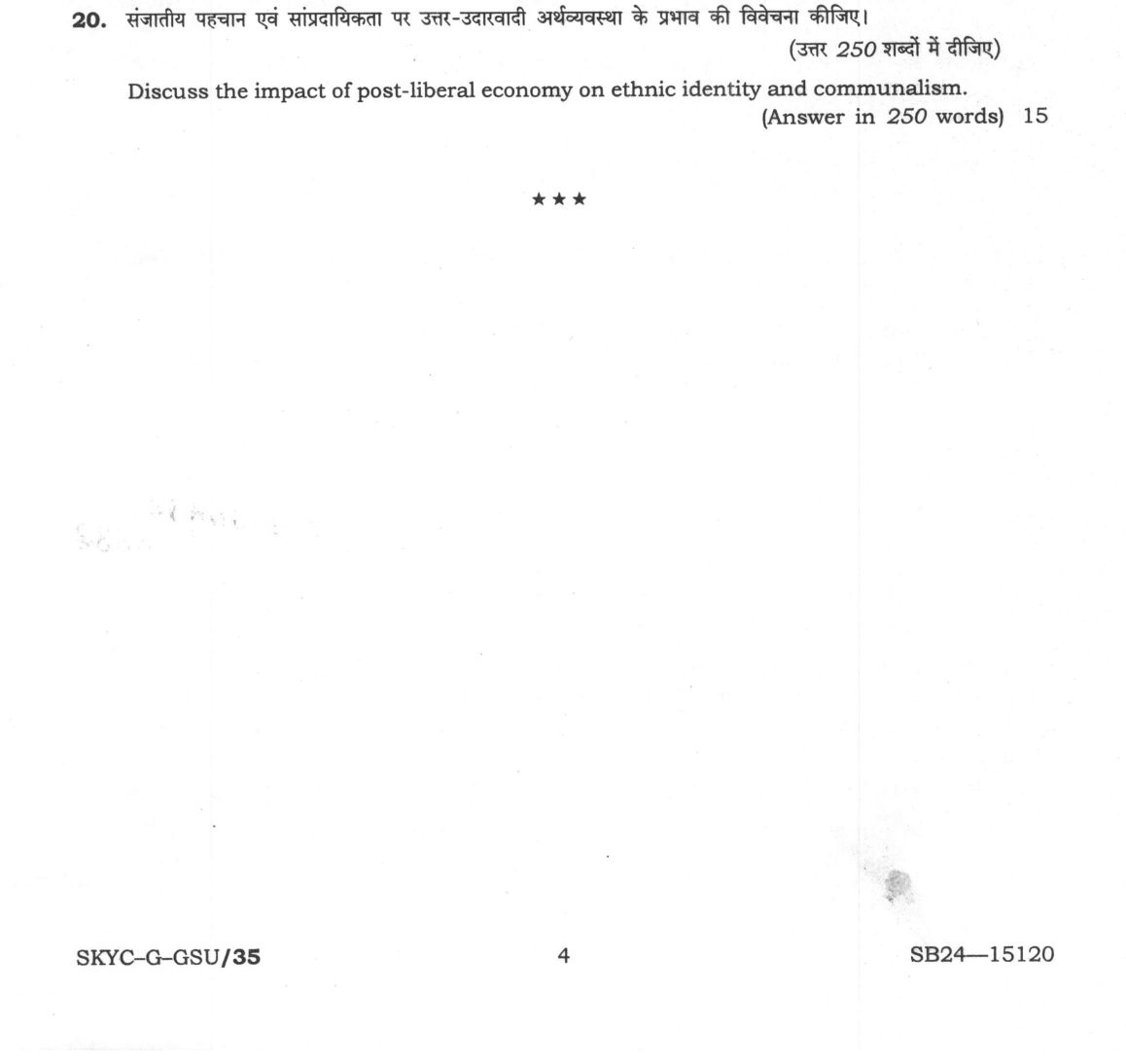
Discuss the impact of post-liberal economy on ethnic identity and communalism. (Answer in 250 words) 15
हिंदी में प्रश्न पढ़ें
संजातीय पहचान एवं सांप्रदायिकता पर उत्तर-उदारवादी अर्थव्यवस्था के प्रभाव की विवेचना कीजिए। (उत्तर 250 शब्दों में दीजिए)
Model answer
Written by UPSC Answer Check against this question's marking rubric, to the 250-word length. UPSC does not publish answers for Mains — this is one way to score well, not an official key.
The 1991 economic liberalization accelerated India’s integration into global markets, simultaneously reshaping the contours of ethnic identity and communal relations through uneven growth, resource competition, and spatial reorganization.
Resource Competition and Regional Mobilization Liberalization intensified market-driven resource extraction, triggering ethnic mobilization in resource-rich tribal belts like Jharkhand and Chhattisgarh against displacement and environmental degradation in industrial corridors. Simultaneously, widening inter-state disparities ethnicized economic aspirations, consolidating regional sub-nationalism through parties like the DMK and AIADMK in Tamil Nadu, TMC in West Bengal, and BJD in Odisha, which framed federal fiscal autonomy as central to regional identity.
Economically-Driven Communalism Post-reform communalism increasingly shifted from traditional religious friction toward economic "othering." Urban competition and market anxieties underwrote communal flashpoints like the 2002 Gujarat riots. Similarly, disputes over cattle trade and beef bans directly weaponized identity against traditional minority livelihoods in the dairy and leather sectors. Furthermore, the Sachar Committee (2006) highlighted the structural economic marginalization of Muslims in the post-liberalization era, fueling defensive political mobilization.
Urbanization, Migration, and Globalization Unregulated market-led urbanization created demographic pressures and ethnic enclaves, triggering nativist backlash against migrants, such as Shiv Sena’s mobilization in Mumbai and political targeting of Bihari labor in Delhi. Globalization also produced a dual cultural effect: diaspora wealth and digital networks bolstered transnational identity politics, including Khalistan and Dravidian assertions, even as a burgeoning cosmopolitan corporate culture diluted traditional caste and ethnic markers among the urban middle class.
Moving forward, preventing economic liberalization from hardening ethnic and communal fault lines requires decentralized industrialization, equitable federal resource sharing, and inclusive social security safety nets to align market growth with constitutional secularism.
What "Discuss" is asking you to do
Lay the issue out from more than one side — how it arose, what is claimed for it, what is held against it, and where it now stands. UPSC attaches discuss to broad topics with several live dimensions, so coverage of the dimensions earns more than the strength of your opinion.
Structure that answers it
Set the issue up → the case as it is made → the case against → the dimension both sides leave out → where the balance now lies
Where marks are lost
Listing facts with no thread between them, or arguing one side throughout and calling it a discussion.
How this answer will be evaluated
Approach
Framework: GS1 Society: Continuity, Data, Intersectionality, Solution. discuss: intro > 3-4 dimensions > example > balanced close Full marks: Deep analysis of economic-identity nexus with specific examples and balanced view.
Key points expected
- Define post-liberal economy (neoliberalism/globalization) context
- Explain economic marginalization as a driver of identity
- Link market forces to communalism (e.g., caste/religion)
- Provide a specific Indian example (e.g., 1992-93 riots)
Evaluation rubric
Each sub-part is marked on its own, against the marks and word limit printed on the paper.
- The answer Analyze the causal link between post-liberal economic shifts and the rise of ethnic/communal identities. 15 marks · 250 words
discuss— intro → 3-4 dimensions → example → balanced close
Must cover
- Define post-liberal economy (neoliberalism/globalization) context
- Explain economic marginalization as a driver of identity
- Link market forces to communalism (e.g., caste/religion)
- Provide a specific Indian example (e.g., 1992-93 riots)
Loses marks
- Narrating history without economic analysis
- Using emotive language instead of objective terms
- Ignoring the 'post-liberal' economic context
Earns more
- Mention 'identity politics' as a political response
- Discuss the role of media in amplifying identity
- Reference specific economic policies (e.g., LPG reforms)
- Balanced view on economic benefits vs social costs
Extra mark
- Cite a specific statistic on unemployment/inequality
- Name a specific scholar (e.g., Partha Chatterjee)
Practice this exact question
Write your answer and it is marked point by point against the model answer above — what you covered, what you missed, what you got wrong.
Evaluate my answer →More from General Studies 2023 GS Paper I
- Q17 From being net food importer in 1960s, India has emerged as a net food exporter to the wo…
- Q18 Does urbanization lead to more segregation and/or marginalization of the poor in Indian m…
- Q19 Why is caste identity in India both fluid and static? (Answer in 250 words) 15
- Q20 Discuss the impact of post-liberal economy on ethnic identity and communalism. (Answer in…