GS Paper I — Q8
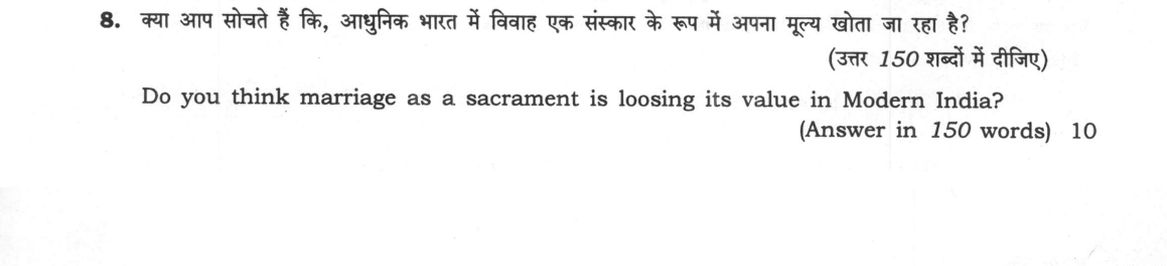
Do you think marriage as a sacrament is loosing its value in Modern India? (Answer in 150 words) 10
हिंदी में प्रश्न पढ़ें
क्या आप सोचते हैं कि, आधुनिक भारत में विवाह एक संस्कार के रूप में अपना मूल्य खोता जा रहा है? (उत्तर 150 शब्दों में दीजिए)
Model answer
Written by UPSC Answer Check against this question's marking rubric, to the 150-word length. UPSC does not publish answers for Mains — this is one way to score well, not an official key.
Traditionally, marriage in Indian ethos is regarded as a sacrament (samskara) consecrated through rituals like saptapadi, signifying an indissoluble, divine union rather than a dissoluble civil contract. In modern India, this sacramental character is undergoing significant shifts.
Erosion of Sacramental Rigidity: Legal reforms, including the Hindu Marriage Act 1955 (introducing divorce provisions), the Special Marriage Act 1954, and judicial recognition of live-in relationships, have infused contractual elements into marriage. Societal transformations—such as women’s increasing economic independence, delayed marriages, rising divorce rates, and inter-caste or inter-faith unions—have prioritized individual autonomy over sacramental fatalism.
Enduring Sanctity: However, the sacramental foundation remains resilient. Over 90% of Indian marriages remain arranged, traditional religious ceremonies continue across classes, and the judiciary repeatedly reinforces marital sanctity, as observed in the Sarla Mudgal (1995) judgment prohibiting the circumvention of monogamy.
Thus, marriage is not losing its sacramental value, but undergoing institutional adaptation—evolving from a rigid patriarchal bond into an egalitarian union balancing sacred tradition with individual rights.
What "Analyse" is asking you to do
Break the subject into its working parts and show how they act on each other. The marks are in the interconnections — which factor drives which, and what the resulting structure explains — not in the inventory of factors.
Structure that answers it
Define the whole → separate it into its parts → show which part drives which → what that interaction produces → what the structure implies
Where marks are lost
A flat list of causes with no account of which drives which. An answer of neatly separated headings, each self-contained, scores as description.
How this answer will be evaluated
Approach
Framework: GS1 Society: Continuity, Data, Intersectionality, Solution. comment: context > arguments both sides > judgment > close Full marks: Balanced judgment with specific legal/social drivers and continuity acknowledged.
Key points expected
- Define marriage as a sacrament (sanskara) vs. a social contract.
- Identify drivers of change: urbanization, individualism, and legal reforms.
- Acknowledge continuity: persistence of rituals and family pressure.
- Provide a balanced judgment on the 'loss of value' claim.
Evaluation rubric
Each sub-part is marked on its own, against the marks and word limit printed on the paper.
- The answer Contextualize the shift in marriage values and provide a balanced judgment on its status in modern India. 10 marks · 150 words
comment— context → arguments both sides → judgment → close
Must cover
- Define marriage as a sacrament (sanskara) vs. a social contract.
- Identify drivers of change: urbanization, individualism, and legal reforms.
- Acknowledge continuity: persistence of rituals and family pressure.
- Provide a balanced judgment on the 'loss of value' claim.
Loses marks
- Emotive or moralistic language without sociological analysis.
- Narrating a chronological history of marriage.
- Ignoring the 'sacrament' aspect and treating it purely as a contract.
Earns more
- Mention specific legal changes (e.g., Special Marriage Act, divorce laws).
- Reference changing social bases (nuclear families, career focus).
- Discuss the intersection of tradition and modernity.
- Use the term 'sanskara' to show cultural depth.
Extra mark
- Cite a specific statistic on divorce rates or inter-caste marriages.
- Reference a specific Supreme Court judgment on marriage rights.
Practice this exact question
Write your answer and it is marked point by point against the model answer above — what you covered, what you missed, what you got wrong.
Evaluate my answer →More from General Studies 2023 GS Paper I
- Q5 Why is the world today confronted with a crisis of availability of and access to freshwat…
- Q6 How are the fjords formed? Why do they constitute some of the most picturesque areas of t…
- Q7 Why is the South-West Monsoon called 'Purvaiya' (easterly) in Bhojpur Region? How has thi…
- Q8 Do you think marriage as a sacrament is loosing its value in Modern India? (Answer in 150…
- Q9 Explain why suicide among young women is increasing in Indian society. (Answer in 150 wor…
- Q10 Child cuddling is now being replaced by mobile phones. Discuss its impact on the socializ…
- Q11 What are the main features of Vedic society and religion? Do you think some of the featur…