GS Paper I — Q17
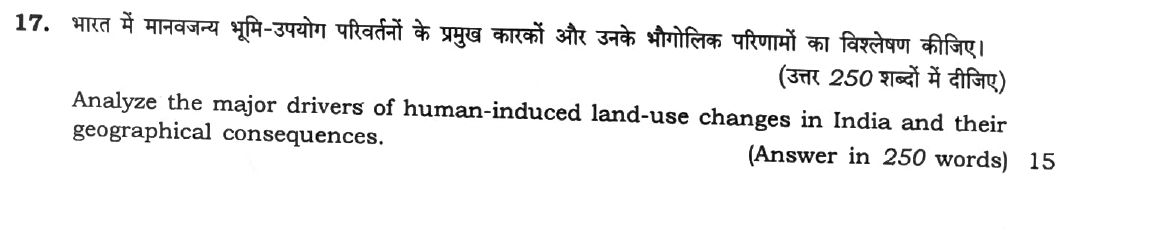
Analyze the major drivers of human-induced land-use changes in India and their geographical consequences. (Answer in 250 words) 15
हिंदी में प्रश्न पढ़ें
भारत में मानवजन्य भूमि-उपयोग परिवर्तनों के प्रमुख कारकों और उनके भौगोलिक परिणामों का विश्लेषण कीजिए। (उत्तर 250 शब्दों में दीजिए)
Model answer
Written by UPSC Answer Check against this question's marking rubric, to the 250-word length. UPSC does not publish answers for Mains — this is one way to score well, not an official key.
Anthropogenic land-use and land-cover change (LULCC) in India reflects competing socio-economic demands, transforming natural ecosystems into heavily modified landscapes with distinct geographical and ecological consequences.
Agricultural Intensification and Expansion The shift toward water-intensive monocultures, notably the paddy-wheat cycle in Punjab, has disrupted local hydrology through severe groundwater depletion and soil degradation. Concurrently, the expansion of commercial agriculture and horticulture into forest-fringe areas has caused habitat fragmentation, edge effects, and altered soil nutrient dynamics.
Urbanization and Peri-Urban Sprawl Unplanned urban expansion has driven widespread wetland conversion and encroachment on natural floodplains. The destruction of interconnected lake systems in Bengaluru and the reclamation of the East Kolkata Wetlands have impaired natural drainage, reduced groundwater recharge, and intensified urban flood frequency. Furthermore, the substitution of vegetative cover with concrete creates pronounced Urban Heat Islands (UHIs).
Mining and Infrastructure Development Extensive forest land diversion for open-cast coal mining across the central Indian tribal belt, particularly in Jharkhand and Chhattisgarh, has led to accelerated soil erosion, landscape scarring, and critical biodiversity and habitat loss. Additionally, linear infrastructure projects, including highways and large dams in fragile terrains, induce slope instability and sever wildlife corridors.
Coastal Landscape Modifications Commercial aquaculture expansion and coastal development have caused severe mangrove deforestation, notably in the Sundarbans. The removal of these natural bio-shields exacerbates coastal erosion and significantly heightens vulnerability to tropical cyclones, tidal storm surges, and saline ingress into inland aquifers.
Way Forward Addressing these spatial imbalances requires operationalizing an integrated National Land Use Policy, mandating agro-ecological zoning, enforcing spatial carrying-capacity limits, and adopting landscape-level restoration to harmonize developmental needs with ecological resilience.
What "Analyse" is asking you to do
Break the subject into its working parts and show how they act on each other. The marks are in the interconnections — which factor drives which, and what the resulting structure explains — not in the inventory of factors.
Structure that answers it
Define the whole → separate it into its parts → show which part drives which → what that interaction produces → what the structure implies
Where marks are lost
A flat list of causes with no account of which drives which. An answer of neatly separated headings, each self-contained, scores as description.
How this answer will be evaluated
Approach
Framework: GS1 Geography: Human-Environment Interaction. analyse: intro > causes > effects > stakeholders/linkages > way forward Full marks: Analyzes drivers with specific mechanisms and links them to distinct geographical consequences.
Key points expected
- Identify drivers: urbanization, industrialization, agriculture, infrastructure.
- Explain the mechanism of change (e.g., conversion of forest to urban).
- Detail geographical consequences: hydrological, ecological, or climatic.
- Link specific drivers to specific regional consequences.
Evaluation rubric
Each sub-part is marked on its own, against the marks and word limit printed on the paper.
- The answer Explain the causal mechanisms of land-use change and their spatial impacts. 15 marks · 250 words
analyse— intro → causes → effects → stakeholders/linkages → way forward
Must cover
- Identify drivers: urbanization, industrialization, agriculture, infrastructure.
- Explain the mechanism of change (e.g., conversion of forest to urban).
- Detail geographical consequences: hydrological, ecological, or climatic.
- Link specific drivers to specific regional consequences.
Loses marks
- Listing drivers without explaining the mechanism of change.
- Narrating chronology of land use without causal analysis.
- Ignoring the 'geographical' aspect of the consequences.
Earns more
- Mention specific schemes (e.g., Green Revolution, Smart Cities).
- Reference specific regions (e.g., Deccan, Ganga Plain).
- Discuss the impact on biodiversity or water table.
Extra mark
- 30-second sketch map showing a specific land-use shift.
- One robust statistic on forest cover or urban expansion.
Practice this exact question
Write your answer and it is marked point by point against the model answer above — what you covered, what you missed, what you got wrong.
Evaluate my answer →More from General Studies 2026 GS Paper I
- Q14 Compare the Loo, Chinook and Foehn winds with respect to their regions of prevalence, the…
- Q15 Analyze the role of satellite-based technologies in achieving climate-smart agriculture a…
- Q16 "The centre of global trade is gradually shifting from the Atlantic region to the Indo-Pa…
- Q17 Analyze the major drivers of human-induced land-use changes in India and their geographic…
- Q18 Is caste disappearing in urban India? Illustrate your answer with examples. (Answer in 25…
- Q19 Critically examine the challenges of demographic transition in contemporary India. (Answe…
- Q20 Evaluate the impact of globalization on Indian youths with reference to social, political…