GS Paper I — Q14
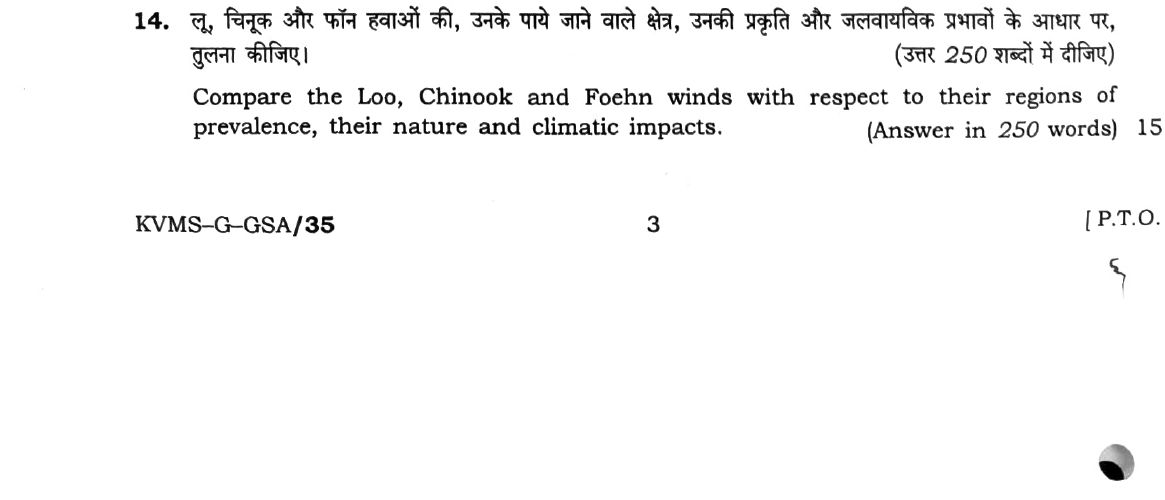
Compare the Loo, Chinook and Foehn winds with respect to their regions of prevalence, their nature and climatic impacts. (Answer…
Compare the Loo, Chinook and Foehn winds with respect to their regions of prevalence, their nature and climatic impacts. (Answer in 250 words) 15 marks
हिंदी में प्रश्न पढ़ें
लू, चिनूक और फॉन हवाओं की, उनके पाये जाने वाले क्षेत्र, उनकी प्रकृति और जलवायविक प्रभावों के आधार पर, तुलना कीजिए। (उत्तर 250 शब्दों में दीजिए)
Model answer
Written by UPSC Answer Check against this question's marking rubric, to the 250-word length. UPSC does not publish answers for Mains — this is one way to score well, not an official key.
Local winds significantly modulate microclimates, ecology, and human settlements. While the Loo, Chinook, and Foehn are all warm, dry winds, they exhibit vital contrasts in their geography, physical genesis, and bioclimatic impacts.
Regional Prevalence and Seasonality The Loo is confined to the Indo-Gangetic plains of northern India (from Punjab to Bihar) and is strictly a summer phenomenon occurring between April and June. In contrast, the Chinook operates along the eastern leeward slopes of the Rocky Mountains in North America, while the Foehn blows down the northern leeward valleys of the European Alps. Both mountain winds occur primarily in winter and spring, or whenever synoptic pressure conditions induce cross-mountain airflow.
Nature and Atmospheric Mechanism Chinook and Foehn are orographic katabatic winds. Moist air sheds precipitation on the windward slope and descends the leeward side, warming rapidly through dry adiabatic compression. Conversely, the Loo is a non-orographic, advective thermal wind generated by intense continental insolation over the Thar Desert and western plains, blowing as a gusty, dry, and dust-laden westerly airstream.
Climatic and Socio-Economic Impacts Chinook, known as the "snow eater", and Foehn rapidly raise local temperatures by 10°C to 20°C within hours. This triggers rapid snowmelt that aids winter livestock grazing in the Prairies and early grape ripening in Alpine valleys, though it elevates avalanche risks. In contrast, the Loo brings severe heatwave conditions, causing agricultural desiccation and acute public health emergencies through fatal heatstrokes.
Thus, whereas Chinook and Foehn act as topographically driven thermal moderators with distinct agro-climatic benefits, the Loo functions as an unmitigated extreme heat hazard.
What "Compare" is asking you to do
Set the items against each other on named dimensions. In UPSC practice compare already carries both halves — likeness and difference — and where the stem names the dimensions, as in region, nature and climatic impact, those are the headings the examiner expects to see.
Structure that answers it
Dimensions named → both items on dimension 1 → dimension 2 → dimension 3 → where they converge and where they part
Where marks are lost
Two self-contained descriptive blocks with the comparison left for the reader to make. Marks here sit on the dimensions, so an answer that names none of them gives the examiner nothing to award.
How this answer will be evaluated
Approach
Framework: GS1 Geography: Physical Geography (Winds & Climate). compare: paired headings or table > key differences > significance > conclusion Full marks: Clear table/structure; precise regions; mechanism explained; distinct impacts.
Key points expected
- Identify specific regions of prevalence for each wind
- Explain the mechanism of adiabatic heating (nature)
- Detail distinct climatic impacts (e.g., heatstroke vs. snowmelt)
- Structure answer using paired headings or a comparison table
Evaluation rubric
Each sub-part is marked on its own, against the marks and word limit printed on the paper.
- The answer Differentiate Loo, Chinook, and Foehn winds across three specific parameters. 15 marks · 250 words
compare— paired headings or table → key differences → significance → conclusion
Must cover
- Identify specific regions of prevalence for each wind
- Explain the mechanism of adiabatic heating (nature)
- Detail distinct climatic impacts (e.g., heatstroke vs. snowmelt)
- Structure answer using paired headings or a comparison table
Loses marks
- Narrating chronology instead of comparing features
- Confusing the nature of Loo with Foehn/Chinook
- Listing regions without explaining the 'why' of the mechanism
Earns more
- Mention specific local names (e.g., 'Loo' in Punjab)
- Reference specific climatic outcomes (e.g., 'Haboob' dust storms)
- Distinguish between seasonal (Loo) and orographic (Chinook/Foehn) triggers
Extra mark
- 30-second sketch map locating the three wind systems
- One robust statistic on temperature rise or snowmelt rate
Practice this exact question
Write your answer and it is marked point by point against the model answer above — what you covered, what you missed, what you got wrong.
Evaluate my answer →More from General Studies 2026 GS Paper I
- Q11 Vijayanagara architecture exemplifies the amalgamation of past traditions with contempora…
- Q12 Linguistic reorganization of Indian States was driven by popular pressure from below. Com…
- Q13 The model of planned economy was adopted in India to address the regional imbalances left…
- Q14 Compare the Loo, Chinook and Foehn winds with respect to their regions of prevalence, the…
- Q15 Analyze the role of satellite-based technologies in achieving climate-smart agriculture a…
- Q16 "The centre of global trade is gradually shifting from the Atlantic region to the Indo-Pa…
- Q17 Analyze the major drivers of human-induced land-use changes in India and their geographic…