GS Paper II — Q20
"China's Belt and Road Initiative (BRI) has transformed South Asia from a regional space into a theatre of great power…
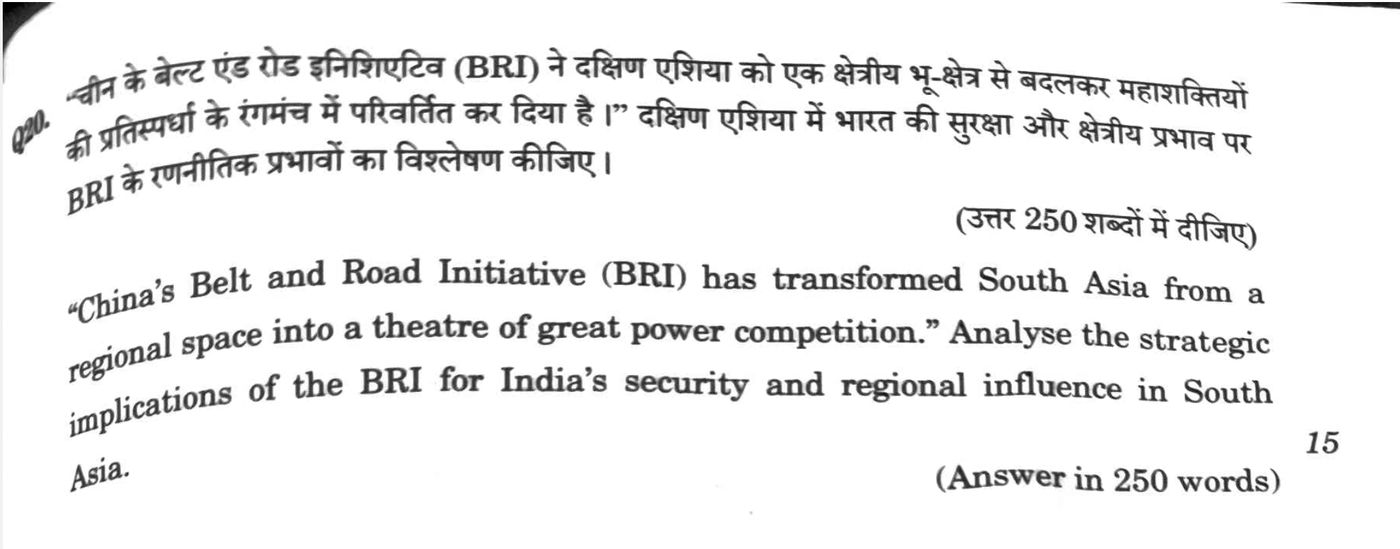
"China's Belt and Road Initiative (BRI) has transformed South Asia from a regional space into a theatre of great power competition." Analyse the strategic implications of the BRI for India's security and regional influence in South Asia. (Answer in 250 words) 15 marks
हिंदी में प्रश्न पढ़ें
“चीन के बेल्ट एंड रोड इनिशिएटिव (BRI) ने दक्षिण एशिया को एक क्षेत्रीय भू-क्षेत्र से बदलकर महाशक्तियों की प्रतिस्पर्धा के रंगमंच में परिवर्तित कर दिया है।” दक्षिण एशिया में भारत की सुरक्षा और क्षेत्रीय प्रभाव पर BRI के रणनीतिक प्रभावों का विश्लेषण कीजिए। (उत्तर 250 शब्दों में दीजिए)
Model answer
Written by UPSC Answer Check against this question's marking rubric, to the 250-word length. UPSC does not publish answers for Mains — this is one way to score well, not an official key.
China’s Belt and Road Initiative (BRI) has fundamentally altered South Asia's balance of power, transforming India’s immediate neighbourhood into an arena of great-power contestation.
Sovereignty and Security Implications The China-Pakistan Economic Corridor (CPEC), the flagship component of the BRI, traverses Pakistan-occupied Kashmir. This direct violation of India’s territorial integrity forms New Delhi's core sovereignty objection, prompting its boycott of the Belt and Road Forum since its inaugural edition in 2017. Furthermore, the strategic footprint of the BRI manifests concerns over 'debt-trap diplomacy', demonstrated by Sri Lanka granting a 99-year lease of Hambantota Port to a Chinese state-owned firm in 2017 following unsustainable debt distress, creating dual-use naval risks in India's maritime backyard.
Erosion of Regional Influence BRI-funded infrastructure projects across Nepal, Bangladesh, and the Maldives have expanded Beijing’s economic and political leverage. This commercial entrenchment complicates India’s traditional primacy by offering regional states capital alternatives that allow them to strategically hedge between New Delhi and Beijing.
India’s Strategic and Connectivity Counter-Measures To offset Chinese encirclement, India has reinforced its Neighbourhood First policy and SAGAR (Security and Growth for All in the Region) framework, prioritising demand-driven connectivity, local capacity-building, and first-responder disaster-relief diplomacy. On the trans-regional front, India promotes viable connectivity alternatives, including the International North-South Transport Corridor (INSTC) and the India-Middle East-Europe Economic Corridor (IMEC), launched at the 2023 G20 Summit.
To secure its strategic space, India must integrate these regional mechanisms with multilateral frameworks like the Quad and the Indo-Pacific Oceans Initiative (IPOI), ensuring timely project execution and offering debt-sustainable developmental alternatives across South Asia.
What "Analyse" is asking you to do
Break the subject into its working parts and show how they act on each other. The marks are in the interconnections — which factor drives which, and what the resulting structure explains — not in the inventory of factors.
Structure that answers it
Define the whole → separate it into its parts → show which part drives which → what that interaction produces → what the structure implies
Where marks are lost
A flat list of causes with no account of which drives which. An answer of neatly separated headings, each self-contained, scores as description.
How this answer will be evaluated
Approach
Framework: GS2 International Relations. analyse: intro > causes > effects > stakeholders/linkages > way forward Full marks: Critical analysis of security threats (CPEC) and influence loss with specific counter-strategies.
Key points expected
- Threat to sovereignty via CPEC in PoK
- Strategic encirclement through 'String of Pearls'
- Erosion of regional influence via debt-trap diplomacy
- Way forward: India's counter-initiatives (MILAN, MCI)
Evaluation rubric
Each sub-part is marked on its own, against the marks and word limit printed on the paper.
- The answer Strategic implications of BRI for India's security and regional influence. 15 marks · 250 words
analyse— intro → causes → effects → stakeholders/linkages → way forward
Must cover
- Threat to sovereignty via CPEC in PoK
- Strategic encirclement through 'String of Pearls'
- Erosion of regional influence via debt-trap diplomacy
- Way forward: India's counter-initiatives (MILAN, MCI)
Loses marks
- Reciting BRI facts without strategic analysis
- Ignoring the security dimension (CPEC)
- Failing to link BRI to regional influence
Earns more
- Mention of Chabahar Port as a counter-strategy
- Reference to India's 'Neighbourhood First' policy
- Analysis of 'debt-trap' in Sri Lanka (Hambantota)
- Mention of India's 'Act East' policy
Extra mark
- Reference to 'Necklace of Pearls' concept
- Mention of India's 'Neighbourhood First' policy
Practice this exact question
Write your answer and it is marked point by point against the model answer above — what you covered, what you missed, what you got wrong.
Evaluate my answer →More from General Studies 2026 GS Paper II
- Q17 Can the constitutional mandate of rights-based welfare be effectively realised in the con…
- Q18 Should education be treated primarily as a welfare obligation of the state or as a strate…
- Q19 "India's global diaspora acts as a living bridge, as a critical economic factor and knowl…
- Q20 "China's Belt and Road Initiative (BRI) has transformed South Asia from a regional space…