GS Paper II — Q18
Should education be treated primarily as a welfare obligation of the state or as a strategic investment for building a globally…
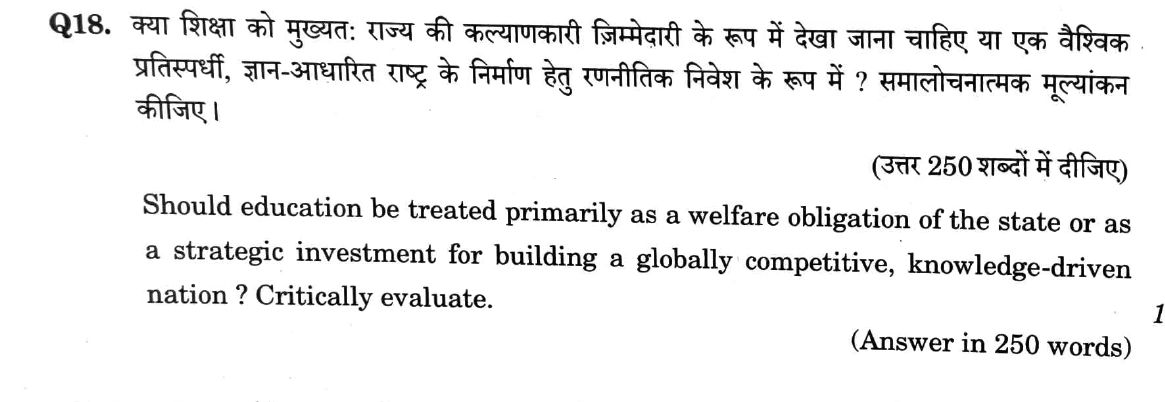
Should education be treated primarily as a welfare obligation of the state or as a strategic investment for building a globally competitive, knowledge-driven nation? Critically evaluate. (Answer in 250 words) 15 marks
हिंदी में प्रश्न पढ़ें
क्या शिक्षा को मुख्यत: राज्य की कल्याणकारी ज़िम्मेदारी के रूप में देखा जाना चाहिए या एक वैश्विक प्रतिस्पर्धी, ज्ञान-आधारित राष्ट्र के निर्माण हेतु रणनीतिक निवेश के रूप में? समालोचनात्मक मूल्यांकन कीजिए। (उत्तर 250 शब्दों में दीजिए)
Model answer
Written by UPSC Answer Check against this question's marking rubric, to the 250-word length. UPSC does not publish answers for Mains — this is one way to score well, not an official key.
Education cannot be reduced to either charity or mere capital formation. Article 21A and the Right of Children to Free and Compulsory Education Act, 2009 make elementary education a justiciable fundamental right, fixing a minimum welfare obligation on the state. Yet the fiscal history shows how weakly that obligation has been resourced: the Kothari Commission (1964-66) recommended raising public expenditure on education to 6 per cent of national income, a target still largely unmet.
The strategic-investment case is equally strong. Human capital theory, associated with Gary Becker, treats education as productivity-enhancing investment, while demographic-dividend arguments stress that converting a young population into skilled workers is essential for global competitiveness. NEP 2020 blends the two: it does not create a new legal entitlement, but it sets policy targets for universal foundational literacy and numeracy, anchored in the existing Article 21A/RTE floor, and pushes vocational/skilling integration from Grade 6 to build economic capability.
A purely instrumental view is incomplete. Amartya Sen’s capability approach values education for expanding freedoms and human development, not only for output. In practice, India is already pairing the welfare floor with investment logic: Skill India Mission and industry-linked apprenticeship schemes operationalise competitiveness alongside RTE’s guaranteed elementary education.
Thus, the dichotomy is false. Education must remain a constitutional welfare obligation, but it should be financed and designed as a strategic investment, because rights-based access and knowledge-driven growth reinforce each other.
What "Critically evaluate" is asking you to do
Judge how well something has performed against the standard it set for itself — its stated aim, mandate or promise — and commit to a verdict. Name the yardstick before you judge; an unanchored judgement reads as opinion. “Critically” is not a section added at the end: name the yardstick you are judging by — the evidence, the stated objective, a constitutional principle, a rival explanation — and let a verdict close each part of the body. Where the question quotes a claim, that verdict must land on the claim itself, accepted, qualified or rejected, and not on the theme in general.
Structure that answers it
Name the yardstick — stated aim, mandate or benchmark → performance against it → shortfall against it → why the gap exists → verdict
Where marks are lost
Merits in one paragraph, demerits in the next, and a conclusion calling for a balanced and holistic approach. That is a survey with the judgement left out and it holds the answer in the middle band. The opposite error is reading “critically” as permission to attack — and with the odd pairings, critically describe or critically explain, the exposition still carries most of the marks, the judgement being a layer on it rather than a substitute for it.
How this answer will be evaluated
Approach
Framework: GS2 Governance & Policy Analysis. critically evaluate: positives > negatives/limits > conditions/safeguards > conclusion Full marks: Balanced, critical analysis with constitutional and policy references.
Key points expected
- Arguments for education as a state welfare obligation
- Arguments for education as a strategic economic investment
- Critical analysis of the limitations of both views
- Balanced conclusion or synthesis of the two perspectives
Evaluation rubric
Each sub-part is marked on its own, against the marks and word limit printed on the paper.
- The answer Assess the dual nature of education as welfare vs. strategic investment with a balanced judgment. 15 marks · 250 words
critically evaluate— positives → negatives/limits → conditions/safeguards → conclusion
Must cover
- Arguments for education as a state welfare obligation
- Arguments for education as a strategic economic investment
- Critical analysis of the limitations of both views
- Balanced conclusion or synthesis of the two perspectives
Loses marks
- Reciting articles without applying them to the context
- Taking an extreme activist tone without balance
- Ending without a clear reform or judgment
Earns more
- Reference to Article 41 or 45 of the Constitution
- Mention of NEP 2020 or specific government schemes
- Use of data on education expenditure or outcomes
- Discussion of the 'knowledge economy' or global competitiveness
Extra mark
- Citation of a specific Supreme Court judgment on education
- Reference to 2nd ARC or Law Commission recommendations
Practice this exact question
Write your answer and it is marked point by point against the model answer above — what you covered, what you missed, what you got wrong.
Evaluate my answer →More from General Studies 2026 GS Paper II
- Q15 To what extent do pressure groups, social movements and corporate lobbies deepen pluralis…
- Q16 "Transparency and accountability in governance are not about controlling corruption but a…
- Q17 Can the constitutional mandate of rights-based welfare be effectively realised in the con…
- Q18 Should education be treated primarily as a welfare obligation of the state or as a strate…
- Q19 "India's global diaspora acts as a living bridge, as a critical economic factor and knowl…
- Q20 "China's Belt and Road Initiative (BRI) has transformed South Asia from a regional space…