GS Paper II — Q15
To what extent do pressure groups, social movements and corporate lobbies deepen pluralistic democracy in India by representing…
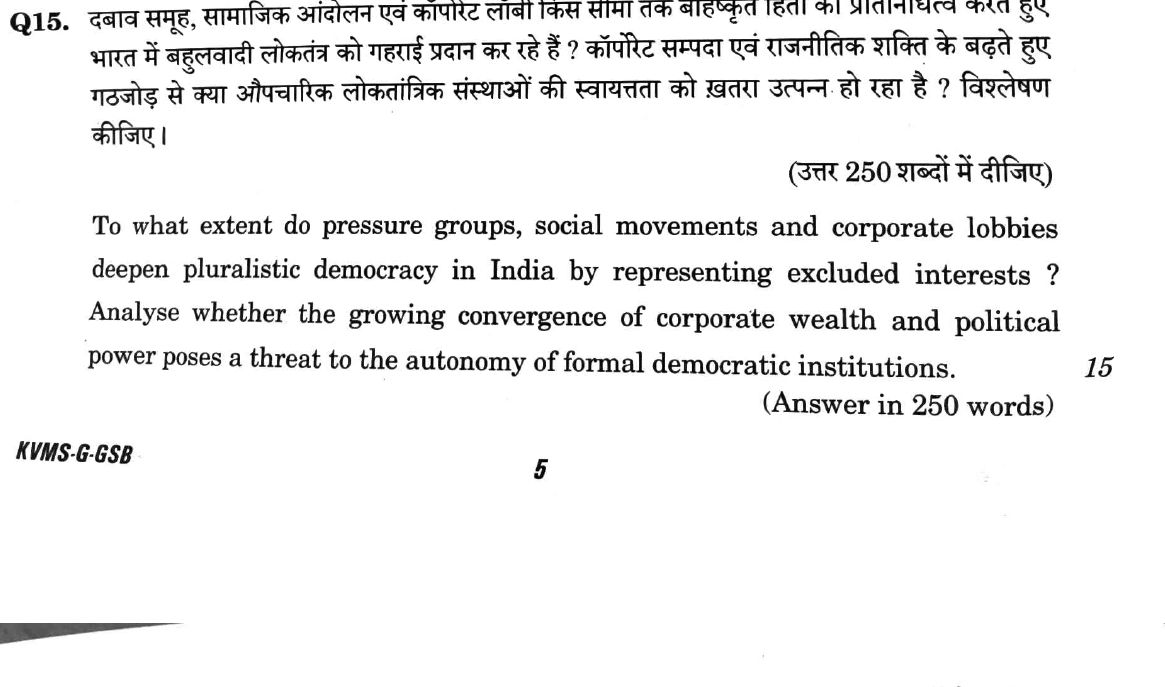
To what extent do pressure groups, social movements and corporate lobbies deepen pluralistic democracy in India by representing excluded interests? Analyse whether the growing convergence of corporate wealth and political power poses a threat to the autonomy of formal democratic institutions. (Answer in 250 words) 15 marks
हिंदी में प्रश्न पढ़ें
दबाव समूह, सामाजिक आंदोलन एवं कॉर्पोरेट लॉबी किस सीमा तक बहिष्कृत हितों का प्रतिनिधित्व करते हुए भारत में बहुलवादी लोकतंत्र को गहराई प्रदान कर रहे हैं? कॉर्पोरेट सम्पदा एवं राजनीतिक शक्ति के बढ़ते गठजोड़ से क्या औपचारिक लोकतांत्रिक संस्थाओं की स्वायत्तता को ख़तरा उत्पन्न हो रहा है? विश्लेषण कीजिए। (उत्तर 250 शब्दों में दीजिए)
Model answer
Written by UPSC Answer Check against this question's marking rubric, to the 250-word length. UPSC does not publish answers for Mains — this is one way to score well, not an official key.
Pluralist democracy, as conceptualised by Robert Dahl, relies on continuous competition among diverse interest groups to prevent the monopolisation of power. In India, pressure groups and social movements expand this democratic space by articulating demands that bypass rigid party structures. Trade unions such as AITUC and INTUC, industry associations like FICCI and CII, and agrarian collectives channel distinct socio-economic interests into policy debates. Grassroots mobilisations have been pivotal in empowering marginalised citizens; the Mazdoor Kisan Shakti Sangathan (MKSS) led the Right to Information movement, embedding citizen oversight into governance. Similarly, the Samyukt Kisan Morcha (SKM) organised sustained grassroots resistance during the 2020–21 protests, successfully securing the repeal of the three farm laws in 2021 outside formal parliamentary channels.
Corporate Convergence and Institutional Autonomy
However, the growing convergence of corporate wealth and political power skews this pluralist equilibrium. Unlike mass movements, concentrated corporate lobbies possess asymmetric financial leverage, creating risks of regulatory capture where state policy prioritises private capital over broader public welfare.
This nexus was institutionalised through the Electoral Bonds Scheme (2018), which facilitated unlimited, anonymous corporate donations to political parties. The Supreme Court invalidated the scheme in Association for Democratic Reforms v. Union of India (2024), holding that unchecked corporate financing infringes upon the voters' fundamental right to information and distorts electoral parity. The resultant financial dependence of political parties threatens the autonomy and neutrality of formal democratic institutions, including regulatory authorities and investigative agencies.
To preserve genuine pluralism, India must enact statutory lobbying disclosures, establish strict limits on corporate political contributions, and insulate regulatory bodies from executive and commercial influence.
What "Analyse" is asking you to do
Break the subject into its working parts and show how they act on each other. The marks are in the interconnections — which factor drives which, and what the resulting structure explains — not in the inventory of factors.
Structure that answers it
Define the whole → separate it into its parts → show which part drives which → what that interaction produces → what the structure implies
Where marks are lost
A flat list of causes with no account of which drives which. An answer of neatly separated headings, each self-contained, scores as description.
How this answer will be evaluated
Approach
Framework: GS2: Polity & Governance. analyse: intro > causes > effects > stakeholders/linkages > way forward Full marks: Deep analysis of both parts with specific examples, clear link to institutional autonomy, and a strong reform conclusion.
Key points expected
- Define 'excluded interests' represented by social movements
- Explain how pressure groups deepen pluralistic democracy
- Analyze the convergence of corporate wealth and political power
- Assess the threat to autonomy of formal democratic institutions
Evaluation rubric
Each sub-part is marked on its own, against the marks and word limit printed on the paper.
- The answer Evaluate the role of non-state actors in deepening democracy and the threat of corporate-political convergence to institutional autonomy. 15 marks · 250 words
analyse— intro → causes → effects → stakeholders/linkages → way forward
Must cover
- Define 'excluded interests' represented by social movements
- Explain how pressure groups deepen pluralistic democracy
- Analyze the convergence of corporate wealth and political power
- Assess the threat to autonomy of formal democratic institutions
Loses marks
- Reciting definitions without analytical depth
- Failing to link corporate power to institutional autonomy
- Ending without a realistic reform or way forward
Earns more
- Cite specific examples of social movements (e.g., Narmada Bachao Andolan)
- Reference specific corporate lobbying instances or data
- Discuss the role of political funding in convergence
- Mention the impact on policy formulation
Extra mark
- Cite 2nd ARC or Law Commission recommendations on political funding
- Reference a relevant Supreme Court judgment on corporate funding
Practice this exact question
Write your answer and it is marked point by point against the model answer above — what you covered, what you missed, what you got wrong.
Evaluate my answer →More from General Studies 2026 GS Paper II
- Q12 What is meant by judicial legislation? In this context, discuss the verdicts of the apex…
- Q13 How far has the Indian federal framework been successful in accommodating regional and cu…
- Q14 Examine how the separation of powers is practised in India compared to the rigid presiden…
- Q15 To what extent do pressure groups, social movements and corporate lobbies deepen pluralis…
- Q16 "Transparency and accountability in governance are not about controlling corruption but a…
- Q17 Can the constitutional mandate of rights-based welfare be effectively realised in the con…
- Q18 Should education be treated primarily as a welfare obligation of the state or as a strate…