GS Paper II — Q12
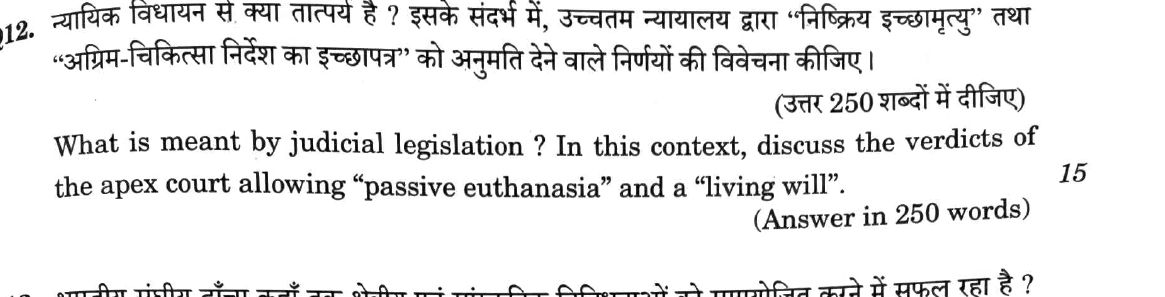
What is meant by judicial legislation? In this context, discuss the verdicts of the apex court allowing "passive euthanasia" and…
What is meant by judicial legislation? In this context, discuss the verdicts of the apex court allowing "passive euthanasia" and a "living will". (Answer in 250 words) 15 marks
हिंदी में प्रश्न पढ़ें
न्यायिक विधायन से क्या तात्पर्य है? इसके संदर्भ में, उच्चतम न्यायालय द्वारा “निष्क्रिय इच्छामृत्यु” तथा “अग्रिम-चिकित्सा निर्देश का इच्छापत्र” को अनुमति देने वाले निर्णयों की विवेचना कीजिए। (उत्तर 250 शब्दों में दीजिए)
Model answer
Written by UPSC Answer Check against this question's marking rubric, to the 250-word length. UPSC does not publish answers for Mains — this is one way to score well, not an official key.
Judicial legislation refers to the judiciary laying down binding norms and procedural guidelines under Articles 141 and 142 to fill a legislative vacuum where Parliament has not acted, classically exemplified in Vishaka v. State of Rajasthan (1997). In the domain of end-of-life care, the Supreme Court has progressively assumed this role through landmark rulings.
Doctrinal Evolution on Euthanasia and Living Wills
Gian Kaur v. State of Punjab (1996): A Constitution Bench held that the right to life under Article 21 does not include the right to die, thereby distinguishing suicide from the natural cessation of life, while leaving the question of dying with dignity open.
Aruna Ramchandra Shanbaug v. Union of India (2011): The Court ruled that active euthanasia remains illegal and amounts to culpable homicide. However, it permitted passive euthanasia (withdrawing life support) for patients in a permanent vegetative state under a strict interim mechanism supervised by High Courts and medical boards.
Common Cause v. Union of India (2018): A five-judge Constitution Bench held the right to die with dignity to be a fundamental right under Article 21. It legalised passive euthanasia and Advance Medical Directives ("living wills"), establishing elaborate procedural safeguards.
2023 Modification: Addressing practical hurdles flagged by petitioners, the Court streamlined the 2018 guidelines by removing the cumbersome requirement of Judicial Magistrate attestation and simplifying the medical-board approval process.
Way Forward
In the continuing absence of dedicated parliamentary legislation, these judicial directions operate as binding law. To resolve this democratic deficit, Parliament must enact a comprehensive statute on end-of-life care that balances patient autonomy with safeguards against misuse.
What "Discuss" is asking you to do
Lay the issue out from more than one side — how it arose, what is claimed for it, what is held against it, and where it now stands. UPSC attaches discuss to broad topics with several live dimensions, so coverage of the dimensions earns more than the strength of your opinion.
Structure that answers it
Set the issue up → the case as it is made → the case against → the dimension both sides leave out → where the balance now lies
Where marks are lost
Listing facts with no thread between them, or arguing one side throughout and calling it a discussion.
How this answer will be evaluated
Approach
Framework: GS2 Paper 2: Constitutional Law & Judicial Activism. discuss: intro > 3-4 dimensions > example > balanced close Full marks: Precise definition of judicial legislation; clear distinction between Aruna and Common Cause cases; strong constitutional link to Art 21.
Key points expected
- Define judicial legislation as law-making by courts
- Cite Aruna Ramachandran case for passive euthanasia
- Cite Common Cause case for living wills
- Link verdicts to Article 21 (Right to Life)
Evaluation rubric
Each sub-part is marked on its own, against the marks and word limit printed on the paper.
- The answer Define judicial legislation and analyze the Supreme Court's role in expanding rights via specific verdicts. 15 marks · 250 words
discuss— intro → 3-4 dimensions → example → balanced close
Must cover
- Define judicial legislation as law-making by courts
- Cite Aruna Ramachandran case for passive euthanasia
- Cite Common Cause case for living wills
- Link verdicts to Article 21 (Right to Life)
Loses marks
- Reciting Article 21 without linking to specific cases
- Confusing active vs passive euthanasia definitions
- Failing to distinguish between the two specific verdicts
Earns more
- Mention 'right to die with dignity' as part of Art 21
- Reference 9th Schedule or specific constitutional provisions
- Mention safeguards like 'clear and unambiguous' wills
- Reference the 2018 Medical Treatment of Minors Act
Extra mark
- Cite Justice Chandrachud's dissent or specific legal reasoning
- Reference Law Commission Report on Euthanasia
Practice this exact question
Write your answer and it is marked point by point against the model answer above — what you covered, what you missed, what you got wrong.
Evaluate my answer →More from General Studies 2026 GS Paper II
- Q9 "IPMDA (Indo-Pacific Partnership for Maritime Domain Awareness) bridges the gap between I…
- Q10 "BRICS acts as a powerful counterweight in global governance, actively amplifying the voi…
- Q11 Discuss the position of the Governor in the federal polity of India. What is the nature o…
- Q12 What is meant by judicial legislation? In this context, discuss the verdicts of the apex…
- Q13 How far has the Indian federal framework been successful in accommodating regional and cu…
- Q14 Examine how the separation of powers is practised in India compared to the rigid presiden…
- Q15 To what extent do pressure groups, social movements and corporate lobbies deepen pluralis…