GS Paper II — Q11
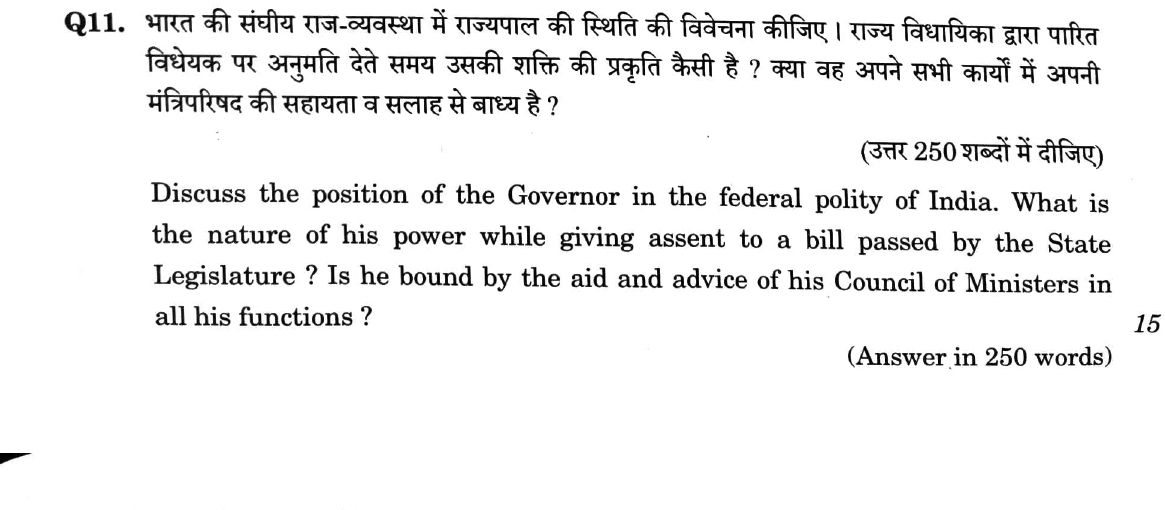
Discuss the position of the Governor in the federal polity of India. What is the nature of his power while giving assent to a…
Discuss the position of the Governor in the federal polity of India. What is the nature of his power while giving assent to a bill passed by the State Legislature? Is he bound by the aid and advice of his Council of Ministers in all his functions? (Answer in 250 words) 15 marks
हिंदी में प्रश्न पढ़ें
भारत की संघीय राज्य-व्यवस्था में राज्यपाल की स्थिति की विवेचना कीजिए। राज्य विधायिका द्वारा पारित विधेयक पर अनुमति देते समय उसकी शक्ति की प्रकृति कैसी है? क्या वह अपने सभी कार्यों में अपनी मंत्रिपरिषद की सहायता व सलाह से बाध्य है? (उत्तर 250 शब्दों में दीजिए)
Model answer
Written by UPSC Answer Check against this question's marking rubric, to the 250-word length. UPSC does not publish answers for Mains — this is one way to score well, not an official key.
Under Articles 153 to 162, the Governor serves as the constitutional head of the State executive, appointed by the President under Article 155 and holding office during presidential pleasure under Article 156. Occupying a dual role as the titular head of the state and the vital link between the Union and States, the Governor operates within a parliamentary system where real executive authority vests in the elected Council of Ministers.
Assent to Bills and Legislative Powers Under Article 200, the Governor possesses four options upon receiving a state bill: grant assent, withhold assent, return the bill (except Money Bills) for reconsideration, or reserve it for the President’s consideration under Article 201. This power is not an absolute veto. In State of Punjab (2023) and the Tamil Nadu Governor case (2025), the Supreme Court held that sitting indefinitely on bills or withholding assent arbitrarily is unconstitutional, prescribing time-bound action and affirming the court's power under Article 142 to prevent legislative paralysis. If the legislature repasses a returned bill, the Governor is constitutionally bound to grant assent.
Aid and Advice versus Discretionary Powers Under Article 163, the Governor is bound by the aid and advice of the Council of Ministers in all functions, except matters where the Constitution explicitly provides for independent discretion. These narrow exceptions include reporting under Article 356, reserving bills under Article 200, and choosing a Chief Minister in a hung assembly. In Nabam Rebia (2016), the Supreme Court clarified that the Governor’s discretion is an exception, not the rule, and does not extend to discretionary summoning or proroguing of the Assembly.
Way Forward To preserve cooperative federalism, the recommendations of the Sarkaria Commission (1988) and Punchhi Commission (2010)—specifically mandating strict timelines for gubernatorial assent and curbing discretionary misuse—should be codified into binding constitutional conventions.
What "Discuss" is asking you to do
Lay the issue out from more than one side — how it arose, what is claimed for it, what is held against it, and where it now stands. UPSC attaches discuss to broad topics with several live dimensions, so coverage of the dimensions earns more than the strength of your opinion.
Structure that answers it
Set the issue up → the case as it is made → the case against → the dimension both sides leave out → where the balance now lies
Where marks are lost
Listing facts with no thread between them, or arguing one side throughout and calling it a discussion.
How this answer will be evaluated
Approach
Framework: GS2 Paper 2: Constitutional Governance & Federalism. discuss: intro > 3-4 dimensions > example > balanced close Full marks: Nuanced analysis of discretionary powers with specific case law and constitutional articles.
Key points expected
- Position as Union's representative in state
- Nature of assent power (Art 200) and reservation
- Distinction between discretionary and non-discretionary functions
- Judicial interpretation of 'aid and advice' (Art 163)
Evaluation rubric
Each sub-part is marked on its own, against the marks and word limit printed on the paper.
- The answer Analyze the Governor's constitutional role, assent powers, and the scope of ministerial advice. · 250 words
discuss— intro → 3-4 dimensions → example → balanced close
Must cover
- Position as Union's representative in state
- Nature of assent power (Art 200) and reservation
- Distinction between discretionary and non-discretionary functions
- Judicial interpretation of 'aid and advice' (Art 163)
Loses marks
- Reciting Article 153-167 without analysis
- Ignoring the 'aid and advice' constraint
- Treating Governor as purely ceremonial
Earns more
- Reference to Sarkaria Commission recommendations
- Mention of 'discretionary powers' in Art 163(1)
- Citing the 'Governor's role in hung assemblies'
- Balanced view on federalism vs central control
Extra mark
- Citing Samsher Singh v. State of Punjab judgment
- Reference to 2nd ARC on Governor's role
Practice this exact question
Write your answer and it is marked point by point against the model answer above — what you covered, what you missed, what you got wrong.
Evaluate my answer →More from General Studies 2026 GS Paper II
- Q8 Analyse the advantages and limitations of the generalist structure of the Indian Civil Se…
- Q9 "IPMDA (Indo-Pacific Partnership for Maritime Domain Awareness) bridges the gap between I…
- Q10 "BRICS acts as a powerful counterweight in global governance, actively amplifying the voi…
- Q11 Discuss the position of the Governor in the federal polity of India. What is the nature o…
- Q12 What is meant by judicial legislation? In this context, discuss the verdicts of the apex…
- Q13 How far has the Indian federal framework been successful in accommodating regional and cu…
- Q14 Examine how the separation of powers is practised in India compared to the rigid presiden…