GS Paper II — Q14
Examine how the separation of powers is practised in India compared to the rigid presidential model of the United States of…
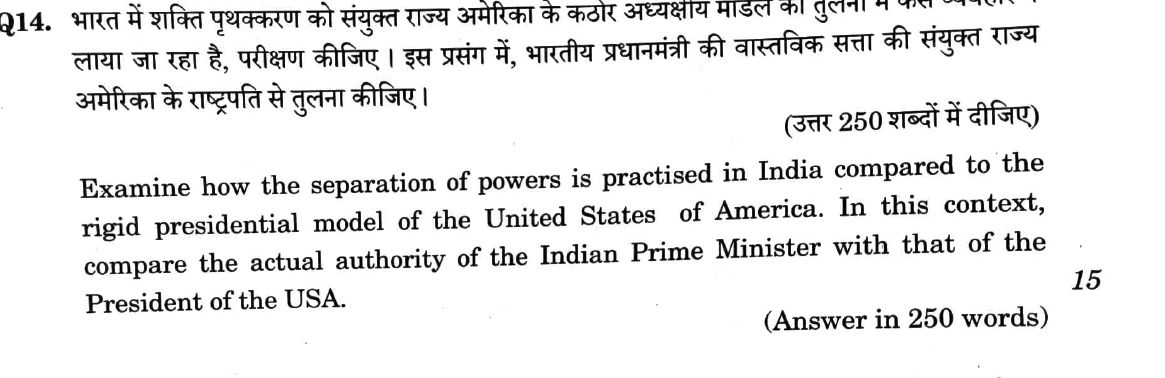
Examine how the separation of powers is practised in India compared to the rigid presidential model of the United States of America. In this context, compare the actual authority of the Indian Prime Minister with that of the President of the USA. (Answer in 250 words) 15 marks
हिंदी में प्रश्न पढ़ें
भारत में शक्ति पृथक्करण को संयुक्त राज्य अमेरिका के कठोर अध्यक्षीय मॉडल की तुलना में कैसे व्यवहार में लाया जा रहा है, परीक्षण कीजिए। इस प्रसंग में, भारतीय प्रधानमंत्री की वास्तविक सत्ता की संयुक्त राज्य अमेरिका के राष्ट्रपति से तुलना कीजिए। (उत्तर 250 शब्दों में दीजिए)
Model answer
Written by UPSC Answer Check against this question's marking rubric, to the 250-word length. UPSC does not publish answers for Mains — this is one way to score well, not an official key.
India follows a parliamentary model of checks and balances, not rigid separation of powers. Article 50 directs separation of judiciary from executive in the State, while executive power is fused with the legislature: the Council of Ministers is collectively responsible to the Lok Sabha under Article 75(3), and ministers must be members of either House, or become so within six months, under Article 75(5). The Prime Minister is primus inter pares, the chief executive, but remains dependent on party support and can be removed by a no-confidence motion.
The United States follows a Montesquieuian separation. The President is independently elected, is not a member of Congress, cannot introduce bills directly, and can be removed only by impeachment for high crimes, not by a legislative confidence vote. The President has a veto, subject to a two-thirds congressional override, while the Senate exercises advice-and-consent over appointments and treaties.
India’s President is nominal, acting on the aid and advice of the Council of Ministers under Article 74. Thus the Prime Minister’s authority is collective, party-dependent and legislative, whereas the US President’s is a four-year, independently elected, constitutionally insulated office. Nevertheless, India’s judiciary provides a separation safeguard: Kesavananda Bharati recognised separation of powers as part of the basic structure, and Indira Nehru Gandhi v. Raj Narain struck down an amendment insulating the Prime Minister’s election from judicial review.
The trade-off is: the US model offers stability and independent executive authority, while India’s fusion permits responsible government and legislative accountability, and judicial review prevents abuse.
What "Examine" is asking you to do
Test the proposition the question puts to you and return a finding on how far it holds. Examine stems carry a claim, or ask whether something has happened, and expect evidence weighed both ways before the extent is stated — often with remedial measures attached.
Structure that answers it
Restate the claim as the question frames it → evidence that supports it → evidence that undercuts it → the conditions under which it holds → verdict on how far it stands
Where marks are lost
Stopping at description. An examination has to reach a finding, and “examine with justification” means the extent must be stated, not implied.
How this answer will be evaluated
Approach
Framework: GS2 Method: Principle > Institution > Problem > Reform. compare: paired headings or table > key differences > significance > conclusion Full marks: Clear comparison of models and authorities with specific examples and a strong conclusion.
Key points expected
- Contrast India's flexible separation with US rigidity
- Compare PM's actual authority with US President
- Explain the fusion of powers in India
- Conclude on the significance of the difference
Evaluation rubric
Each sub-part is marked on its own, against the marks and word limit printed on the paper.
- The answer Contrast India's flexible separation of powers with the US rigid model and compare PM vs President authority. · 250 words
compare— paired headings or table → key differences → significance → conclusion
Must cover
- Contrast India's flexible separation with US rigidity
- Compare PM's actual authority with US President
- Explain the fusion of powers in India
- Conclude on the significance of the difference
Loses marks
- Reciting Articles without analysis
- Failing to compare PM and President
- Ending without a reform or conclusion
Earns more
- Mention US checks and balances
- Cite Indian constitutional provisions
- Discuss the role of the President in India
- Reference the 2nd ARC or Law Commission
Extra mark
- Cite a specific Supreme Court judgment
- Reference a specific Article of the Constitution
Practice this exact question
Write your answer and it is marked point by point against the model answer above — what you covered, what you missed, what you got wrong.
Evaluate my answer →More from General Studies 2026 GS Paper II
- Q11 Discuss the position of the Governor in the federal polity of India. What is the nature o…
- Q12 What is meant by judicial legislation? In this context, discuss the verdicts of the apex…
- Q13 How far has the Indian federal framework been successful in accommodating regional and cu…
- Q14 Examine how the separation of powers is practised in India compared to the rigid presiden…
- Q15 To what extent do pressure groups, social movements and corporate lobbies deepen pluralis…
- Q16 "Transparency and accountability in governance are not about controlling corruption but a…
- Q17 Can the constitutional mandate of rights-based welfare be effectively realised in the con…