GS Paper II — Q13
How far has the Indian federal framework been successful in accommodating regional and cultural diversities? Highlight the role…
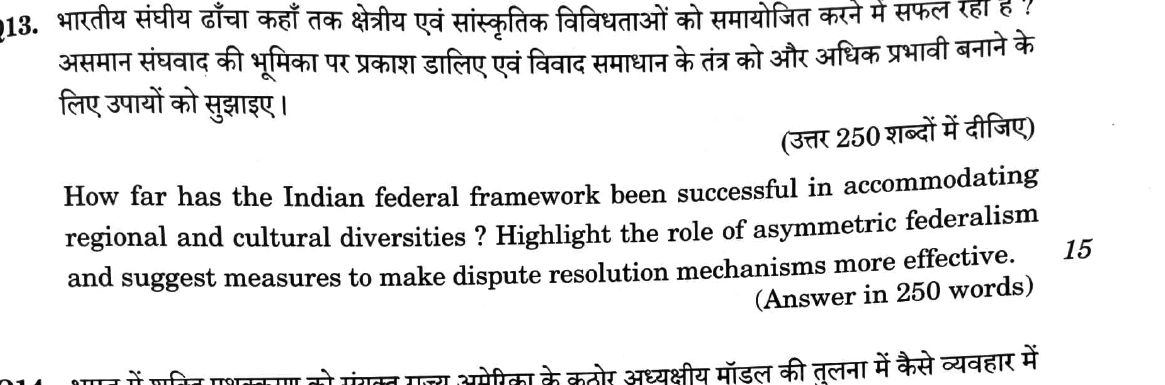
How far has the Indian federal framework been successful in accommodating regional and cultural diversities? Highlight the role of asymmetric federalism and suggest measures to make dispute resolution mechanisms more effective. (Answer in 250 words) 15 marks
हिंदी में प्रश्न पढ़ें
भारतीय संघीय ढाँचा कहाँ तक क्षेत्रीय एवं सांस्कृतिक विविधताओं को समायोजित करने में सफल रहा है? असमान संघवाद की भूमिका पर प्रकाश डालिए एवं विवाद समाधान के तंत्र को और अधिक प्रभावी बनाने के लिए उपायों को सुझाइए। (उत्तर 250 शब्दों में दीजिए)
Model answer
Written by UPSC Answer Check against this question's marking rubric, to the 250-word length. UPSC does not publish answers for Mains — this is one way to score well, not an official key.
India’s federal framework has largely succeeded in preserving national unity while accommodating deep ethno-cultural diversities, primarily through constitutionally sanctioned asymmetric arrangements.
Role of Asymmetric Federalism The Constitution tailors autonomy through differential provisions. The Article 371 series protects indigenous traditions and resources, evident in Article 371A (protecting Nagaland’s customary laws and land ownership), Article 371G (Mizoram), Article 371F (Sikkim), and Article 371C (Manipur hill areas). Similarly, the Sixth Schedule grants legislative, judicial, and administrative autonomy to tribal areas in Assam, Meghalaya, Tripura, and Mizoram through Autonomous District Councils, insulating them from standard state frameworks. Historically, erstwhile Article 370 for Jammu and Kashmir represented the most pronounced asymmetry; its abrogation in 2019 marked a pivotal shift toward greater constitutional symmetry, altering the traditional accommodation paradigm.
Persistent Deficits in Dispute Resolution Accommodation has often outpaced conflict-resolution capacities. Inter-state water disputes (e.g., Cauvery, Krishna) under Article 262 and the Inter-State River Water Disputes Act, 1956, suffer from protracted litigation and politicisation despite tribunal awards. Furthermore, the Inter-State Council (Article 263) remains underutilised and advisory, contrary to the Punchhi Commission (2010) recommendations to institutionalise it into a permanent, professionally staffed deliberative body.
Measures for Effective Resolution To streamline dispute settlement, the Inter-State Council requires a permanent standing secretariat with mandatory meeting schedules and binding conciliation timelines. Water dispute resolution needs fast-track tribunals with non-extendable, fixed adjudication periods and verifiable enforcement mechanisms. Finally, institutionalising the GST Council model of cooperative, consensus-based decision-making across other socio-economic domains will ensure that federal accommodation remains robust and resilient.
What "Examine" is asking you to do
Test the proposition the question puts to you and return a finding on how far it holds. Examine stems carry a claim, or ask whether something has happened, and expect evidence weighed both ways before the extent is stated — often with remedial measures attached.
Structure that answers it
Restate the claim as the question frames it → evidence that supports it → evidence that undercuts it → the conditions under which it holds → verdict on how far it stands
Where marks are lost
Stopping at description. An examination has to reach a finding, and “examine with justification” means the extent must be stated, not implied.
How this answer will be evaluated
Approach
Framework: GS2 Paper 2: Federalism & Governance. evaluate: criteria > evidence > balanced judgment Full marks: Nuanced judgment on success, clear link between asymmetry and diversity, and specific institutional reforms for dispute resolution.
Key points expected
- Judgment on success of federal framework in accommodating diversity
- Explanation of asymmetric federalism (e.g., 7th/13th/14th Schedules)
- Analysis of current dispute resolution mechanisms (e.g., Finance Commission)
- Specific, implementable measures to make dispute resolution more effective
Evaluation rubric
Each sub-part is marked on its own, against the marks and word limit printed on the paper.
- The answer Assess success of Indian federalism in managing diversity, role of asymmetry, and dispute resolution reforms. · 250 words
evaluate— criteria → evidence → balanced judgment
Must cover
- Judgment on success of federal framework in accommodating diversity
- Explanation of asymmetric federalism (e.g., 7th/13th/14th Schedules)
- Analysis of current dispute resolution mechanisms (e.g., Finance Commission)
- Specific, implementable measures to make dispute resolution more effective
Loses marks
- Reciting Articles without analyzing their impact on diversity
- Vague suggestions for dispute resolution (e.g., 'better communication')
- Ignoring the specific role of asymmetric federalism
Earns more
- Citing specific examples of asymmetric provisions (e.g., J&K, NE states)
- Reference to specific inter-state disputes (e.g., Cauvery, Ganga water)
- Mention of the role of the Supreme Court in federal disputes
- Discussion of the 'cooperative federalism' vs 'competitive federalism' dynamic
Extra mark
- Citing 2nd ARC or Law Commission recommendations on federalism
- Citing a specific landmark Supreme Court judgment on federalism
Practice this exact question
Write your answer and it is marked point by point against the model answer above — what you covered, what you missed, what you got wrong.
Evaluate my answer →More from General Studies 2026 GS Paper II
- Q10 "BRICS acts as a powerful counterweight in global governance, actively amplifying the voi…
- Q11 Discuss the position of the Governor in the federal polity of India. What is the nature o…
- Q12 What is meant by judicial legislation? In this context, discuss the verdicts of the apex…
- Q13 How far has the Indian federal framework been successful in accommodating regional and cu…
- Q14 Examine how the separation of powers is practised in India compared to the rigid presiden…
- Q15 To what extent do pressure groups, social movements and corporate lobbies deepen pluralis…
- Q16 "Transparency and accountability in governance are not about controlling corruption but a…