GS Paper II — Q16
"Transparency and accountability in governance are not about controlling corruption but about creating the trust of stakeholders…
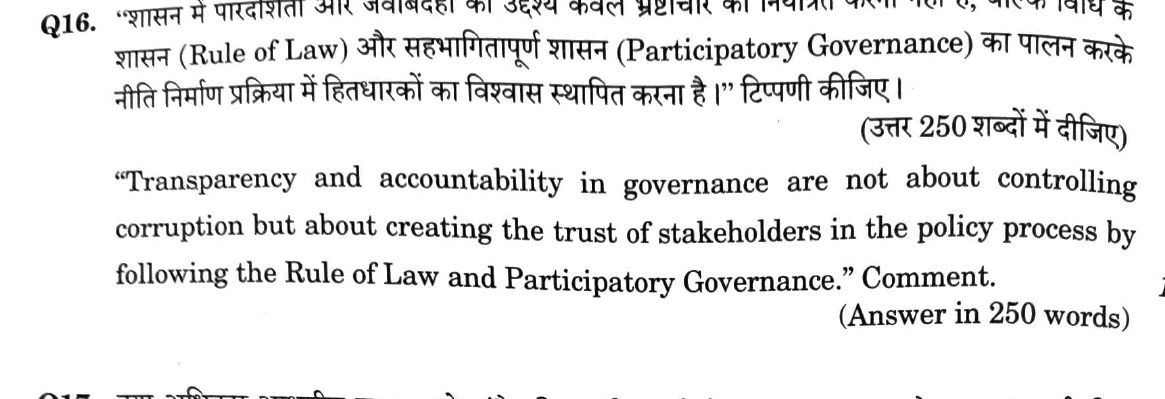
"Transparency and accountability in governance are not about controlling corruption but about creating the trust of stakeholders in the policy process by following the Rule of Law and Participatory Governance." Comment. (Answer in 250 words) 15 marks
हिंदी में प्रश्न पढ़ें
“शासन में पारदर्शिता और जवाबदेही का उद्देश्य केवल भ्रष्टाचार को नियंत्रित करना नहीं है, बल्कि विधि के शासन (Rule of Law) और सहभागितापूर्ण शासन (Participatory Governance) का पालन करके नीति निर्माण प्रक्रिया में हितधारकों का विश्वास स्थापित करना है।” टिप्पणी कीजिए। (उत्तर 250 शब्दों में दीजिए)
Model answer
Written by UPSC Answer Check against this question's marking rubric, to the 250-word length. UPSC does not publish answers for Mains — this is one way to score well, not an official key.
Transparency and accountability are often viewed through the instrumental lens of curbing graft, but their deeper normative purpose is cementing citizen-state trust and democratic legitimacy. As emphasized by the 2nd Administrative Reforms Commission in its report on Ethics in Governance, transparency is central to bridging the trust deficit, transforming governance from an opaque authority into an open covenant with the people.
Rule of Law and Institutional Predictability Trust in policy processes is anchored in A.V. Dicey’s Rule of Law principles—namely the supremacy of law, equality before the law, and procedural predictability. Instruments like the Right to Information (RTI) Act, 2005 operationalize this foundation by institutionalizing informational trust, enabling citizens to scrutinize decisions beyond mere corruption detection. Similarly, Citizen’s Charters and e-governance platforms under Digital India, such as Direct Benefit Transfer (DBT), remove arbitrary administrative discretion, ensuring uniform, rule-bound service delivery that reinforces public confidence.
Participatory Governance and Civic Ownership Accountability fosters trust when stakeholders become active participants in decision-making. Devolved platforms like the Gram Sabha under the 73rd Constitutional Amendment and PESA, 1996 convert policy subjects into decision-makers. Furthermore, social audits under MGNREGA—pioneered systematically in Andhra Pradesh and Meghalaya—replace adversarial surveillance with participatory validation, embedding collective ownership within public administration.
This relational dimension is mirrored globally in World Bank governance frameworks, where indicators such as 'Voice and Accountability' capture stakeholder agency beyond narrow corruption metrics. Ultimately, while curbing malfeasance is an essential byproduct, transparency and accountability primarily function to uphold the Rule of Law, assuring stakeholders of a fair, predictable, and participatory policy ecosystem.
What "Comment" is asking you to do
Take a position on the statement and support it. Comment usually attaches to a quoted line in the short slots, so the reasoning must be compressed — an opening view, a few load-bearing reasons, and the limit of the claim.
Structure that answers it
Unpack what the statement asserts → your stance → two or three supporting reasons → the qualification that limits it
Where marks are lost
Neutral summary; a comment without a stance has not answered. Equally costly is accepting the quoted line wholesale and never testing where it fails.
How this answer will be evaluated
Approach
Framework: GS2 Governance. comment: context > arguments both sides > judgment > close Full marks: Nuanced argument linking Rule of Law and participation to trust, with specific examples and a clear judgment.
Key points expected
- Define transparency/accountability as trust-building mechanisms
- Explain Rule of Law as the foundation of stakeholder trust
- Explain Participatory Governance as a tool for policy legitimacy
- Provide a balanced judgment on the quote's validity
Evaluation rubric
Each sub-part is marked on its own, against the marks and word limit printed on the paper.
- The answer Contextualize the quote, argue for the primacy of trust over anti-corruption, and provide a judgment. 15 marks · 250 words
comment— context → arguments both sides → judgment → close
Must cover
- Define transparency/accountability as trust-building mechanisms
- Explain Rule of Law as the foundation of stakeholder trust
- Explain Participatory Governance as a tool for policy legitimacy
- Provide a balanced judgment on the quote's validity
Loses marks
- Focusing primarily on anti-corruption measures
- Reciting Articles without linking to trust
- Failing to provide a clear judgment
Earns more
- Cite specific examples of participatory mechanisms (e.g., Panchayati Raj)
- Reference the 2nd ARC report on governance
- Mention the role of RTI in transparency
- Discuss the link between trust and policy implementation
Extra mark
- Cite a specific Supreme Court judgment on Rule of Law
- Reference a specific Law Commission report on accountability
Practice this exact question
Write your answer and it is marked point by point against the model answer above — what you covered, what you missed, what you got wrong.
Evaluate my answer →More from General Studies 2026 GS Paper II
- Q13 How far has the Indian federal framework been successful in accommodating regional and cu…
- Q14 Examine how the separation of powers is practised in India compared to the rigid presiden…
- Q15 To what extent do pressure groups, social movements and corporate lobbies deepen pluralis…
- Q16 "Transparency and accountability in governance are not about controlling corruption but a…
- Q17 Can the constitutional mandate of rights-based welfare be effectively realised in the con…
- Q18 Should education be treated primarily as a welfare obligation of the state or as a strate…
- Q19 "India's global diaspora acts as a living bridge, as a critical economic factor and knowl…