GS Paper II — Q17
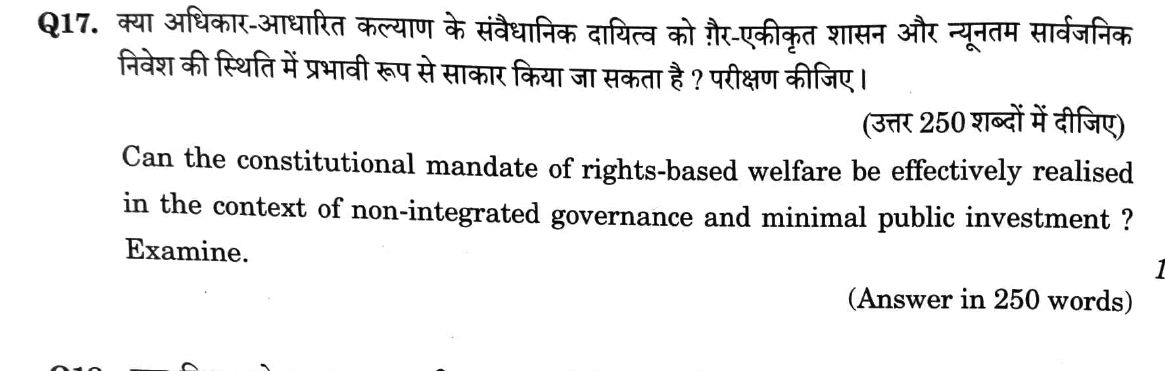
Can the constitutional mandate of rights-based welfare be effectively realised in the context of non-integrated governance and…
Can the constitutional mandate of rights-based welfare be effectively realised in the context of non-integrated governance and minimal public investment? Examine. (Answer in 250 words) 15 marks
हिंदी में प्रश्न पढ़ें
क्या अधिकार-आधारित कल्याण के संवैधानिक दायित्व को गैर-एकीकृत शासन और न्यूनतम सार्वजनिक निवेश की स्थिति में प्रभावी रूप से साकार किया जा सकता है? परीक्षण कीजिए। (उत्तर 250 शब्दों में दीजिए)
Model answer
Written by UPSC Answer Check against this question's marking rubric, to the 250-word length. UPSC does not publish answers for Mains — this is one way to score well, not an official key.
The constitutional mandate of rights-based welfare is anchored in justiciable rights: Article 21A and the Right to Education Act, 2009; the National Food Security Act, 2013; and MGNREGA, 2005. These create statutory entitlements to education, food and wage employment, enforceable through courts. Yet their realisation depends on integrated governance and adequate public investment.
India’s public investment remains minimal. Public health expenditure is roughly 1.3–1.5 per cent of GDP, and education spending remains below the Kothari Commission’s recommended 6 per cent of national income target. This fiscal shortfall is especially consequential because welfare rights require continuous public expenditure and institutional capacity. With limited resources, non-integrated governance magnifies weakness. Centrally sponsored schemes often operate as central-scheme silos, poorly coordinated with state implementation machinery, producing overlapping beneficiaries, leakages and monitoring gaps. Fiscal federalism deepens the constraint: states bear large implementation responsibility for centrally sponsored schemes without commensurate untied fiscal resources, as reflected in Finance Commission devolution debates.
Integration attempts exist. The Aspirational Districts Programme (2018) and its successor Aspirational Blocks Programme attempt convergence-based, integrated governance across sectoral indicators, while NITI Aayog’s SDG India Index tracks cross-sectoral, integrated welfare outcomes rather than scheme-by-scheme silos. Yet these remain coordination tools, not substitutes for fiscal capacity.
Overall, rights-based welfare can be partially realised, but not effectively, under non-integrated governance and minimal public investment. The result is a gap between legal entitlement and material public benefit. Effective realisation requires integrated mission-mode governance, stronger state fiscal capacity, and long-term sustained public spending aligned with constitutional entitlements.
What "Examine" is asking you to do
Test the proposition the question puts to you and return a finding on how far it holds. Examine stems carry a claim, or ask whether something has happened, and expect evidence weighed both ways before the extent is stated — often with remedial measures attached.
Structure that answers it
Restate the claim as the question frames it → evidence that supports it → evidence that undercuts it → the conditions under which it holds → verdict on how far it stands
Where marks are lost
Stopping at description. An examination has to reach a finding, and “examine with justification” means the extent must be stated, not implied.
How this answer will be evaluated
Approach
Framework: GS2 Paper 2 Method: Principle > Institution/Article > Problem > Reform. examine: intro > how/why with reasoning > evidence > conclusion Full marks: Links constitutional mandate to specific governance failures and investment gaps with a clear reform path.
Key points expected
- Define rights-based welfare (e.g., Article 39, 41, 47).
- Explain 'non-integrated governance' (fragmentation of schemes).
- Link minimal public investment to implementation failure.
- Provide a realistic reform or conclusion.
Evaluation rubric
Each sub-part is marked on its own, against the marks and word limit printed on the paper.
- The answer Assess feasibility of rights-based welfare amidst fragmented governance and low investment. · 250 words
examine— intro → how/why with reasoning → evidence → conclusion
Must cover
- Define rights-based welfare (e.g., Article 39, 41, 47).
- Explain 'non-integrated governance' (fragmentation of schemes).
- Link minimal public investment to implementation failure.
- Provide a realistic reform or conclusion.
Loses marks
- Reciting Articles without linking to governance context.
- Activist tone without structural analysis.
- Ending without a reform or way forward.
Earns more
- Cite specific welfare schemes (e.g., MGNREGA, PDS).
- Reference 2nd ARC or Law Commission recommendations.
- Mention specific Supreme Court judgments on welfare rights.
- Discuss the 'Three Fs' (Finance, Function, Functionary).
Extra mark
- Cite specific data on public investment trends.
- Reference specific 2nd ARC report numbers.
Practice this exact question
Write your answer and it is marked point by point against the model answer above — what you covered, what you missed, what you got wrong.
Evaluate my answer →More from General Studies 2026 GS Paper II
- Q14 Examine how the separation of powers is practised in India compared to the rigid presiden…
- Q15 To what extent do pressure groups, social movements and corporate lobbies deepen pluralis…
- Q16 "Transparency and accountability in governance are not about controlling corruption but a…
- Q17 Can the constitutional mandate of rights-based welfare be effectively realised in the con…
- Q18 Should education be treated primarily as a welfare obligation of the state or as a strate…
- Q19 "India's global diaspora acts as a living bridge, as a critical economic factor and knowl…
- Q20 "China's Belt and Road Initiative (BRI) has transformed South Asia from a regional space…