GS Paper II — Q8
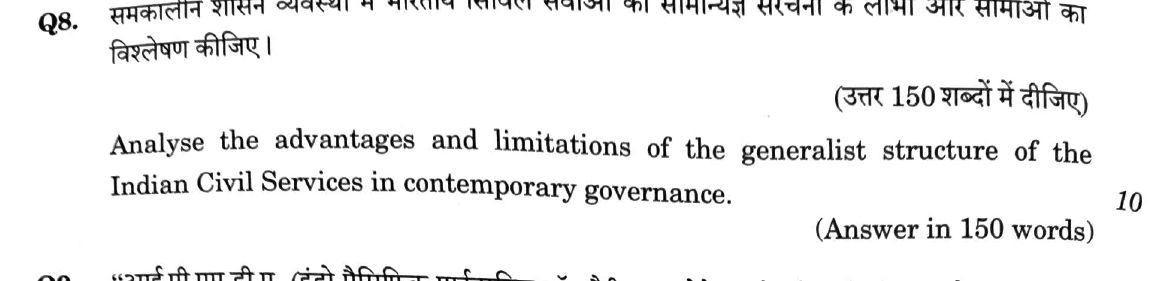
Analyse the advantages and limitations of the generalist structure of the Indian Civil Services in contemporary governance…
Analyse the advantages and limitations of the generalist structure of the Indian Civil Services in contemporary governance. (Answer in 150 words) 10 marks
हिंदी में प्रश्न पढ़ें
समकालीन शासन व्यवस्था में भारतीय सिविल सेवाओं की सामान्यज्ञ संरचना के लाभों और सीमाओं का विश्लेषण कीजिए। (उत्तर 150 शब्दों में दीजिए)
Model answer
Written by UPSC Answer Check against this question's marking rubric, to the 150-word length. UPSC does not publish answers for Mains — this is one way to score well, not an official key.
The generalist structure of the Indian Civil Services rests on Article 312, which provides for All-India Services. The IAS and IPS carry forward the colonial ICS generalist tradition, while the IFoS is a specialised service. Its strengths are cross-sectoral coordination, field-level administrative exposure, and, within the permanent service, political neutrality and continuity across governments, the “steel frame” evoked by Sardar Patel. In complex governance, however, generalists may lack technical depth in finance, public health and technology-driven policy, and frequent transfers can erode institutional memory. The 2nd Administrative Reforms Commission therefore recommended greater domain specialisation and longer, stable tenures. Lateral entry, begun in 2018 at Joint Secretary level and later extended to Director/Deputy Secretary, brings domain expertise into technical ministries. Mission Karmayogi, launched in 2020, and iGOT Karmayogi seek to build role-specific, competency-based capacity within the existing generalist cadre. Thus, generalism should be retained for coordination, supplemented by specialisation, tenure stability and continuous learning.
What "Analyse" is asking you to do
Break the subject into its working parts and show how they act on each other. The marks are in the interconnections — which factor drives which, and what the resulting structure explains — not in the inventory of factors.
Structure that answers it
Define the whole → separate it into its parts → show which part drives which → what that interaction produces → what the structure implies
Where marks are lost
A flat list of causes with no account of which drives which. An answer of neatly separated headings, each self-contained, scores as description.
How this answer will be evaluated
Approach
Framework: GS2 Governance: Administrative Structure & Reforms. analyse: intro > causes > effects > stakeholders/linkages > way forward Full marks: Balanced analysis of pros/cons with specific contemporary examples and 2nd ARC reference.
Key points expected
- Advantages: Holistic view, policy coherence, administrative flexibility
- Limitations: Lack of technical depth, bureaucratic bottlenecks
- Contemporary context: Digital governance, specialized policy needs
- Way forward: Sectoral specialization or hybrid models
Evaluation rubric
Each sub-part is marked on its own, against the marks and word limit printed on the paper.
- The answer Critical evaluation of the generalist IAS structure's utility and flaws in modern governance. 10 marks · 150 words
analyse— intro → causes → effects → stakeholders/linkages → way forward
Must cover
- Advantages: Holistic view, policy coherence, administrative flexibility
- Limitations: Lack of technical depth, bureaucratic bottlenecks
- Contemporary context: Digital governance, specialized policy needs
- Way forward: Sectoral specialization or hybrid models
Loses marks
- Reciting history of IAS without analysis
- Ignoring the 'contemporary' aspect of the question
- Ending without a reform or way forward
Earns more
- Reference to 2nd ARC recommendations
- Mention of specialized services (e.g., IFS, IPS)
- Example of policy failure due to lack of expertise
Extra mark
- Citing specific 2nd ARC report on civil services
- Reference to specific technical policy failure (e.g., IT/Health)
Practice this exact question
Write your answer and it is marked point by point against the model answer above — what you covered, what you missed, what you got wrong.
Evaluate my answer →More from General Studies 2026 GS Paper II
- Q5 Do constitutional bodies like the National Commission for Scheduled Castes (NCSC) and the…
- Q6 Does India's tribal development policy reflect the aspirations for a socially grounded an…
- Q7 Malnutrition in India is not merely a public health concern; it is also a challenge of so…
- Q8 Analyse the advantages and limitations of the generalist structure of the Indian Civil Se…
- Q9 "IPMDA (Indo-Pacific Partnership for Maritime Domain Awareness) bridges the gap between I…
- Q10 "BRICS acts as a powerful counterweight in global governance, actively amplifying the voi…
- Q11 Discuss the position of the Governor in the federal polity of India. What is the nature o…