GS Paper II — Q7
Malnutrition in India is not merely a public health concern; it is also a challenge of social equity, human development and…
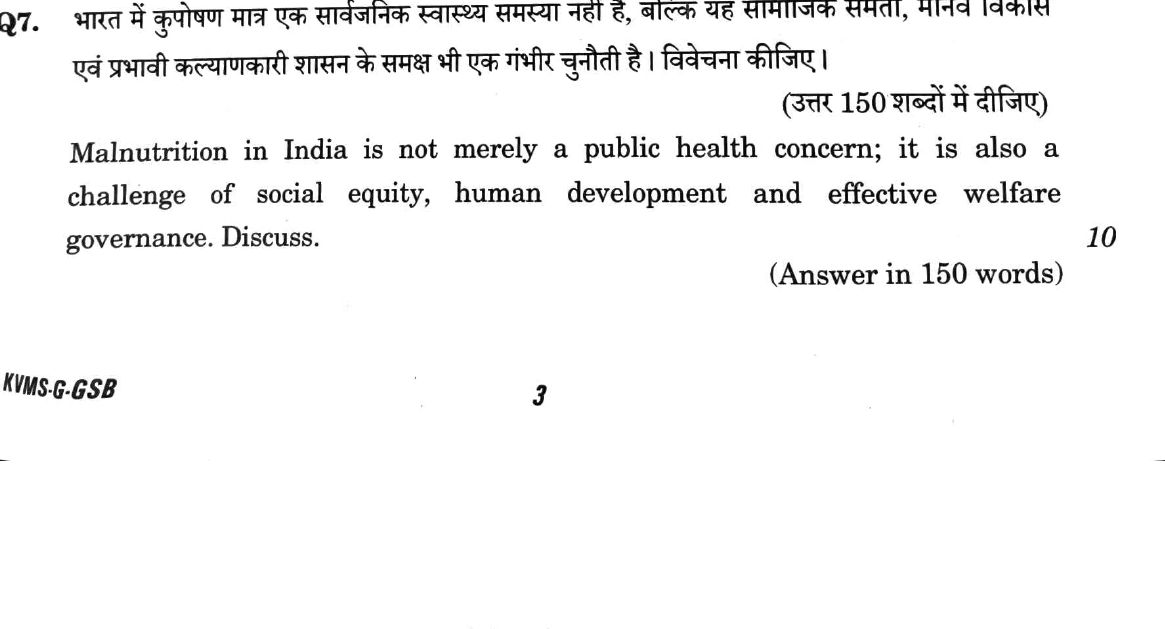
Malnutrition in India is not merely a public health concern; it is also a challenge of social equity, human development and effective welfare governance. Discuss. (Answer in 150 words) 10 marks
हिंदी में प्रश्न पढ़ें
भारत में कुपोषण मात्र एक सार्वजनिक स्वास्थ्य समस्या नहीं है, बल्कि यह सामाजिक समता, मानव विकास एवं प्रभावी कल्याणकारी शासन के समक्ष भी एक गंभीर चुनौती है। विवेचना कीजिए। (उत्तर 150 शब्दों में दीजिए)
Model answer
Written by UPSC Answer Check against this question's marking rubric, to the 150-word length. UPSC does not publish answers for Mains — this is one way to score well, not an official key.
Malnutrition in India reflects structural socio-economic deprivation and administrative bottlenecks rather than mere biological deficiency. NFHS-5 (2019–21) reports 35.5% stunting and 19.3% wasting among under-five children, highlighting persistent implementation gaps despite decades of programmatic intervention.
Social Equity and Human Development: Nutritional security is intrinsic to the Right to Life with dignity under Article 21, operationalised through the National Food Security Act (NFSA), 2013. However, intra-household gender discrimination in food distribution systematically disadvantages women and girls, perpetuating an inter-generational cycle of maternal and child undernutrition. Interventions like PM POSHAN (Mid-Day Meal) actively address this by integrating educational retention with social equity and child nutrition.
Welfare Governance: Flagship architectures like ICDS (Saksham Anganwadi) and POSHAN Abhiyaan 2.0 drive delivery, yet face last-mile monitoring deficits. While India has raised valid methodological objections to its poor Global Hunger Index rankings, the contested metrics underline an undeniable challenge.
Accelerating progress requires decentralized governance, dietary diversification, and inter-sectoral convergence across health, sanitation, and women’s empowerment.
What "Discuss" is asking you to do
Lay the issue out from more than one side — how it arose, what is claimed for it, what is held against it, and where it now stands. UPSC attaches discuss to broad topics with several live dimensions, so coverage of the dimensions earns more than the strength of your opinion.
Structure that answers it
Set the issue up → the case as it is made → the case against → the dimension both sides leave out → where the balance now lies
Where marks are lost
Listing facts with no thread between them, or arguing one side throughout and calling it a discussion.
How this answer will be evaluated
Approach
Framework: GS2 Social Justice / Governance. discuss: intro > 3-4 dimensions > example > balanced close Full marks: Integrates health, equity, and governance with specific institutional critique.
Key points expected
- Link malnutrition to social equity and inequality
- Connect to human development (health, education, productivity)
- Critique welfare governance (implementation, targeting, convergence)
- Balanced conclusion with a forward-looking perspective
Evaluation rubric
Each sub-part is marked on its own, against the marks and word limit printed on the paper.
- The answer Analyze malnutrition as a systemic failure of equity, development, and governance. 10 marks · 150 words
discuss— intro → 3-4 dimensions → example → balanced close
Must cover
- Link malnutrition to social equity and inequality
- Connect to human development (health, education, productivity)
- Critique welfare governance (implementation, targeting, convergence)
- Balanced conclusion with a forward-looking perspective
Loses marks
- Treating it solely as a medical/health issue
- Reciting statistics without analytical context
- Ending without a governance or policy reform angle
Earns more
- Mention specific schemes (ICDS, PDS, Mid-day Meal)
- Reference NFHS data or specific regional disparities
- Discuss the 'hidden hunger' or micronutrient deficiency aspect
- Link to constitutional rights (Article 21, Right to Food)
Extra mark
- Cite 2nd ARC or Law Commission recommendations
- Reference a specific Supreme Court judgment on Right to Food
Practice this exact question
Write your answer and it is marked point by point against the model answer above — what you covered, what you missed, what you got wrong.
Evaluate my answer →More from General Studies 2026 GS Paper II
- Q4 Is the right to vote a fundamental right? Discuss the position of the Election Commission…
- Q5 Do constitutional bodies like the National Commission for Scheduled Castes (NCSC) and the…
- Q6 Does India's tribal development policy reflect the aspirations for a socially grounded an…
- Q7 Malnutrition in India is not merely a public health concern; it is also a challenge of so…
- Q8 Analyse the advantages and limitations of the generalist structure of the Indian Civil Se…
- Q9 "IPMDA (Indo-Pacific Partnership for Maritime Domain Awareness) bridges the gap between I…
- Q10 "BRICS acts as a powerful counterweight in global governance, actively amplifying the voi…