GS Paper II — Q6
Does India's tribal development policy reflect the aspirations for a socially grounded and equity-based governance? Justify your…
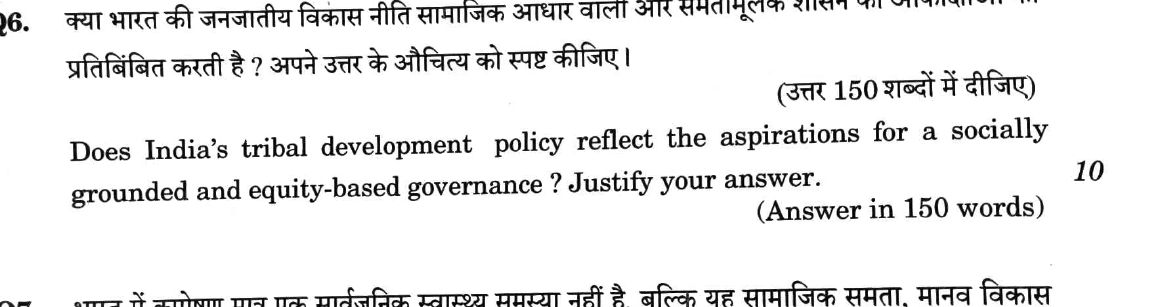
Does India's tribal development policy reflect the aspirations for a socially grounded and equity-based governance? Justify your answer. (Answer in 150 words) 10 marks
हिंदी में प्रश्न पढ़ें
क्या भारत की जनजातीय विकास नीति सामाजिक आधार वाली और समतामूलक शासन की आकांक्षाओं को प्रतिबिंबित करती है? अपने उत्तर के औचित्य को स्पष्ट कीजिए। (उत्तर 150 शब्दों में दीजिए)
Model answer
Written by UPSC Answer Check against this question's marking rubric, to the 150-word length. UPSC does not publish answers for Mains — this is one way to score well, not an official key.
India’s tribal policy partly reflects socially grounded, equity-based governance. Differentiated constitutional protections exist: the Fifth Schedule governs peninsular tribal areas, while the Sixth Schedule creates autonomous district/regional councils in Assam, Meghalaya, Tripura and Mizoram. PESA, 1996 strengthens Gram Sabhas over minor forest produce, land alienation and local governance in Fifth Schedule areas. The Forest Rights Act, 2006 recognises individual and community forest rights. Samatha v. State of Andhra Pradesh (1997) restricted mining leases/land transfers in tribal land in Scheduled Areas, while Niyamgiri/Vedanta (2013) specifically required Gram Sabha consent/referendum, exposing displacement-versus-rehabilitation tension. Welfare instruments—PM-JANMAN (2023) for Particularly Vulnerable Tribal Groups, Eklavya Model Residential Schools and Van Dhan Vikas Yojana under TRIFED—target inclusion. Yet the Xaxa Committee (2014) observed that development often meant displacement without adequate rehabilitation, weakening equity. Thus, the framework is aspirational, but its equity claim remains conditional on Gram Sabha consent, forest rights implementation and rehabilitation.
What "Justify" is asking you to do
Defend a position with reasons that carry evidence, and show why the contrary view does not hold. Where the stem runs as a question and asks you to justify your answer, the position is yours to choose and the marks lie wholly in the defence.
Structure that answers it
Position stated plainly → reason 1 with evidence → reason 2 with evidence → strongest objection, met → position restated as qualified
Where marks are lost
Reasons stated and none of them evidenced. The other standard loss is fence-sitting — an answer that finds merit on both sides and commits to neither has justified nothing.
How this answer will be evaluated
Approach
Framework: GS2 Social Justice / Governance. justify: claim > 3-4 reasons > evidence > conclusion Full marks: Clear claim, 3-4 specific reasons with evidence, balanced conclusion, bonus element.
Key points expected
- Clear claim on whether policy reflects equity
- 3-4 specific reasons (e.g., PESA, 5th/6th Schedule, reservations)
- Evidence of social grounding (e.g., FRA, tribal self-governance)
- Balanced conclusion acknowledging gaps
Evaluation rubric
Each sub-part is marked on its own, against the marks and word limit printed on the paper.
- The answer Claim on tribal policy's equity focus, supported by 3-4 reasons and evidence. 10 marks · 150 words
justify— claim → 3-4 reasons → evidence → conclusion
Must cover
- Clear claim on whether policy reflects equity
- 3-4 specific reasons (e.g., PESA, 5th/6th Schedule, reservations)
- Evidence of social grounding (e.g., FRA, tribal self-governance)
- Balanced conclusion acknowledging gaps
Loses marks
- Reciting Articles without analysis
- Activist tone without evidence
- Ending without reform or balanced judgment
Earns more
- Mention of PESA Act 1996
- Reference to 5th/6th Schedule protections
- Citation of specific schemes (e.g., TRIFED, Van Dhan)
- Link to constitutional morality
Extra mark
- 2nd ARC recommendation on tribal governance
- Supreme Court judgment on FRA or PESA
Practice this exact question
Write your answer and it is marked point by point against the model answer above — what you covered, what you missed, what you got wrong.
Evaluate my answer →More from General Studies 2026 GS Paper II
- Q3 Examine whether the constitutional office of the Lok Sabha Speaker has become vulnerable…
- Q4 Is the right to vote a fundamental right? Discuss the position of the Election Commission…
- Q5 Do constitutional bodies like the National Commission for Scheduled Castes (NCSC) and the…
- Q6 Does India's tribal development policy reflect the aspirations for a socially grounded an…
- Q7 Malnutrition in India is not merely a public health concern; it is also a challenge of so…
- Q8 Analyse the advantages and limitations of the generalist structure of the Indian Civil Se…
- Q9 "IPMDA (Indo-Pacific Partnership for Maritime Domain Awareness) bridges the gap between I…