GS Paper II — Q3
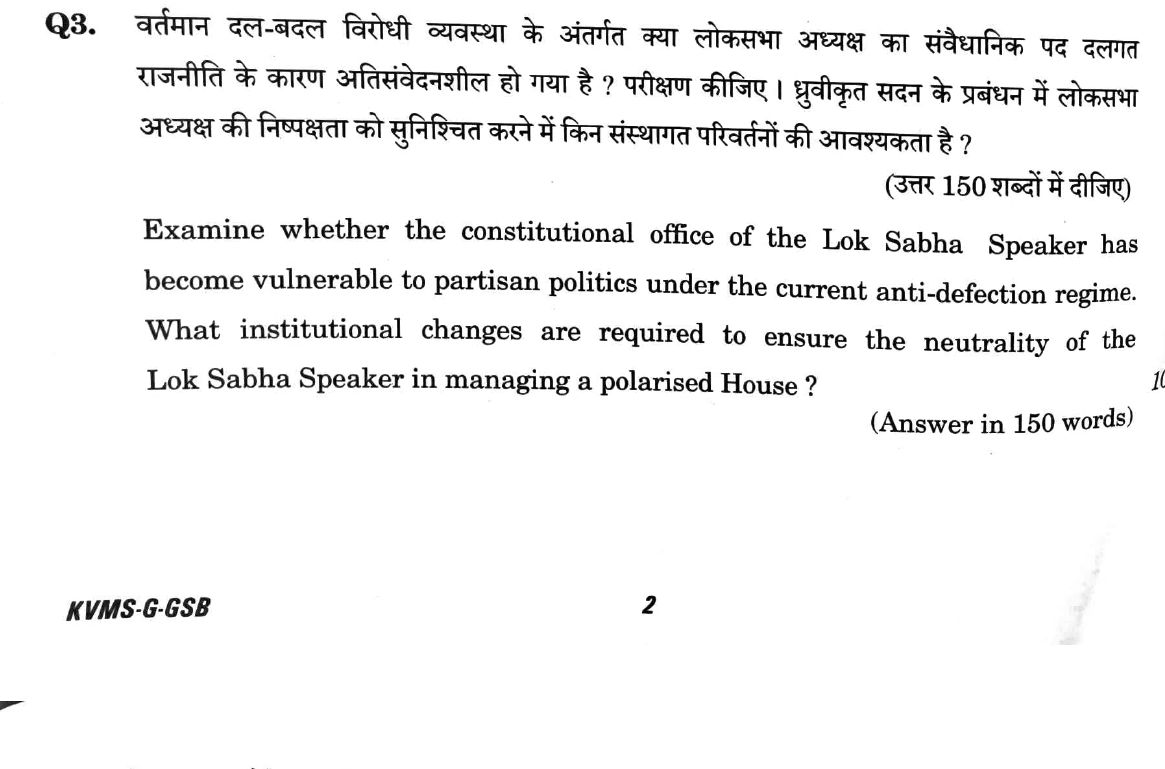
Examine whether the constitutional office of the Lok Sabha Speaker has become vulnerable to partisan politics under the current…
Examine whether the constitutional office of the Lok Sabha Speaker has become vulnerable to partisan politics under the current anti-defection regime. What institutional changes are required to ensure the neutrality of the Lok Sabha Speaker in managing a polarised House? (Answer in 150 words) 10 marks
हिंदी में प्रश्न पढ़ें
वर्तमान दल-बदल विरोधी व्यवस्था के अंतर्गत क्या लोकसभा अध्यक्ष का संवैधानिक पद दलगत राजनीति के कारण अतिसंवेदनशील हो गया है? परीक्षण कीजिए। ध्रुवीकृत सदन के प्रबंधन में लोकसभा अध्यक्ष की निष्पक्षता को सुनिश्चित करने में किन संस्थागत परिवर्तनों की आवश्यकता है? (उत्तर 150 शब्दों में दीजिए)
Model answer
Written by UPSC Answer Check against this question's marking rubric, to the 150-word length. UPSC does not publish answers for Mains — this is one way to score well, not an official key.
Article 93 establishes the Speaker’s office, while the Tenth Schedule (52nd Amendment, 1985) designates the Speaker as the sole adjudicating authority on defection petitions. Although Kihoto Hollohan (1992) upheld this quasi-judicial power subject to judicial review for perversity, mala fides, or violation of natural justice, a structural conflict of interest persists because the Speaker retains ruling party allegiance. Unlike the UK House of Commons convention of political neutrality, this has fostered partisan vulnerability, evident in prolonged inactions during legislative splits (e.g., the 2022–23 Shiv Sena and NCP matters) which invited Supreme Court strictures mandating time-bound disposal.
Institutional Reforms To insulate the office in a polarised House:
- Defection adjudication should be transferred to an independent tribunal headed by a retired judge, or to the President acting on Election Commission advice, as recommended by the Dinesh Goswami Committee and the 2nd ARC.
- Institutionalising the British convention requiring the Speaker to formally relinquish party membership upon election will guarantee structural neutrality.
What "Examine" is asking you to do
Test the proposition the question puts to you and return a finding on how far it holds. Examine stems carry a claim, or ask whether something has happened, and expect evidence weighed both ways before the extent is stated — often with remedial measures attached.
Structure that answers it
Restate the claim as the question frames it → evidence that supports it → evidence that undercuts it → the conditions under which it holds → verdict on how far it stands
Where marks are lost
Stopping at description. An examination has to reach a finding, and “examine with justification” means the extent must be stated, not implied.
How this answer will be evaluated
Approach
Framework: GS2: Governance & Constitutional Mechanisms. examine: intro > how/why with reasoning > evidence > conclusion Full marks: Analytically links anti-defection to vulnerability and offers specific, realistic institutional reforms.
Key points expected
- Link anti-defection law to Speaker's partisan vulnerability
- Identify specific institutional changes for neutrality
- Address management of a polarised House
- Provide a reasoned conclusion on the current state
Evaluation rubric
Each sub-part is marked on its own, against the marks and word limit printed on the paper.
- The answer Assess the impact of the anti-defection regime on Speaker neutrality and propose institutional reforms. · 150 words
examine— intro → how/why with reasoning → evidence → conclusion
Must cover
- Link anti-defection law to Speaker's partisan vulnerability
- Identify specific institutional changes for neutrality
- Address management of a polarised House
- Provide a reasoned conclusion on the current state
Loses marks
- Reciting Articles without analysis
- Ending without proposing reforms
- Adopting an activist tone
Earns more
- Mention specific powers of the Speaker (e.g., disqualification)
- Reference the 10th Schedule mechanism
- Suggest specific reforms (e.g., independent panel)
Extra mark
- Cite 2nd ARC or Law Commission recommendations
- Reference a relevant Supreme Court judgment
Practice this exact question
Write your answer and it is marked point by point against the model answer above — what you covered, what you missed, what you got wrong.
Evaluate my answer →More from General Studies 2026 GS Paper II
- Q1 Right to privacy relating to self-identity is very dear to every human being and well pro…
- Q2 "Women as a class neither belong to a minority group nor are they regarded as forming a b…
- Q3 Examine whether the constitutional office of the Lok Sabha Speaker has become vulnerable…
- Q4 Is the right to vote a fundamental right? Discuss the position of the Election Commission…
- Q5 Do constitutional bodies like the National Commission for Scheduled Castes (NCSC) and the…
- Q6 Does India's tribal development policy reflect the aspirations for a socially grounded an…