GS Paper II — Q1
Right to privacy relating to self-identity is very dear to every human being and well protected under Article 21 of the…
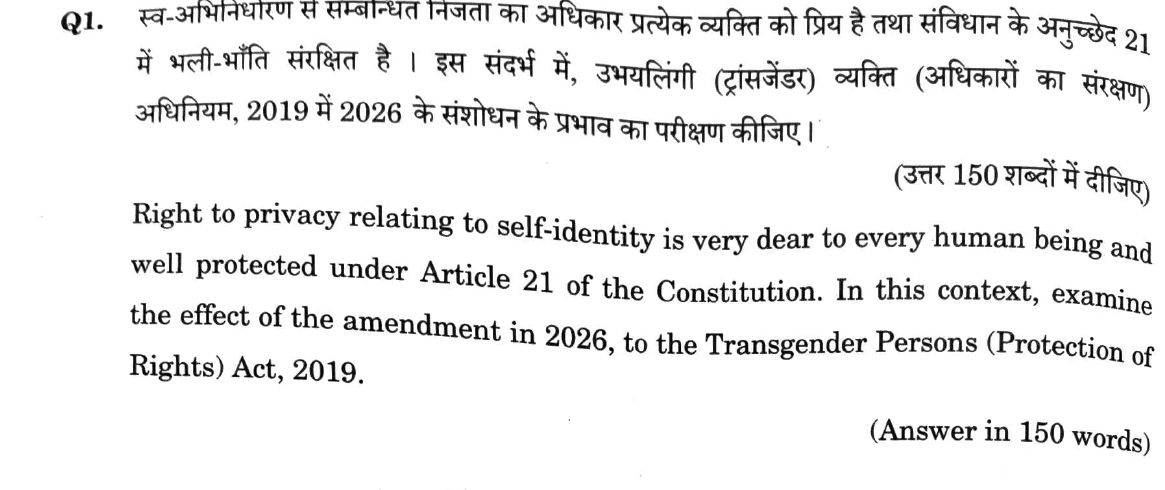
Right to privacy relating to self-identity is very dear to every human being and well protected under Article 21 of the Constitution. In this context, examine the effect of the amendment in 2026, to the Transgender Persons (Protection of Rights) Act, 2019. (Answer in 150 words) 10 marks
हिंदी में प्रश्न पढ़ें
स्व-अभिनिर्धारण से सम्बन्धित निजता का अधिकार प्रत्येक व्यक्ति को प्रिय है तथा संविधान के अनुच्छेद 21 में भली-भाँति संरक्षित है। इस संदर्भ में, उभयलिंगी (ट्रांसजेंडर) व्यक्ति (अधिकारों का संरक्षण) अधिनियम, 2019 में 2026 के संशोधन के प्रभाव का परीक्षण कीजिए। (उत्तर 150 शब्दों में दीजिए)
Model answer
Written by UPSC Answer Check against this question's marking rubric, to the 150-word length. UPSC does not publish answers for Mains — this is one way to score well, not an official key.
In K.S. Puttaswamy (2017) and NALSA (2014), the Supreme Court anchored gender self-identity within Article 21’s guarantees of privacy, dignity, and autonomy, upholding self-perceived gender identity without mandatory medical proof. The Transgender Persons Act, 2019 compromised this principle by mandating District Magistrate certification, subordinating self-determination to bureaucratic verification.
The 2026 Amendment significantly advances constitutional protections by streamlining self-certification, simplifying appellate procedures, and restructuring Transgender Welfare Boards with greater community representation. It substantially strengthens horizontal privacy rights against discrimination by private employers, families, and institutions, while reinforcing vertical safeguards against state intrusion.
However, critical gaps persist, including the absence of firm statutory timelines for certificate issuance, weak penal deterrence against violations, and the non-provision of dedicated grievance redressal tribunals. Thus, while the 2026 amendment meaningfully fortifies the Article 21 right to self-identity and privacy, fully realizing its constitutional promise requires closing these procedural and enforcement deficits.
What "Examine" is asking you to do
Test the proposition the question puts to you and return a finding on how far it holds. Examine stems carry a claim, or ask whether something has happened, and expect evidence weighed both ways before the extent is stated — often with remedial measures attached.
Structure that answers it
Restate the claim as the question frames it → evidence that supports it → evidence that undercuts it → the conditions under which it holds → verdict on how far it stands
Where marks are lost
Stopping at description. An examination has to reach a finding, and “examine with justification” means the extent must be stated, not implied.
How this answer will be evaluated
Approach
Framework: GS2: Constitutional Law & Governance. examine: intro > how/why with reasoning > evidence > conclusion Full marks: Critically links the 2026 medical board and definition changes to the erosion of Article 21 privacy and self-identity.
Key points expected
- Link Article 21 privacy to the 2019 Act's self-identification mechanism
- Identify the 2026 shift to medical board certification
- Analyze the exclusion of self-perceived identity from the definition
- Evaluate the conflict between state regulation and individual autonomy
Evaluation rubric
Each sub-part is marked on its own, against the marks and word limit printed on the paper.
- The answer Assess the 2026 amendment's impact on the constitutional right to privacy and self-identity. · 150 words
examine— intro → how/why with reasoning → evidence → conclusion
Must cover
- Link Article 21 privacy to the 2019 Act's self-identification mechanism
- Identify the 2026 shift to medical board certification
- Analyze the exclusion of self-perceived identity from the definition
- Evaluate the conflict between state regulation and individual autonomy
Loses marks
- Reciting the 2019 Act's provisions without analyzing the 2026 change
- Failing to connect the amendment to Article 21
- Adopting an activist tone without legal reasoning
Earns more
- Reference to the 2014 NALSA judgment on gender identity
- Mention of the 2026 mandatory surgery requirement for revised certificates
- Discussion of the 'constitutional morality' test
- Reference to the exclusion of sexual orientation from the Act
Extra mark
- Citation of the 2017 Puttaswamy judgment on privacy
- Reference to Law Commission or 2nd ARC recommendations on rights
Practice this exact question
Write your answer and it is marked point by point against the model answer above — what you covered, what you missed, what you got wrong.
Evaluate my answer →More from General Studies 2026 GS Paper II
- Q1 Right to privacy relating to self-identity is very dear to every human being and well pro…
- Q2 "Women as a class neither belong to a minority group nor are they regarded as forming a b…
- Q3 Examine whether the constitutional office of the Lok Sabha Speaker has become vulnerable…
- Q4 Is the right to vote a fundamental right? Discuss the position of the Election Commission…