GS Paper II — Q2
"Women as a class neither belong to a minority group nor are they regarded as forming a backward class." In the light of this…
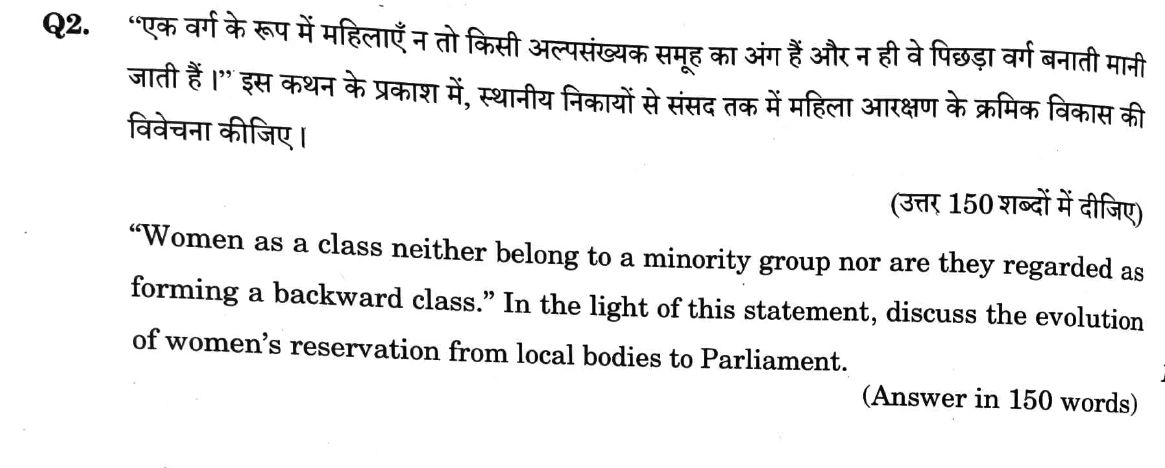
"Women as a class neither belong to a minority group nor are they regarded as forming a backward class." In the light of this statement, discuss the evolution of women's reservation from local bodies to Parliament. (Answer in 150 words) 10 marks
हिंदी में प्रश्न पढ़ें
“एक वर्ग के रूप में महिलाएँ न तो किसी अल्पसंख्यक समूह का अंग हैं और न ही वे पिछड़ा वर्ग बनाती मानी जाती हैं।” इस कथन के प्रकाश में, स्थानीय निकायों से संसद तक में महिला आरक्षण के क्रमिक विकास की विवेचना कीजिए। (उत्तर 150 शब्दों में दीजिए)
Model answer
Written by UPSC Answer Check against this question's marking rubric, to the 150-word length. UPSC does not publish answers for Mains — this is one way to score well, not an official key.
The premise separates women from minority and backward-class claims under Articles 15(4) and 16(4); Article 15(3) permits special provisions, but political reservation flows from amendments. The 73rd and 74th Amendments (1992) inserted Articles 243D and 243T, reserving one-third of Panchayat and municipal seats for women. Parliament’s reservation was long pending: the Women’s Reservation Bill, examined by the Geeta Mukherjee Committee (1996), made recommendations for amendments, including OBC sub-reservation, yet lapsed repeatedly. The 106th Amendment (Nari Shakti Vandan Adhiniyam, 2023) inserted Articles 330A and 332A, reserving one-third Lok Sabha and State Assembly seats for women, with one-third of SC/ST-reserved seats for SC/ST women. Enforcement awaits delimitation after the next Census. The need for OBC women’s sub-quotas, and the adequacy of SC/ST women’s sub-quota, remains contested; Indra Sawhney’s backward-class test cautions against treating women as a backward class. Thus, the evolution shows constitutional recognition, but implementation and internal equity remain unfinished.
What "Discuss" is asking you to do
Lay the issue out from more than one side — how it arose, what is claimed for it, what is held against it, and where it now stands. UPSC attaches discuss to broad topics with several live dimensions, so coverage of the dimensions earns more than the strength of your opinion.
Structure that answers it
Set the issue up → the case as it is made → the case against → the dimension both sides leave out → where the balance now lies
Where marks are lost
Listing facts with no thread between them, or arguing one side throughout and calling it a discussion.
How this answer will be evaluated
Approach
Framework: Constitutional Evolution & Representation. discuss: intro > 3-4 dimensions > example > balanced close Full marks: Precise timeline of Amendments with constitutional logic.
Key points expected
- 73rd/74th Amendments (1992)
- 106th Amendment (2010)
- 106th Amendment (2023)
- Women as a distinct class
Evaluation rubric
Each sub-part is marked on its own, against the marks and word limit printed on the paper.
- The answer Trace the legislative journey of women's reservation from Panchayats to Parliament. · 150 words
discuss— intro → 3-4 dimensions → example → balanced close
Must cover
- 73rd/74th Amendments (1992) local body reservation
- 106th Amendment (2010) Rajya Sabha 1/3rd
- 106th Amendment (2023) Lok Sabha 1/3rd
- Constitutional logic: women as distinct class
Loses marks
- Reciting Articles without linking to evolution
- Ignoring the 'minority/backward class' context
- Ending without a forward-looking reform note
Earns more
- Mention of 1996/1997 Bills (stalled)
- Reference to 'Constitutional Morality' argument
- Distinction between 'minority' and 'class' status
- Mention of 2023 Presidential Assent
Extra mark
- 2nd ARC recommendation on women's representation
- Supreme Court judgment on reservation validity
Practice this exact question
Write your answer and it is marked point by point against the model answer above — what you covered, what you missed, what you got wrong.
Evaluate my answer →More from General Studies 2026 GS Paper II
- Q1 Right to privacy relating to self-identity is very dear to every human being and well pro…
- Q2 "Women as a class neither belong to a minority group nor are they regarded as forming a b…
- Q3 Examine whether the constitutional office of the Lok Sabha Speaker has become vulnerable…
- Q4 Is the right to vote a fundamental right? Discuss the position of the Election Commission…
- Q5 Do constitutional bodies like the National Commission for Scheduled Castes (NCSC) and the…