GS Paper II — Q5
Do constitutional bodies like the National Commission for Scheduled Castes (NCSC) and the National Commission for Scheduled…
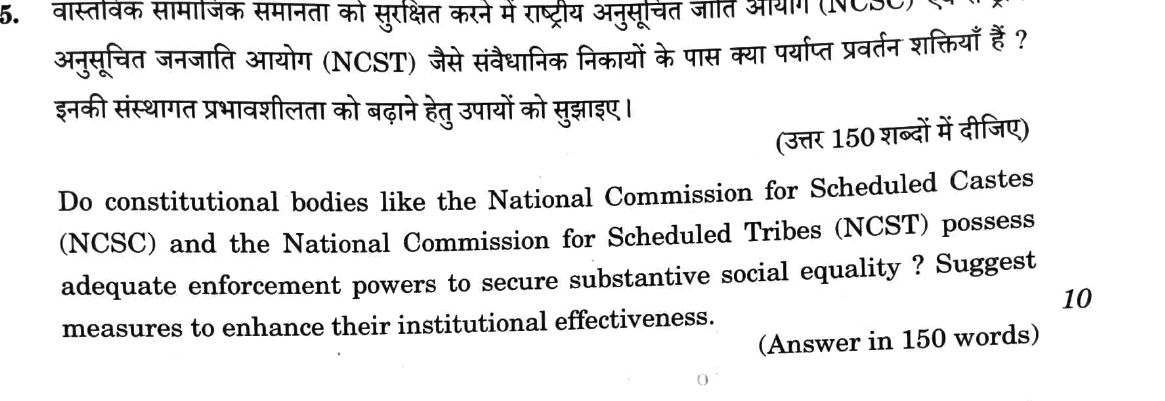
Do constitutional bodies like the National Commission for Scheduled Castes (NCSC) and the National Commission for Scheduled Tribes (NCST) possess adequate enforcement powers to secure substantive social equality? Suggest measures to enhance their institutional effectiveness. (Answer in 150 words) 10 marks
हिंदी में प्रश्न पढ़ें
वास्तविक सामाजिक समानता को सुरक्षित करने में राष्ट्रीय अनुसूचित जाति आयोग (NCSC) एवं राष्ट्रीय अनुसूचित जनजाति आयोग (NCST) जैसे संवैधानिक निकायों के पास क्या पर्याप्त प्रवर्तन शक्तियाँ हैं? इनकी संस्थागत प्रभावशीलता को बढ़ाने हेतु उपायों को सुझाइए। (उत्तर 150 शब्दों में दीजिए)
Model answer
Written by UPSC Answer Check against this question's marking rubric, to the 150-word length. UPSC does not publish answers for Mains — this is one way to score well, not an official key.
NCSC and NCST, created under Articles 338 and 338A by the 89th Amendment, 2003, split the erstwhile combined National Commission for SCs and STs. Under 338(6)/338A(6) they possess quasi-judicial civil-court powers—summoning witnesses, compelling documents and receiving evidence—to investigate specific complaints. Yet their reports are recommendatory and non-binding; 338(8)/338A(8) only requires them to be laid before Parliament with an explanatory memorandum, without compelling executive action. Hence, they cannot secure substantive social equality. An enforcement gap remains vis-à-vis the Protection of Civil Rights Act, 1955 and the SC/ST (Prevention of Atrocities) Act, 1989, where prosecution lies with police and special courts, not the commissions. Unlike NHRC, they lack a robust investigative-cum-prosecutorial mandate. To enhance institutional effectiveness, Parliament should give statutory backing making Action Taken Reports time-bound and reportable to Parliament, create dedicated implementation/monitoring cells, provide adequate staffing and budgetary autonomy, and strengthen coordination with State Commissions and District Vigilance and Monitoring Committees.
What "Suggest" is asking you to do
Propose measures that attach to the causes the question has just had you identify. Each should name who acts, on what, and why it would work; a measure with no actor behind it is a wish rather than a suggestion.
Structure that answers it
The problem in one line → measure 1 with the cause it addresses → measure 2 → measure 3 → how it would be implemented and what it requires
Where marks are lost
Prescriptions that would fit any question on any subject — awareness campaigns, capacity building, better coordination. The examiner checks whether each measure is traceable to a cause the answer itself named.
How this answer will be evaluated
Approach
Framework: GS2 Paper 2: Constitutional Bodies & Governance. suggest: the problem in one line > implementable measures > who acts > conclusion Full marks: Sharp analysis of enforcement gaps with specific, implementable reforms.
Key points expected
- Identify specific enforcement gaps (e.g., lack of coercive power)
- Distinguish between advisory and enforcement powers
- Propose concrete measures to enhance institutional effectiveness
- Link powers to securing substantive social equality
Evaluation rubric
Each sub-part is marked on its own, against the marks and word limit printed on the paper.
- The answer Evaluate NCSC/NCST enforcement powers and propose measures for institutional effectiveness. 10 marks · 150 words
suggest— the problem in one line → implementable measures → who acts → conclusion
Must cover
- Identify specific enforcement gaps (e.g., lack of coercive power)
- Distinguish between advisory and enforcement powers
- Propose concrete measures to enhance institutional effectiveness
- Link powers to securing substantive social equality
Loses marks
- Reciting Articles without analysis of powers
- Vague suggestions without implementation details
- Failing to address the 'enforcement' aspect specifically
Earns more
- Mention specific constitutional provisions (Art 338/338A)
- Reference specific challenges (e.g., composition, funding)
- Suggest specific legal or administrative reforms
- Use examples of commission's limited impact
Extra mark
- Cite 2nd ARC or Law Commission recommendations
- Reference relevant Supreme Court judgments
Practice this exact question
Write your answer and it is marked point by point against the model answer above — what you covered, what you missed, what you got wrong.
Evaluate my answer →More from General Studies 2026 GS Paper II
- Q2 "Women as a class neither belong to a minority group nor are they regarded as forming a b…
- Q3 Examine whether the constitutional office of the Lok Sabha Speaker has become vulnerable…
- Q4 Is the right to vote a fundamental right? Discuss the position of the Election Commission…
- Q5 Do constitutional bodies like the National Commission for Scheduled Castes (NCSC) and the…
- Q6 Does India's tribal development policy reflect the aspirations for a socially grounded an…
- Q7 Malnutrition in India is not merely a public health concern; it is also a challenge of so…
- Q8 Analyse the advantages and limitations of the generalist structure of the Indian Civil Se…