GS Paper II — Q4
Is the right to vote a fundamental right? Discuss the position of the Election Commission of India while undertaking the revision…
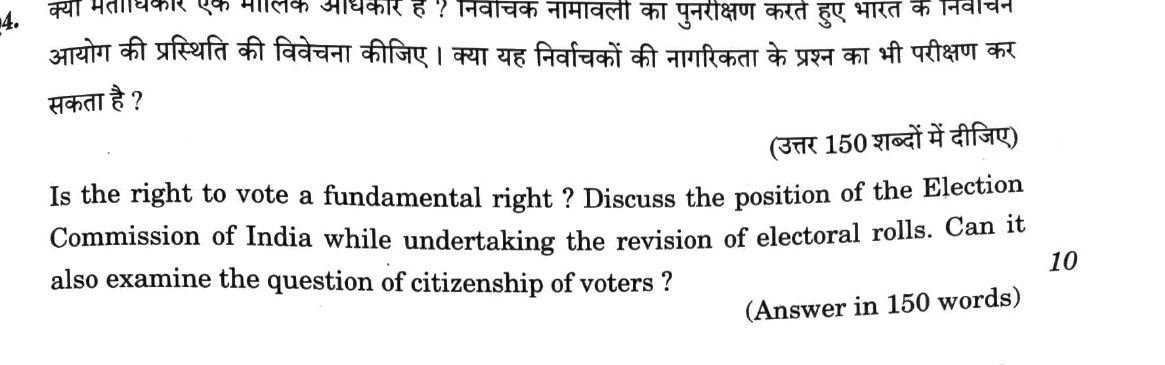
Is the right to vote a fundamental right? Discuss the position of the Election Commission of India while undertaking the revision of electoral rolls. Can it also examine the question of citizenship of voters? (Answer in 150 words) 10 marks
हिंदी में प्रश्न पढ़ें
क्या मताधिकार एक मौलिक अधिकार है? निर्वाचक नामावली का पुनरीक्षण करते हुए भारत के निर्वाचन आयोग की प्रस्थिति की विवेचना कीजिए। क्या यह निर्वाचकों की नागरिकता के प्रश्न का भी परीक्षण कर सकता है? (उत्तर 150 शब्दों में दीजिए)
Model answer
Written by UPSC Answer Check against this question's marking rubric, to the 150-word length. UPSC does not publish answers for Mains — this is one way to score well, not an official key.
The right to vote is not a Part III Fundamental Right, but a constitutional right under Article 326 and a statutory right under Section 62 of the Representation of the People Act (RPA), 1951, as affirmed in Jyoti Basu v. Debi Ghosal (1982) and PUCL v. UOI (2003).
ECI’s Role in Electoral Roll Revision Article 324 vests the superintendence, direction, and control of electoral rolls in the Election Commission of India (ECI). Sections 21–23 of the RPA, 1950 govern intensive and summary revisions for inclusions, exclusions, and objections. Exercises like the Special Intensive Revision (SIR) underscore the ECI's administrative mandate to ensure pure rolls, while raising critical due-process concerns regarding the protection of genuine electors.
Determining Citizenship Substantive citizenship determination is governed by the Citizenship Act, 1955, not by the ECI. In Lal Babu Hussein v. ERO, the Supreme Court held that while the ECI can verify prima facie eligibility for enrollment, it cannot summarily disenfranchise voters without a fair inquiry adhering to principles of natural justice.
Way Forward
What "Discuss" is asking you to do
Lay the issue out from more than one side — how it arose, what is claimed for it, what is held against it, and where it now stands. UPSC attaches discuss to broad topics with several live dimensions, so coverage of the dimensions earns more than the strength of your opinion.
Structure that answers it
Set the issue up → the case as it is made → the case against → the dimension both sides leave out → where the balance now lies
Where marks are lost
Listing facts with no thread between them, or arguing one side throughout and calling it a discussion.
How this answer will be evaluated
Approach
Framework: GS2 Polity: Constitutional Provisions & Institutional Powers. discuss: intro > 3-4 dimensions > example > balanced close Full marks: Correctly distinguishes statutory voting right from fundamental right and clearly limits ECI's power to roll revision, not citizenship adjudication.
Key points expected
- Voting is a statutory right, not fundamental
- ECI revises rolls under Representation of the People Act
- ECI cannot adjudicate citizenship disputes
- Citizenship questions go to courts/authorities
Evaluation rubric
Each sub-part is marked on its own, against the marks and word limit printed on the paper.
- The answer Legal status of voting right and ECI's jurisdiction over citizenship during roll revision. 10 marks · 150 words
discuss— intro → 3-4 dimensions → example → balanced close
Must cover
- Voting is a statutory right, not fundamental
- ECI revises rolls under Representation of the People Act
- ECI cannot adjudicate citizenship disputes
- Citizenship questions go to courts/authorities
Loses marks
- Claims voting is a fundamental right
- States ECI can decide citizenship
- Recites Article 326 without analysis
Earns more
- Cites Article 326 (Parliamentary power)
- Mentions Citizenship Act 1955
- Distinguishes 'right to vote' from 'right to citizenship'
Extra mark
- Cites Supreme Court judgment on voting rights
- Mentions specific ECI notification regarding revision
Practice this exact question
Write your answer and it is marked point by point against the model answer above — what you covered, what you missed, what you got wrong.
Evaluate my answer →More from General Studies 2026 GS Paper II
- Q1 Right to privacy relating to self-identity is very dear to every human being and well pro…
- Q2 "Women as a class neither belong to a minority group nor are they regarded as forming a b…
- Q3 Examine whether the constitutional office of the Lok Sabha Speaker has become vulnerable…
- Q4 Is the right to vote a fundamental right? Discuss the position of the Election Commission…
- Q5 Do constitutional bodies like the National Commission for Scheduled Castes (NCSC) and the…
- Q6 Does India's tribal development policy reflect the aspirations for a socially grounded an…
- Q7 Malnutrition in India is not merely a public health concern; it is also a challenge of so…