GS Paper III — Q3
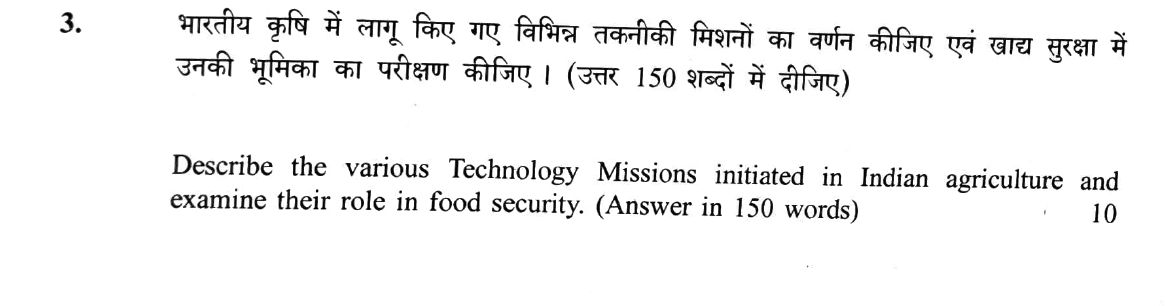
Describe the various Technology Missions initiated in Indian agriculture and examine their role in food security. (Answer in 150…
Describe the various Technology Missions initiated in Indian agriculture and examine their role in food security. (Answer in 150 words) 10 marks
हिंदी में प्रश्न पढ़ें
भारतीय कृषि में लागू किए गए विभिन्न तकनीकी मिशनों का वर्णन कीजिए एवं खाद्य सुरक्षा में उनकी भूमिका का परीक्षण कीजिए। (उत्तर 150 शब्दों में दीजिए)
Model answer
Written by UPSC Answer Check against this question's marking rubric, to the 150-word length. UPSC does not publish answers for Mains — this is one way to score well, not an official key.
India’s agricultural Technology Missions began as crop-specific interventions to raise productivity. The Technology Mission on Oilseeds (1986) and Technology Mission on Pulses/Oilseeds targeted oilseeds/pulses; the Technology Mission on Cotton (2000) raised cotton yield; the Technology Mission for Integrated Development of Horticulture in the North Eastern and Himalayan States expanded horticulture; and the National Mission on Oilseeds and Oil Palm (NMOOP) boosts oilseeds/oil-palm productivity.
Later missions/schemes widened scope: NFSM boosts rice, wheat, pulses and coarse cereals; NMSA promotes climate-resilient practices under NAPCC; SMAM supports custom hiring centres/equipment access; Digital Agriculture Mission/NeGP-A builds AgriStack, farmer database and digital advisories; National Mission on Natural Farming and PM-KUSUM cut input costs and enable solar irrigation; RKVY funds state-specific technology adoption.
They strengthen food security through higher output, diversification, lower costs and access. Yet gains are uneven due to smallholder, seed/credit, regional and implementation gaps. Food security needs convergence, extension and inclusive delivery.
What "Describe" is asking you to do
Give a full, ordered account of the thing named — its parts, stages or mechanism — in the sequence in which it actually exists or occurs. Most describe questions come from the science optionals, where the marks sit in correct technical detail and, where the stem says so, a labelled diagram.
Structure that answers it
One-line identification of the subject → the parts or stages in their real order, each with its defining detail → labelled diagram where the subject is structural → closing line on function or significance
Where marks are lost
Loose general prose where the examiner is ticking named parts, correct terminology and their sequence; and in the General Studies papers, turning to evaluation before the description is finished.
How this answer will be evaluated
Approach
Framework: Situation > Analysis > Measures > Assessment. examine: intro > how/why with reasoning > evidence > conclusion Full marks: Names 3+ missions, clearly links each to food security, and provides a balanced assessment.
Key points expected
- Name at least 3 distinct missions (e.g., Wheat, Rice, Horticulture)
- Explain the specific technology or focus of each mission
- Link mission outcomes to food security (production, availability, or nutrition)
- Provide a balanced assessment of their role
Evaluation rubric
Each sub-part is marked on its own, against the marks and word limit printed on the paper.
- The answer Identify key agricultural technology missions and analyze their specific contribution to food security. 10 marks · 150 words
examine— intro → how/why with reasoning → evidence → conclusion
Must cover
- Name at least 3 distinct missions (e.g., Wheat, Rice, Horticulture)
- Explain the specific technology or focus of each mission
- Link mission outcomes to food security (production, availability, or nutrition)
- Provide a balanced assessment of their role
Loses marks
- Listing missions without explaining their role in food security
- Confusing general agricultural policies with specific technology missions
- Focusing only on one mission in detail
Earns more
- Mentioning specific crops or regions associated with missions
- Referencing the Green Revolution context
- Discussing post-harvest technology missions
- Mentioning the National Food Security Mission (NFSM)
Extra mark
- Citing a specific production statistic for a mission crop
- Mentioning the year of launch for a specific mission
Practice this exact question
Write your answer and it is marked point by point against the model answer above — what you covered, what you missed, what you got wrong.
Evaluate my answer →More from General Studies 2026 GS Paper III
- Q1 What do you mean by Digital Rupee? In this context, explain the working and progress of I…
- Q2 Examine the view that financial inclusion is an integral part of social and economic incl…
- Q3 Describe the various Technology Missions initiated in Indian agriculture and examine thei…
- Q4 Explain the factors responsible for inefficiency of agri-produce marketing. How e-commerc…
- Q5 Explain by giving two examples, how biotechnology has helped the Indian farmers in proces…
- Q6 Distinguish between a Fast Breeder Reactor (FBR) and a thermal nuclear reactor. In the co…