GS Paper III — Q4
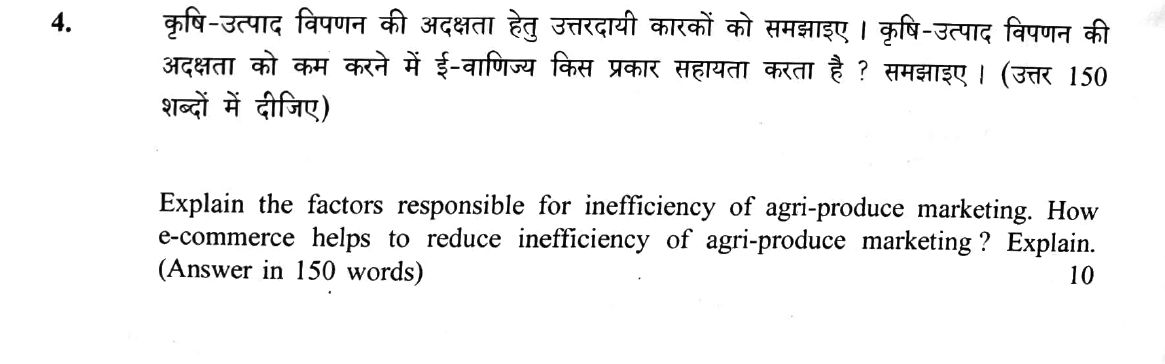
Explain the factors responsible for inefficiency of agri-produce marketing. How e-commerce helps to reduce inefficiency of…
Explain the factors responsible for inefficiency of agri-produce marketing. How e-commerce helps to reduce inefficiency of agri-produce marketing? Explain. (Answer in 150 words) 10 marks
हिंदी में प्रश्न पढ़ें
कृषि-उत्पाद विपणन की अदक्षता हेतु उत्तरदायी कारकों को समझाइए। कृषि-उत्पाद विपणन की अदक्षता को कम करने में ई-वाणिज्य किस प्रकार सहायता करता है? समझाइए। (उत्तर 150 शब्दों में दीजिए)
Model answer
Written by UPSC Answer Check against this question's marking rubric, to the 150-word length. UPSC does not publish answers for Mains — this is one way to score well, not an official key.
Agri-produce marketing in India suffers from structural bottlenecks that suppress farmer realizations and inflate end-consumer prices.
Factors causing inefficiency: First, a multiplicity of intermediaries and cartelization in APMC mandis inflate the farmer-to-consumer price spread through compounded commissions. Second, deficient cold-chain and warehousing infrastructure triggers severe post-harvest losses, particularly in perishables. Third, pervasive information asymmetry regarding prevailing prices across alternative markets forces smallholders into local distress sales.
Role of e-commerce in reducing inefficiency: E-commerce counteracts these gaps through digital disintermediation and transparent price discovery. The e-NAM portal links fragmented mandis across states, enabling online competitive bidding and transparent price realization. Furthermore, ONDC agri-pilots and direct-to-consumer agritech platforms like Ninjacart and DeHaat eliminate redundant intermediary layers, directly connecting farmers to institutional buyers and urban retail. Additionally, digital logistics apps such as Kisan Rath optimize transport matching and supply-chain routing, significantly curtailing transit delays and spoilage-related losses.
Scaling farm-gate assaying and digital literacy remains vital to maximize these e-commerce efficiencies.
What "Explain" is asking you to do
Make the working of something clear — what sets it off, what follows from what, and what it produces. Explain is the Commission's mechanism word: it dominates the technical papers and the “explain why” stems, where the marks sit in the causal chain and not in the label.
Structure that answers it
State what it is → the initiating condition → the chain of cause, step by step → an instance where it plays out → what the chain produces
Where marks are lost
Describing what something looks like instead of why it works that way. Naming the stages without linking them reads as description too.
How this answer will be evaluated
Approach
Framework: Situation > Analysis > Measures > Assessment. explain: definition/context > points in order > small example > short close Full marks: Precise mapping of specific bottlenecks to specific e-commerce solutions with named platforms.
Key points expected
- Identify 3-4 specific inefficiency factors (e.g., intermediaries, lack of info)
- Explain how e-commerce addresses specific inefficiencies (e.g., direct link, data)
- Mention specific platforms (e.g., e-NAM, ONDC) or mechanisms
- Maintain logical link between problem and digital solution
Evaluation rubric
Each sub-part is marked on its own, against the marks and word limit printed on the paper.
- The answer Identify structural causes of agri-marketing inefficiency and map e-commerce solutions to them. 10 marks · 150 words
explain— definition/context → points in order → small example → short close
Must cover
- Identify 3-4 specific inefficiency factors (e.g., intermediaries, lack of info)
- Explain how e-commerce addresses specific inefficiencies (e.g., direct link, data)
- Mention specific platforms (e.g., e-NAM, ONDC) or mechanisms
- Maintain logical link between problem and digital solution
Loses marks
- Generic praise of technology without specific mechanism
- Ignoring the 'inefficiency' part of the question
- Aspirational writing without implementable measures
Earns more
- Mention specific data points on price spread or wastage
- Reference specific government initiatives (e-NAM, PM-KISAN)
- Brief mention of challenges (digital divide, logistics)
Extra mark
- Simple flowchart of traditional vs e-commerce supply chain
- Specific statistic on price realization improvement
Practice this exact question
Write your answer and it is marked point by point against the model answer above — what you covered, what you missed, what you got wrong.
Evaluate my answer →More from General Studies 2026 GS Paper III
- Q1 What do you mean by Digital Rupee? In this context, explain the working and progress of I…
- Q2 Examine the view that financial inclusion is an integral part of social and economic incl…
- Q3 Describe the various Technology Missions initiated in Indian agriculture and examine thei…
- Q4 Explain the factors responsible for inefficiency of agri-produce marketing. How e-commerc…
- Q5 Explain by giving two examples, how biotechnology has helped the Indian farmers in proces…
- Q6 Distinguish between a Fast Breeder Reactor (FBR) and a thermal nuclear reactor. In the co…
- Q7 Discuss how the contradiction between 'rapid infrastructure development' and 'disaster-ri…