GS Paper III — Q7
Discuss how the contradiction between 'rapid infrastructure development' and 'disaster-risk reduction' in ecologically-sensitive…
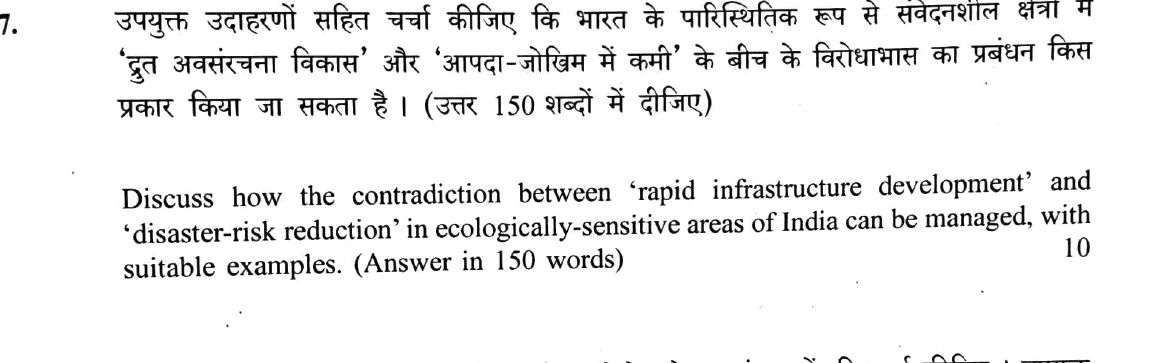
Discuss how the contradiction between 'rapid infrastructure development' and 'disaster-risk reduction' in ecologically-sensitive areas of India can be managed, with suitable examples. (Answer in 150 words) 10 marks
हिंदी में प्रश्न पढ़ें
उपयुक्त उदाहरणों सहित चर्चा कीजिए कि भारत के पारिस्थितिक रूप से संवेदनशील क्षेत्रों में 'द्रुत अवसंरचना विकास' और 'आपदा-जोखिम में कमी' के बीच के विरोधाभास का प्रबंधन किस प्रकार किया जा सकता है। (उत्तर 150 शब्दों में दीजिए)
Model answer
Written by UPSC Answer Check against this question's marking rubric, to the 150-word length. UPSC does not publish answers for Mains — this is one way to score well, not an official key.
Rapid infrastructure expansion in ecologically fragile zones often exacerbates disaster vulnerabilities. In the fragile Himalayas, the Char Dham all-weather road project has triggered slope destabilisation and landslides due to unscientific hill-cutting. Similarly, the 2023 Joshimath land subsidence highlighted how unplanned construction and hydropower tunnelling compromise geologically vulnerable, seismically active terrains. In peninsular India, unchecked infrastructure growth in the Western Ghats—as underscored by the Madhav Gadgil and K. Kasturirangan Committee reports—demonstrates the conflict surrounding Eco-Sensitive Zone (ESZ) demarcation and disaster vulnerability.
Managing the Contradiction To harmonize development with disaster-risk reduction:
- Impact Assessments: Mandate comprehensive Environmental Impact Assessments (EIA) along with cumulative impact assessments to respect regional carrying capacities before project approvals.
- Risk-Informed Planning: Mainstream National Disaster Management Authority (NDMA) and NIDM guidelines on climate-resilient infrastructure, integrating high-resolution multi-hazard zonation mapping.
Adopting nature-based engineering and strict zoning regulations is essential to ensure infrastructure strengthens, rather than undermines, ecological and community resilience.
What "Discuss" is asking you to do
Lay the issue out from more than one side — how it arose, what is claimed for it, what is held against it, and where it now stands. UPSC attaches discuss to broad topics with several live dimensions, so coverage of the dimensions earns more than the strength of your opinion.
Structure that answers it
Set the issue up → the case as it is made → the case against → the dimension both sides leave out → where the balance now lies
Where marks are lost
Listing facts with no thread between them, or arguing one side throughout and calling it a discussion.
How this answer will be evaluated
Approach
Framework: GS3 Environment: threat, causes, impact, mitigation. discuss: intro > 3-4 dimensions > example > balanced close Full marks: Clear contradiction, specific examples, implementable measures, strong risk-reduction focus
Key points expected
- Identify the core contradiction between development and risk reduction
- Provide at least one specific example of an ecologically-sensitive area
- Suggest implementable measures for managing the contradiction
- Link measures to disaster-risk reduction specifically
Evaluation rubric
Each sub-part is marked on its own, against the marks and word limit printed on the paper.
- The answer Explain management of contradiction between rapid infrastructure development and disaster-risk reduction in ecologically-sensitive areas. 10 marks · 150 words
discuss— intro → 3-4 dimensions → example → balanced close
Must cover
- Identify the core contradiction between development and risk reduction
- Provide at least one specific example of an ecologically-sensitive area
- Suggest implementable measures for managing the contradiction
- Link measures to disaster-risk reduction specifically
Loses marks
- Generic discussion without specific examples
- Focusing only on development without addressing risk reduction
- Aspirational solutions without implementation details
Earns more
- Mentions specific legislation like Environment Impact Assessment Act
- References specific projects like dams or highways in sensitive zones
- Discusses institutional mechanisms for balancing development and safety
- Mentions specific disaster types relevant to the area
Extra mark
- Cites specific committee recommendations or policy documents
- Provides specific data on disaster losses in sensitive areas
Practice this exact question
Write your answer and it is marked point by point against the model answer above — what you covered, what you missed, what you got wrong.
Evaluate my answer →More from General Studies 2026 GS Paper III
- Q4 Explain the factors responsible for inefficiency of agri-produce marketing. How e-commerc…
- Q5 Explain by giving two examples, how biotechnology has helped the Indian farmers in proces…
- Q6 Distinguish between a Fast Breeder Reactor (FBR) and a thermal nuclear reactor. In the co…
- Q7 Discuss how the contradiction between 'rapid infrastructure development' and 'disaster-ri…
- Q8 Discuss the aim and goals of Kunming-Montreal global biodiversity framework. Mention Indi…
- Q9 Explain how fake news and disinformation pose threat to Internal Security and Public Orde…
- Q10 Ladakh is strategically located between China and Pakistan. As a measure to win hearts an…