GS Paper III — Q8
Discuss the aim and goals of Kunming-Montreal global biodiversity framework. Mention India's commitments and initiatives to…
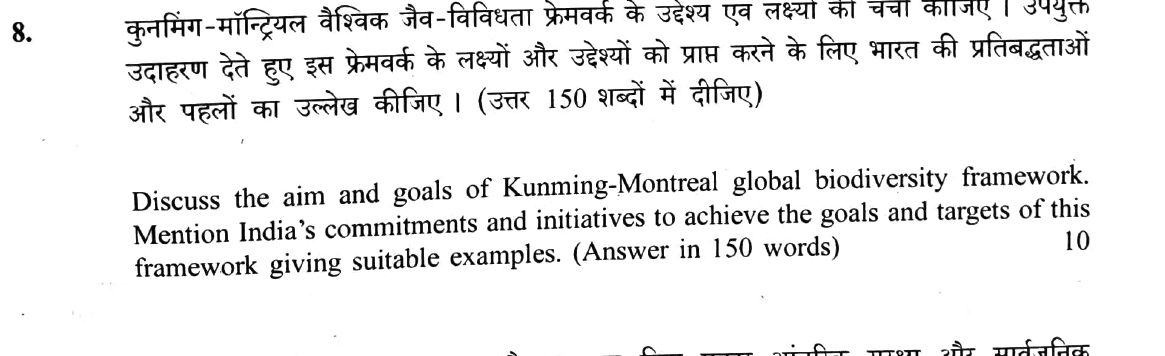
Discuss the aim and goals of Kunming-Montreal global biodiversity framework. Mention India's commitments and initiatives to achieve the goals and targets of this framework giving suitable examples. (Answer in 150 words) 10 marks
हिंदी में प्रश्न पढ़ें
कुनमिंग-मॉन्ट्रियल वैश्विक जैव-विविधता फ्रेमवर्क के उद्देश्य एवं लक्ष्यों की चर्चा कीजिए। उपयुक्त उदाहरण देते हुए इस फ्रेमवर्क के लक्ष्यों और उद्देश्यों को प्राप्त करने के लिए भारत की प्रतिबद्धताओं और पहलों का उल्लेख कीजिए। (उत्तर 150 शब्दों में दीजिए)
Model answer
Written by UPSC Answer Check against this question's marking rubric, to the 150-word length. UPSC does not publish answers for Mains — this is one way to score well, not an official key.
The Kunming-Montreal Global Biodiversity Framework, adopted at CBD COP15 in December 2022, sets four 2050 goals: (A) avoid, prevent and reduce risks of biodiversity loss and maintain ecosystem integrity, resilience, stability; (B) address root causes of biodiversity loss while meeting people’s needs; (C) ensure fair and equitable sharing of benefits from genetic resources; and (D) strengthen knowledge, science, technology and indigenous/local knowledge to reverse loss. It has 23 targets for 2030, including Target 3’s “30×30” conservation of at least 30% of terrestrial, inland water, coastal and marine areas, and mobilising at least USD 200 billion annually from all sources, including international finance. India’s revised National Biodiversity Strategy and Action Plan aligns national targets with the GBF. Initiatives include Project Tiger, Project Lion, Project Elephant, the LiFE mission and expansion of Ramsar wetland sites. India must now integrate these into state plans, financing and monitoring to convert commitments into measurable outcomes.
What "Discuss" is asking you to do
Lay the issue out from more than one side — how it arose, what is claimed for it, what is held against it, and where it now stands. UPSC attaches discuss to broad topics with several live dimensions, so coverage of the dimensions earns more than the strength of your opinion.
Structure that answers it
Set the issue up → the case as it is made → the case against → the dimension both sides leave out → where the balance now lies
Where marks are lost
Listing facts with no thread between them, or arguing one side throughout and calling it a discussion.
How this answer will be evaluated
Approach
Framework: GS3 Environment: Threat, Causes, Impact, Mitigation. discuss: intro > 3-4 dimensions > example > balanced close Full marks: Precise KMBF targets linked to specific Indian schemes (e.g., NEEA, NBSAP).
Key points expected
- State KMBF aim (e.g., 30x30 target)
- Mention India's specific commitment (e.g., 30% NEEA)
- Name one Indian initiative (e.g., National Mission on Bio-diversity)
- Link initiative to a specific framework target
Evaluation rubric
Each sub-part is marked on its own, against the marks and word limit printed on the paper.
- The answer Explain KMBF objectives and India's specific commitments/initiatives with examples. 10 marks · 150 words
discuss— intro → 3-4 dimensions → example → balanced close
Must cover
- State KMBF aim (e.g., 30x30 target)
- Mention India's specific commitment (e.g., 30% NEEA)
- Name one Indian initiative (e.g., National Mission on Bio-diversity)
- Link initiative to a specific framework target
Loses marks
- Generic environmental measures without KMBF link
- Vague mention of 'India's efforts' without examples
- Ignoring the 'suitable examples' requirement
Earns more
- Mention 30x30 target (30% by 2030)
- Reference National Biodiversity Strategy and Action Plan (NBSAP)
- Mention specific target (e.g., Target 2 or 3)
- Reference specific Indian scheme (e.g., Mission LiFE)
Extra mark
- Mention specific percentage of NEEA (30%)
- Mention specific target number (e.g., Target 12)
Practice this exact question
Write your answer and it is marked point by point against the model answer above — what you covered, what you missed, what you got wrong.
Evaluate my answer →More from General Studies 2026 GS Paper III
- Q5 Explain by giving two examples, how biotechnology has helped the Indian farmers in proces…
- Q6 Distinguish between a Fast Breeder Reactor (FBR) and a thermal nuclear reactor. In the co…
- Q7 Discuss how the contradiction between 'rapid infrastructure development' and 'disaster-ri…
- Q8 Discuss the aim and goals of Kunming-Montreal global biodiversity framework. Mention Indi…
- Q9 Explain how fake news and disinformation pose threat to Internal Security and Public Orde…
- Q10 Ladakh is strategically located between China and Pakistan. As a measure to win hearts an…
- Q11 Explain the key challenges for India's energy security. What measures do you suggest for…