GS Paper III — Q9
Explain how fake news and disinformation pose threat to Internal Security and Public Order in Indian context? In this regard…
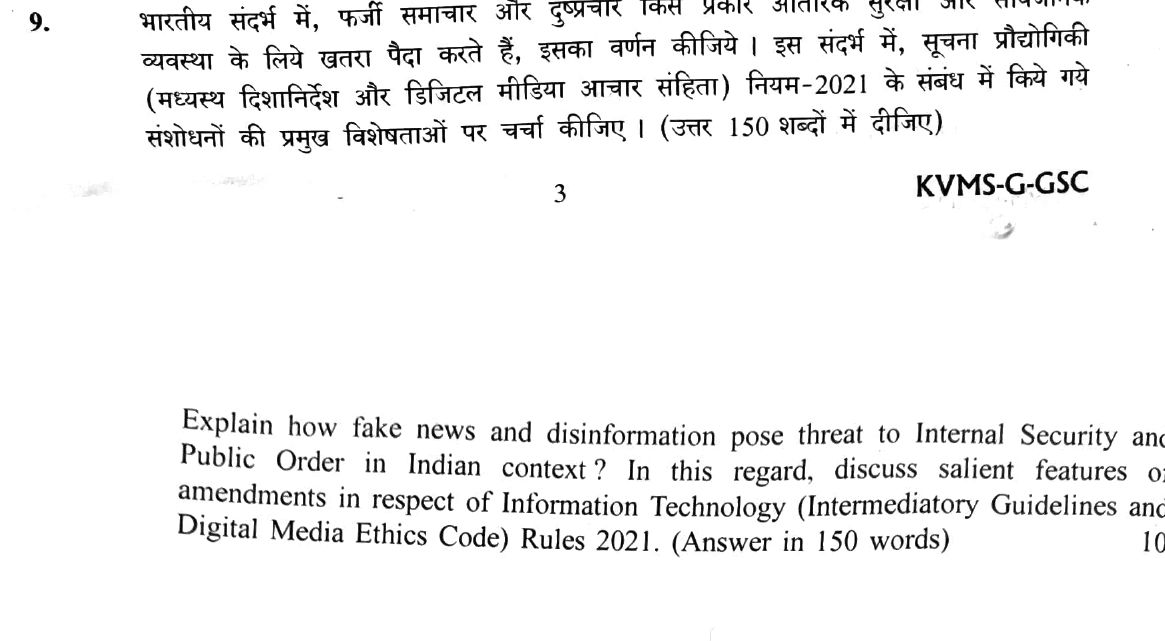
Explain how fake news and disinformation pose threat to Internal Security and Public Order in Indian context? In this regard, discuss salient features of amendments in respect of Information Technology (Intermediary Guidelines and Digital Media Ethics Code) Rules 2021. (Answer in 150 words) 10 marks
हिंदी में प्रश्न पढ़ें
भारतीय संदर्भ में, फ़र्जी समाचार और दुष्प्रचार किस प्रकार आंतरिक सुरक्षा और सार्वजनिक व्यवस्था के लिये खतरा पैदा करते हैं, इसका वर्णन कीजिये। इस संदर्भ में, सूचना प्रौद्योगिकी (मध्यस्थ दिशानिर्देश और डिजिटल मीडिया आचार संहिता) नियम-2021 के संबंध में किये गये संशोधनों की प्रमुख विशेषताओं पर चर्चा कीजिये। (उत्तर 150 शब्दों में दीजिए)
Model answer
Drafted with AI by UPSC Answer Check against this question's marking rubric, to the 150-word length. UPSC does not publish answers for Mains — this is one way to score well, not an official key. How we build rubrics and answers.
Fake news and disinformation threaten internal security and public order when viral forwards trigger rumour-driven mob violence and communal tension, deepfakes distort elections and erode trust, and cross-border influence campaigns seek radicalisation in sensitive regions.
Salient features of the amendments to the IT Rules, 2021:
- 2022: Grievance Appellate Committees hear user appeals against platform decisions; intermediaries must make reasonable efforts to stop users hosting prohibited or patently false content.
- 2023: A government Fact Check Unit for false content about the Centre's business (struck down by the Bombay High Court in September 2024), plus an online gaming framework.
- 2025 (from 15 November): Takedown notices only by senior officers (Joint Secretary-level; DIG-level in police), with monthly review.
- 2026 (from 20 February): Mandatory labels and metadata for AI-generated 'synthetically generated information' such as deepfakes; unlawful content removed within 3 hours of a court or government order (earlier 36) and non-consensual intimate imagery within 2 hours; grievances resolved in 7 days (earlier 15).
Non-compliance forfeits Section 79 safe harbour under the IT Act, 2000. The challenge is curbing disinformation while protecting free speech under Article 19(1)(a).
How this answer will be evaluated
Framework: Security: classify threat, vulnerability, response; stay calm
What earns full marks: Precisely links disinformation to security threats and accurately details the 2021 IT Rules mechanisms.
Evaluation rubric
Each sub-part is marked on its own, against the marks and word limit printed on the paper.
- The answer Explain how fake news and disinformation threaten internal security and public order in India, and discuss the salient features of the amendments to the IT (Intermediary Guidelines and Digital Media Ethics Code) Rules, 2021. 10 marks · 150 words
explain— definition/context → points in order → small example → short close
Must cover
- Link disinformation to internal security and public order (mob violence, communal tension, radicalisation, cross-border influence operations)
- State the 2022 amendment: Grievance Appellate Committees and reasonable-efforts duty on intermediaries
- State the 2023 Fact Check Unit provision and that the Bombay High Court struck it down (2024)
- State the 2026 synthetically generated information (deepfake) rules: labelling and shorter takedown timelines
Loses marks
- Vague generalities without specific rule names or years
- Ignoring the internal security aspect of the question
- Describing only the original 2021 Rules and not the amendments
Earns more
- Mention of specific examples (WhatsApp lynchings, deepfakes in elections, communal riots)
- Reference to traceability of the first originator for significant social media intermediaries
- Mention of free-speech concerns and Article 19(1)(a)
- Cite Section 79 safe harbour of the IT Act, 2000
Extra mark
- Mention the 2025 amendment restricting takedown notices to Joint Secretary/DIG-level officers
- Mention BNS Section 353 (earlier IPC 505) on statements conducing to public mischief
What "Explain" is asking you to do
Make the working of something clear — what sets it off, what follows from what, and what it produces. Explain is the Commission's mechanism word: it dominates the technical papers and the “explain why” stems, where the marks sit in the causal chain and not in the label.
Structure that answers it
State what it is → the initiating condition → the chain of cause, step by step → an instance where it plays out → what the chain produces
Where marks are lost
Describing what something looks like instead of why it works that way. Naming the stages without linking them reads as description too.
Practice this exact question
Write your answer and it is marked point by point against the model answer above — what you covered, what you missed, what you got wrong.
Evaluate my answer →More from General Studies 2026 GS Paper III
- Q6 Distinguish between a Fast Breeder Reactor (FBR) and a thermal nuclear reactor. In the co…
- Q7 Discuss how the contradiction between 'rapid infrastructure development' and 'disaster-ri…
- Q8 Discuss the aim and goals of Kunming-Montreal global biodiversity framework. Mention Indi…
- Q9 Explain how fake news and disinformation pose threat to Internal Security and Public Orde…
- Q10 Ladakh is strategically located between China and Pakistan. As a measure to win hearts an…
- Q11 Explain the key challenges for India's energy security. What measures do you suggest for…
- Q12 How are startups in India promoting entrepreneurship, innovation and employment? Discuss…