GS Paper III — Q12
How are startups in India promoting entrepreneurship, innovation and employment? Discuss the global and domestic challenges in…
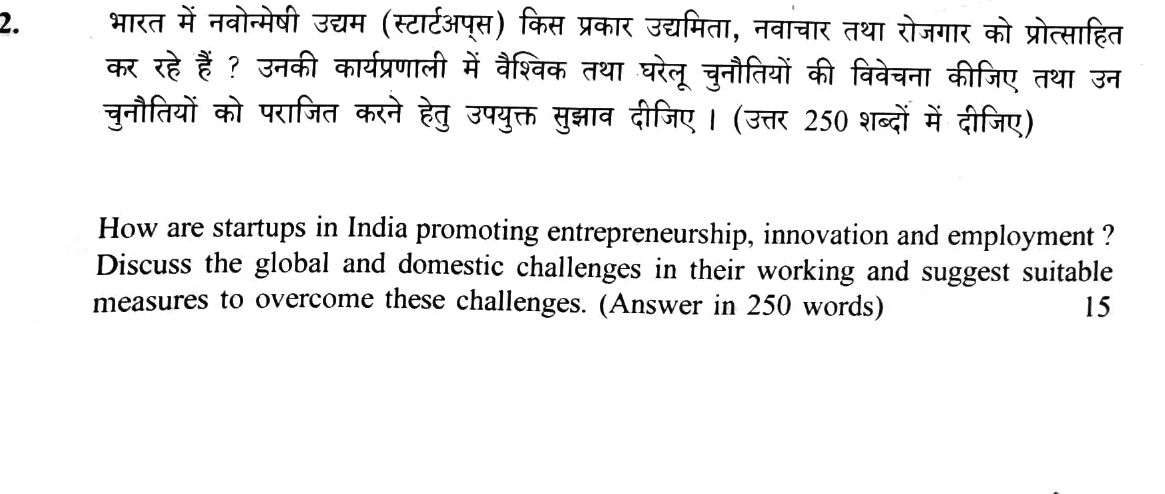
How are startups in India promoting entrepreneurship, innovation and employment? Discuss the global and domestic challenges in their working and suggest suitable measures to overcome these challenges. (Answer in 250 words) 15 marks
हिंदी में प्रश्न पढ़ें
भारत में नवोन्मेषी उद्यम (स्टार्टअप्स) किस प्रकार उद्यमिता, नवाचार तथा रोजगार को प्रोत्साहित कर रहे हैं? उनकी कार्यप्रणाली में वैश्विक तथा घरेलू चुनौतियों की विवेचना कीजिए तथा उन चुनौतियों को पराजित करने हेतु उपयुक्त सुझाव दीजिए। (उत्तर 250 शब्दों में दीजिए)
Model answer
Written by UPSC Answer Check against this question's marking rubric, to the 250-word length. UPSC does not publish answers for Mains — this is one way to score well, not an official key.
Startups in India drive economic transformation by fostering a culture of risk-taking, technological adoption, and self-reliance. Under the Department for Promotion of Industry and Internal Trade (DPIIT) Startup India recognition framework, fiscal incentives such as the three-year tax holiday under Section 80-IAC of the Income Tax Act have accelerated formal entrepreneurship. Innovation and early-stage capital are sustained through institutional mechanisms like the Fund of Funds for Startups (FFS) and the Startup India Seed Fund Scheme (SISFS). Consequently, these enterprises generate large-scale direct and indirect employment across fintech, e-commerce, and deep-tech unicorns, democratising job creation beyond metropolitan hubs.
Global and Domestic Challenges
Globally, the ecosystem faces a prolonged "funding winter" induced by tightening global venture capital flows, elevated interest rates, and macroeconomic headwinds that have compressed valuations and delayed initial public offerings.
Domestically, startups grapple with an onerous regulatory compliance burden spanning multiple authorities and persistent skill mismatches between academic curricula and emerging industry demands. Additionally, despite targeted carve-outs on the Government e-Marketplace (GeM), early-stage enterprises still face limited access to public procurement due to stringent turnover and prior-experience criteria.
Way Forward
To build resilient enterprises, the government should further simplify regulatory compliance through unified single-window portals and expanded self-certification regimes. Enhancing collateral-free debt mechanisms by expanding the credit guarantee cover under the Credit Guarantee Scheme for Startups (CGSS) will reduce dependence on equity funding. Finally, the complete abolition of the angel tax and standardisation of capital gains tax will revive domestic and cross-border investment flows, cementing India's status as a global innovation powerhouse.
What "How" is asking you to do
Set out the route by which the outcome comes about, step by step. Many how stems ask how one thing affects another, and there the channel of transmission is precisely what is being marked.
Structure that answers it
Starting condition → step → step → outcome reached → the conditions the route depends on
Where marks are lost
Answering why it happens instead of how, the commonest single misread in the paper. An answer full of causes and significance that never traces the mechanism has answered a different question.
How this answer will be evaluated
Approach
Framework: Situation > Analysis > Measures: legal, institutional, developmental > Assessment. discuss: intro > 3-4 dimensions > example > balanced close Full marks: Comprehensive analysis with specific examples, clear structure, and implementable measures.
Key points expected
- Mechanisms for promoting entrepreneurship, innovation, and employment
- Global challenges (e.g., funding, competition, regulation)
- Domestic challenges (e.g., infrastructure, policy, talent)
- Suitable measures to overcome challenges
Evaluation rubric
Each sub-part is marked on its own, against the marks and word limit printed on the paper.
- The answer Explain how startups promote entrepreneurship, innovation, and employment; analyze global/domestic challenges; suggest measures. 15 marks · 250 words
discuss— intro → 3-4 dimensions → example → balanced close
Must cover
- Mechanisms for promoting entrepreneurship, innovation, and employment
- Global challenges (e.g., funding, competition, regulation)
- Domestic challenges (e.g., infrastructure, policy, talent)
- Suitable measures to overcome challenges
Loses marks
- Vague generalities without specific examples
- Ignoring either global or domestic challenges
- Measures that are aspirational rather than implementable
Earns more
- Specific examples of Indian startups
- Reference to government schemes (e.g., Startup India)
- Balanced view of opportunities and risks
- Clear structure with distinct sections
Extra mark
- Specific data/statistics on startup growth or employment
- Reference to specific policy documents or reports
Practice this exact question
Write your answer and it is marked point by point against the model answer above — what you covered, what you missed, what you got wrong.
Evaluate my answer →More from General Studies 2026 GS Paper III
- Q9 Explain how fake news and disinformation pose threat to Internal Security and Public Orde…
- Q10 Ladakh is strategically located between China and Pakistan. As a measure to win hearts an…
- Q11 Explain the key challenges for India's energy security. What measures do you suggest for…
- Q12 How are startups in India promoting entrepreneurship, innovation and employment? Discuss…
- Q13 How Indian agriculture has been transformed from food scarcity to food surplus level? Exp…
- Q14 Discuss the different types of subsidies and supports provided by the Government of India…
- Q15 Mention salient features of 'Mission Drishti'. Discuss the imaging techniques used in the…