GS Paper III — Q14
Discuss the different types of subsidies and supports provided by the Government of India to agricultural sector. Examine the…
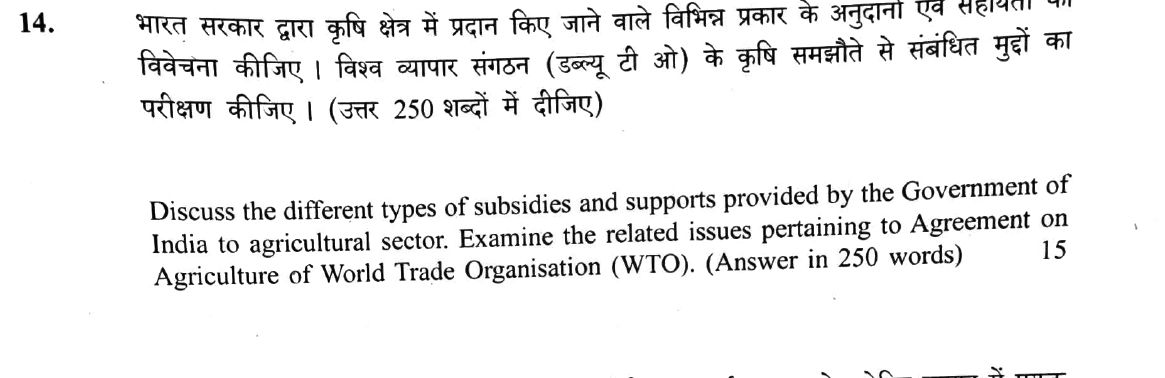
Discuss the different types of subsidies and supports provided by the Government of India to agricultural sector. Examine the related issues pertaining to Agreement on Agriculture of World Trade Organisation (WTO). (Answer in 250 words) 15 marks
हिंदी में प्रश्न पढ़ें
भारत सरकार द्वारा कृषि क्षेत्र में प्रदान किए जाने वाले विभिन्न प्रकार के अनुदानों एवं सहायता की विवेचना कीजिए। विश्व व्यापार संगठन (डब्ल्यू टी ओ) के कृषि समझौते से संबंधित मुद्दों का परीक्षण कीजिए। (उत्तर 250 शब्दों में दीजिए)
Model answer
Written by UPSC Answer Check against this question's marking rubric, to the 250-word length. UPSC does not publish answers for Mains — this is one way to score well, not an official key.
India supports agriculture through input, price, credit and risk measures. Input support includes the Nutrient Based Subsidy (NBS) scheme for fertilisers, and power and irrigation subsidies that cut pumping and water costs. Price and income support rests on Minimum Support Price (MSP) procurement under the PM-AASHA umbrella, where the government buys notified crops at MSP and holds public stocks. Credit and insurance support comprises interest subvention on Kisan Credit Card loans and premium subsidy under PM Fasal Bima Yojana.
WTO’s Agreement on Agriculture classifies support into Amber Box, trade-distorting support; Blue Box, payments under production-limiting programmes; and Green Box, non-distorting support. Developing countries also have a 10% de minimis ceiling, applied product-specifically at 10% of the value of production of that product, and non-product-specifically at 10% of total agricultural production.
The key issue is that India’s MSP-based public stockholding, if valued at market prices, may exceed its Amber Box commitment and be treated as trade-distorting. In Amber Box breach disputes, it has been temporarily shielded by the 2013 Bali Peace Clause, which suspends challenges to public stockholding for food security if financed at administrative cost. Yet this is not a permanent fix. India, through the G-33 coalition, seeks a permanent solution recognising public stockholding for food security within the AoA, while balancing WTO obligations, fiscal costs, farmer income and food security.
What "Discuss" is asking you to do
Lay the issue out from more than one side — how it arose, what is claimed for it, what is held against it, and where it now stands. UPSC attaches discuss to broad topics with several live dimensions, so coverage of the dimensions earns more than the strength of your opinion.
Structure that answers it
Set the issue up → the case as it is made → the case against → the dimension both sides leave out → where the balance now lies
Where marks are lost
Listing facts with no thread between them, or arguing one side throughout and calling it a discussion.
How this answer will be evaluated
Approach
Framework: Situation > Analysis > Measures > Assessment. discuss: intro > 3-4 dimensions > example > balanced close Full marks: Precise mapping of Indian schemes to WTO boxes with clear legal reasoning.
Key points expected
- Categorize subsidies (input, credit, MSP, insurance)
- Define WTO AoA 'Amber Box' and 'Blue Box' limits
- Link MSP to 'Blue Box' (price support) status
- Identify 'de minimis' exemption for developing nations
Evaluation rubric
Each sub-part is marked on its own, against the marks and word limit printed on the paper.
- The answer Map Indian agri subsidies and analyze their compliance with WTO AoA. 15 marks · 250 words
discuss— intro → 3-4 dimensions → example → balanced close
Must cover
- Categorize subsidies (input, credit, MSP, insurance)
- Define WTO AoA 'Amber Box' and 'Blue Box' limits
- Link MSP to 'Blue Box' (price support) status
- Identify 'de minimis' exemption for developing nations
Loses marks
- Treating MSP as a 'Green Box' measure
- Ignoring the 'de minimis' developing country clause
- Vague listing of schemes without WTO classification
Earns more
- Mention 'Green Box' (R&D, infrastructure) support
- Reference 'Peace Clause' for trade disputes
- Cite 'Agriculture Infrastructure Fund' (AIF) as support
- Mention 'PM-KISAN' as direct income support
Extra mark
- Cite specific 'Amber Box' cap percentage (5% for developing)
- Mention 'NAMA' (Non-Agricultural Market Access) linkage
Practice this exact question
Write your answer and it is marked point by point against the model answer above — what you covered, what you missed, what you got wrong.
Evaluate my answer →More from General Studies 2026 GS Paper III
- Q11 Explain the key challenges for India's energy security. What measures do you suggest for…
- Q12 How are startups in India promoting entrepreneurship, innovation and employment? Discuss…
- Q13 How Indian agriculture has been transformed from food scarcity to food surplus level? Exp…
- Q14 Discuss the different types of subsidies and supports provided by the Government of India…
- Q15 Mention salient features of 'Mission Drishti'. Discuss the imaging techniques used in the…
- Q16 What is agentic Artificial Intelligence (AI)? Explain its working. Describe its applicati…
- Q17 What are the challenges to solid waste management in India? Discuss the governmental poli…