GS Paper III — Q17
What are the challenges to solid waste management in India? Discuss the governmental policy framework on solid waste management…
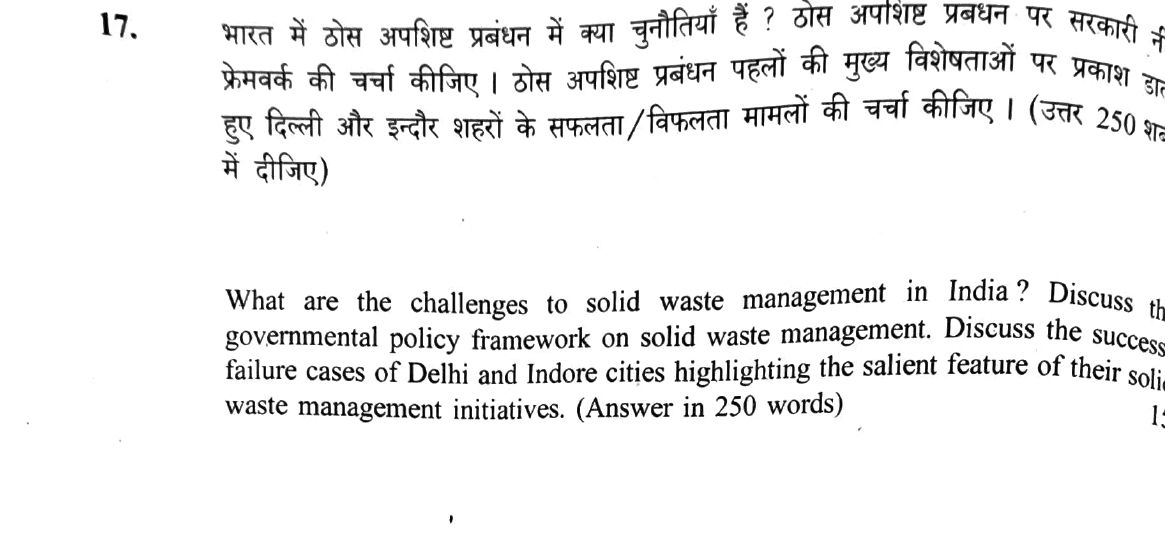
What are the challenges to solid waste management in India? Discuss the governmental policy framework on solid waste management. Discuss the success/failure cases of Delhi and Indore cities highlighting the salient feature of their solid waste management initiatives. (Answer in 250 words) 15 marks
हिंदी में प्रश्न पढ़ें
भारत में ठोस अपशिष्ट प्रबंधन में क्या चुनौतियाँ हैं? ठोस अपशिष्ट प्रबंधन पर सरकारी नीति फ्रेमवर्क की चर्चा कीजिए। ठोस अपशिष्ट प्रबंधन पहलों की मुख्य विशेषताओं पर प्रकाश डालते हुए दिल्ली और इन्दौर शहरों के सफलता/विफलता मामलों की चर्चा कीजिए। (उत्तर 250 शब्दों में दीजिए)
Model answer
Written by UPSC Answer Check against this question's marking rubric, to the 250-word length. UPSC does not publish answers for Mains — this is one way to score well, not an official key.
India’s solid waste management is constrained by weak source segregation, overflowing legacy landfills, and uneven enforcement of the policy framework. A central challenge is low compliance with mandatory segregation of wet, dry and hazardous waste at household and commercial sources. Even where rules require separate bins and collection, mixed waste reaches transfer stations, undermining recycling, composting and safe disposal. This is especially acute in dense urban settlements, where mixed waste increases collection costs and reduces recyclable recovery. In Delhi, the problem is compounded by overflowing legacy landfills such as Ghazipur, Bhalswa and Okhla, where unresolved bioremediation leaves large waste mountains, leachate risks and public-health concerns.
The governing policy framework is anchored in the Solid Waste Management Rules, 2016, which mandate source segregation, door-to-door collection, processing and disposal, and assign responsibilities to municipalities, developers and waste generators. The rules also require municipalities to process waste within prescribed timelines and prevent open dumping. Swachh Bharat Mission (Urban) 2.0 builds on this by targeting garbage-free cities, emphasising segregation, waste processing and citizen participation. However, policy success depends on local implementation, financing and enforcement.
Indore offers a contrasting success. Its sustained 100% door-to-door segregated collection, active citizen participation and Asia’s largest Bio-CNG plant from wet waste have enabled a near zero-landfill approach, reflected in repeated Swachh Survekshan No.1 rankings. Delhi, by contrast, remains a failure case due to persistent legacy-waste mountains and weak segregation enforcement. The way forward is to replicate Indore’s segregation discipline, scale wet-waste processing, and resolve legacy landfills through time-bound bioremediation.
What "What" is asking you to do
What is an interrogative rather than a command word. It opens a multi-part stem — what the thing is, then its causes, risks or remedies — and the definitional clause is the gate rather than the answer, with the marks spread across the clauses that follow it.
Structure that answers it
What it is, in two or three lines → the second clause of the stem, at length → the third clause, at length → a closing line only if room remains
Where marks are lost
Spending half the answer establishing the object and leaving the later clauses, which carry most of the marks, thinly answered.
How this answer will be evaluated
Approach
Framework: Situation > Analysis > Measures > Assessment. discuss: intro > 3-4 dimensions > example > balanced close Full marks: Precise policy framework, sharp contrast between Indore's success and Delhi's failure with specific mechanisms.
Key points expected
- 3-4 specific challenges to solid waste management in India
- Governmental policy framework (e.g., SWM Rules 2016)
- Salient features of Indore's success (e.g., door-to-door collection)
- Salient features of Delhi's failure (e.g., landfill issues)
Evaluation rubric
Each sub-part is marked on its own, against the marks and word limit printed on the paper.
- The answer Challenges, policy framework, and comparative analysis of Delhi vs Indore waste management. · 250 words
discuss— intro → 3-4 dimensions → example → balanced close
Must cover
- 3-4 specific challenges to solid waste management in India
- Governmental policy framework (e.g., SWM Rules 2016)
- Salient features of Indore's success (e.g., door-to-door collection)
- Salient features of Delhi's failure (e.g., landfill issues)
Loses marks
- Generic environmental writing without specific city examples
- Ignoring the comparative aspect of Delhi vs Indore
- Listing challenges without mapping them to policy gaps
Earns more
- Mention of specific waste segregation mechanisms
- Reference to institutional bodies (e.g., MCD, BMC)
- Comparison of waste processing technologies
- Mention of citizen participation models
Extra mark
- Specific statistic on waste generation in Delhi/Indore
- Reference to a specific court order or policy amendment
Practice this exact question
Write your answer and it is marked point by point against the model answer above — what you covered, what you missed, what you got wrong.
Evaluate my answer →More from General Studies 2026 GS Paper III
- Q14 Discuss the different types of subsidies and supports provided by the Government of India…
- Q15 Mention salient features of 'Mission Drishti'. Discuss the imaging techniques used in the…
- Q16 What is agentic Artificial Intelligence (AI)? Explain its working. Describe its applicati…
- Q17 What are the challenges to solid waste management in India? Discuss the governmental poli…
- Q18 "Community participation is the cornerstone of effective disaster management." Analyse th…
- Q19 Separatist movements have been one of the major factors contributing to militancy and ins…
- Q20 Discuss counterfeit currency and money laundering as major sources of terror funding in I…