GS Paper III — Q18
"Community participation is the cornerstone of effective disaster management." Analyse this statement with suitable examples from…
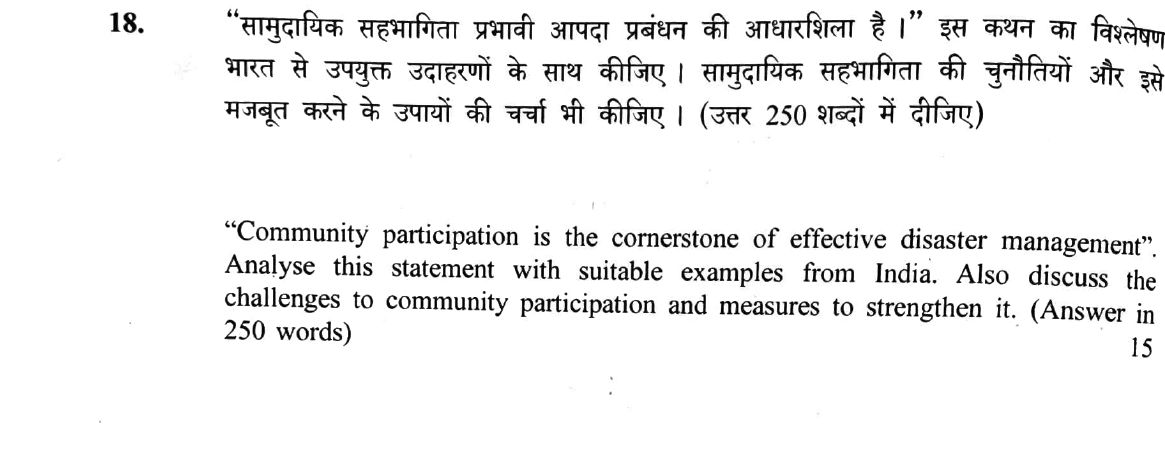
"Community participation is the cornerstone of effective disaster management." Analyse this statement with suitable examples from India. Also discuss the challenges to community participation and measures to strengthen it. (Answer in 250 words) 15 marks
हिंदी में प्रश्न पढ़ें
“सामुदायिक सहभागिता प्रभावी आपदा प्रबंधन की आधारशिला है।” इस कथन का विश्लेषण भारत से उपयुक्त उदाहरणों के साथ कीजिए। सामुदायिक सहभागिता की चुनौतियों और इसे मजबूत करने के उपायों की चर्चा भी कीजिए। (उत्तर 250 शब्दों में दीजिए)
Model answer
Written by UPSC Answer Check against this question's marking rubric, to the 250-word length. UPSC does not publish answers for Mains — this is one way to score well, not an official key.
Communities are the immediate first responders during hazards, functioning as the decisive bridge between institutional warnings and ground-level relief. Community-led action minimizes response latency, protects local livelihoods, and optimizes survival outcomes.
Evidence of Community-Led Response During the 2018 Kerala floods, local fisherfolk mobilized their mechanized boats to rescue over 65,000 stranded citizens, demonstrating that local knowledge and rapid voluntary mobilization are indispensable during severe crises. Similarly, Odisha’s near-zero-casualty evacuations during severe events like Cyclone Fani were enabled by trained community volunteers and shelter management committees executing last-mile warnings and relief distribution. Institutionalising this capacity, the National Disaster Management Authority (NDMA) introduced the Aapda Mitra Scheme to train community volunteers in disaster-prone districts with basic skills in search, rescue, and first-aid operations.
Challenges to Effective Participation Systemic bottlenecks limit sustained grassroots involvement. There is low disaster awareness and inadequate training penetration across vulnerable rural and peri-urban habitations. Additionally, socio-cultural hierarchies result in weak participation of women and marginalised groups in planning and response mechanisms, despite their heightened vulnerability. Furthermore, severe resource constraints in poorer Panchayats restrict the procurement of basic rescue gear and the upkeep of local emergency infrastructure.
Measures for Strengthening To build enduring resilience, Community-Based Disaster Management (CBDM) plans must be formally institutionalised under the Disaster Management Act, 2005, integrating hazard mitigation directly into Gram Panchayat Development Plans. Mobilising Self-Help Groups (SHGs) under national livelihoods missions can empower women as frontline response coordinators. Finally, expanding the National School Safety Programme will institutionalise disaster literacy and regular drills among youth, shifting India’s disaster governance from reactive relief toward inclusive, proactive community resilience.
What "Analyse" is asking you to do
Break the subject into its working parts and show how they act on each other. The marks are in the interconnections — which factor drives which, and what the resulting structure explains — not in the inventory of factors.
Structure that answers it
Define the whole → separate it into its parts → show which part drives which → what that interaction produces → what the structure implies
Where marks are lost
A flat list of causes with no account of which drives which. An answer of neatly separated headings, each self-contained, scores as description.
How this answer will be evaluated
Approach
Framework: Situation > Analysis > Measures: legal, institutional, developmental > Assessment. analyse: intro > causes > effects > stakeholders/linkages > way forward Full marks: Clear analysis with specific Indian examples, well-structured challenges and measures, and strong conclusion.
Key points expected
- Define community participation as cornerstone of disaster management
- Provide specific Indian examples (e.g., Kerala, Odisha, or local initiatives)
- Discuss 3-4 distinct challenges to participation (e.g., awareness, resources)
- Suggest implementable measures to strengthen participation (legal/institutional)
Evaluation rubric
Each sub-part is marked on its own, against the marks and word limit printed on the paper.
- The answer Analyse the role of community participation in disaster management with Indian examples, challenges, and measures. · 250 words
analyse— intro → causes → effects → stakeholders/linkages → way forward
Must cover
- Define community participation as cornerstone of disaster management
- Provide specific Indian examples (e.g., Kerala, Odisha, or local initiatives)
- Discuss 3-4 distinct challenges to participation (e.g., awareness, resources)
- Suggest implementable measures to strengthen participation (legal/institutional)
Loses marks
- Generic statements without specific Indian examples
- Ignoring the 'challenges' or 'measures' components
- Aspirational solutions not implementable in Indian context
Earns more
- Mention specific schemes (e.g., NDRF, State Disaster Management Authority)
- Reference specific disasters (e.g., 1999 Odisha cyclone, 2004 Tsunami)
- Discuss role of local institutions (Panchayats, NGOs)
- Link to Sustainable Development Goals (SDGs)
Extra mark
- Cite specific data/statistics on community response effectiveness
- Mention specific legal provisions (e.g., Disaster Management Act 2005)
Practice this exact question
Write your answer and it is marked point by point against the model answer above — what you covered, what you missed, what you got wrong.
Evaluate my answer →More from General Studies 2026 GS Paper III
- Q15 Mention salient features of 'Mission Drishti'. Discuss the imaging techniques used in the…
- Q16 What is agentic Artificial Intelligence (AI)? Explain its working. Describe its applicati…
- Q17 What are the challenges to solid waste management in India? Discuss the governmental poli…
- Q18 "Community participation is the cornerstone of effective disaster management." Analyse th…
- Q19 Separatist movements have been one of the major factors contributing to militancy and ins…
- Q20 Discuss counterfeit currency and money laundering as major sources of terror funding in I…