GS Paper III — Q20
Discuss counterfeit currency and money laundering as major sources of terror funding in India. State the actions being taken at…
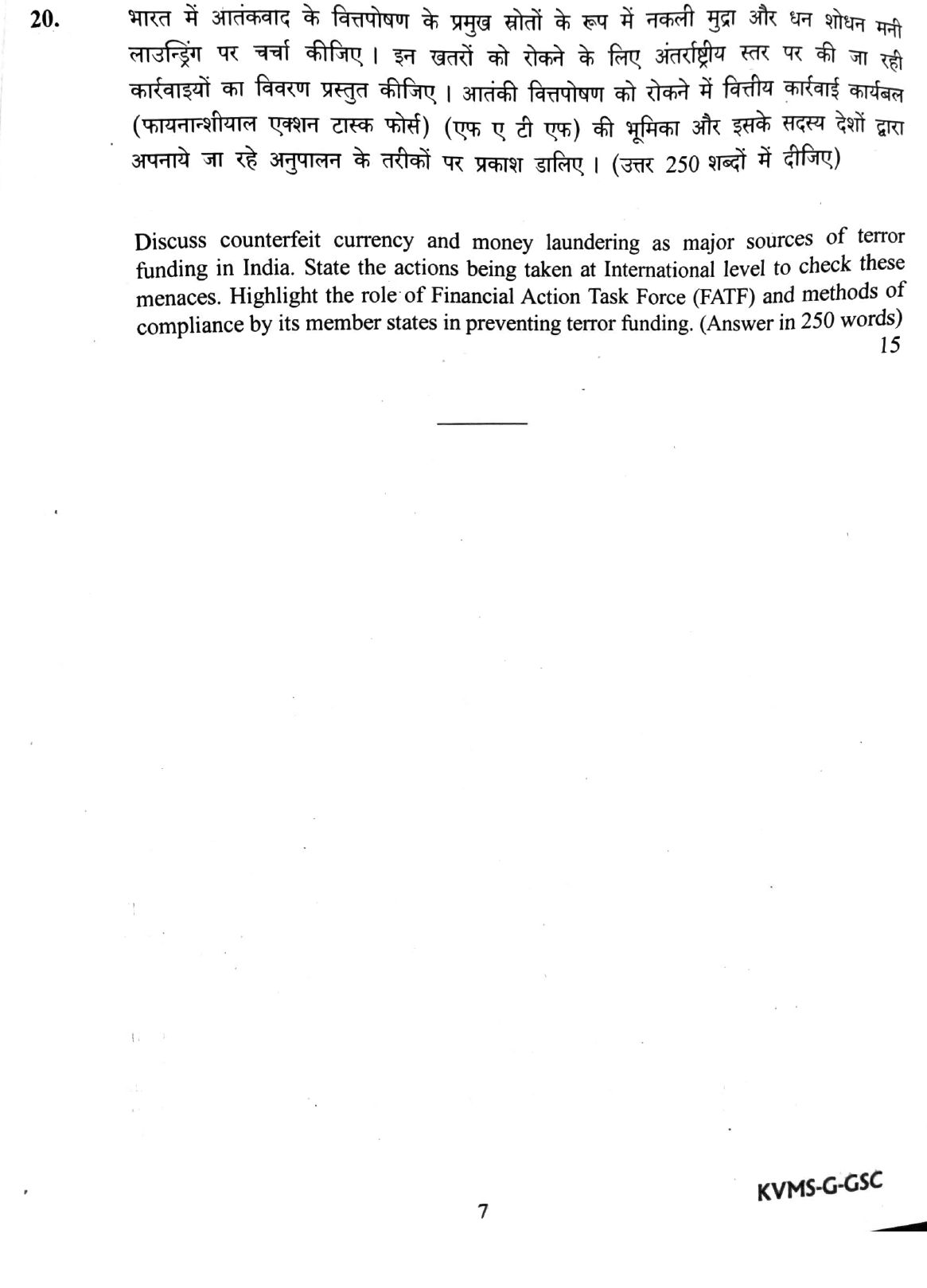
Discuss counterfeit currency and money laundering as major sources of terror funding in India. State the actions being taken at International level to check these menaces. Highlight the role of Financial Action Task Force (FATF) and methods of compliance by its member states in preventing terror funding. (Answer in 250 words) 15 marks
हिंदी में प्रश्न पढ़ें
भारत में आतंकवाद के वित्तपोषण के प्रमुख स्रोतों के रूप में नकली मुद्रा और धन शोधन (मनी लाउन्ड्रिंग) पर चर्चा कीजिए। इन खतरों को रोकने के लिए अंतर्राष्ट्रीय स्तर पर की जा रही कार्रवाइयों का विवरण प्रस्तुत कीजिए। आतंकी वित्तपोषण को रोकने में वित्तीय कार्रवाई कार्यबल (फायनान्शीयल एक्शन टास्क फोर्स) (एफ ए टी एफ) की भूमिका और इसके सदस्य देशों द्वारा अपनाये जा रहे अनुपालन के तरीकों पर प्रकाश डालिए। (उत्तर 250 शब्दों में दीजिए)
Model answer
Written by UPSC Answer Check against this question's marking rubric, to the 250-word length. UPSC does not publish answers for Mains — this is one way to score well, not an official key.
Counterfeit currency and money laundering constitute the primary financial lifelines sustaining terrorism in India. High-Quality Fake Indian Currency Notes (FICN), actively pushed through Pakistan-based and ISI-linked syndicates across porous borders, serve the dual objective of financing subversive outfits like Lashkar-e-Taiba and undermining India's macroeconomic stability. Simultaneously, illicit money laundering mechanisms—ranging from traditional cross-border Hawala channels to modern decentralised cryptocurrency networks—enable terror groups to obfuscate the origin and movement of operational funds undetected.
International Measures Global responses to these threats rely on binding multilateral instruments. United Nations Security Council Resolution (UNSCR) 1373 obligates all member states to criminalise terror financing, freeze terrorist assets, and deny safe havens. Complementing this, the UN Convention against Transnational Organised Crime (Palermo Convention) establishes frameworks for mutual legal assistance, extradition, and the disruption of organised illicit financial networks.
Role of FATF and Compliance Mechanisms The Financial Action Task Force (FATF) drives global standards through its 40 Recommendations. Within these, Recommendation 5 mandates the criminalisation of terrorist financing, while Recommendation 6 enforces targeted financial sanctions against UN-designated entities. FATF ensures compliance through peer reviews and its grey-listing mechanism, which subjects deficient jurisdictions to severe economic scrutiny—exemplified by Pakistan’s grey-listing (2018–2022) to enforce actionable counter-terror financing reforms.
Member states comply by embedding these norms into domestic law. India has harmonised its framework through the Financial Intelligence Unit (FIU-IND), the Prevention of Money Laundering Act (PMLA), 2002, and the 2019 amendments to the Unlawful Activities (Prevention) Act (UAPA), which empower the state to designate individual terrorists. Going forward, closing regulatory gaps around virtual assets and enhancing real-time global intelligence sharing remain vital to fully dismantle terror-funding ecosystems.
What "Discuss" is asking you to do
Lay the issue out from more than one side — how it arose, what is claimed for it, what is held against it, and where it now stands. UPSC attaches discuss to broad topics with several live dimensions, so coverage of the dimensions earns more than the strength of your opinion.
Structure that answers it
Set the issue up → the case as it is made → the case against → the dimension both sides leave out → where the balance now lies
Where marks are lost
Listing facts with no thread between them, or arguing one side throughout and calling it a discussion.
How this answer will be evaluated
Approach
Framework: Security: classify threat, vulnerability, response; stay calm. discuss: intro > 3-4 dimensions > example > balanced close Full marks: Comprehensive analysis of both funding sources, specific international actions, and detailed FATF role with compliance methods.
Key points expected
- Link counterfeit notes to terror funding in India
- Explain money laundering mechanisms for terror financing
- Detail international actions to check these menaces
- Highlight FATF's role and member state compliance methods
Evaluation rubric
Each sub-part is marked on its own, against the marks and word limit printed on the paper.
- The answer Analyze counterfeit currency and money laundering as terror funding sources, international actions, and FATF's role. 15 marks · 250 words
discuss— intro → 3-4 dimensions → example → balanced close
Must cover
- Link counterfeit notes to terror funding in India
- Explain money laundering mechanisms for terror financing
- Detail international actions to check these menaces
- Highlight FATF's role and member state compliance methods
Loses marks
- Generic statements without specific mechanisms
- Ignoring the FATF compliance aspect
- Focusing only on domestic Indian laws
Earns more
- Mention specific international conventions or treaties
- Cite specific FATF recommendations (e.g., 40 Recommendations)
- Reference specific Indian laws (e.g., PMLA, UAPA)
- Mention specific international bodies (e.g., UN, Interpol)
Extra mark
- Mention specific FATF grey/black list status of countries
- Reference specific recent cases of terror funding
Practice this exact question
Write your answer and it is marked point by point against the model answer above — what you covered, what you missed, what you got wrong.
Evaluate my answer →More from General Studies 2026 GS Paper III
- Q17 What are the challenges to solid waste management in India? Discuss the governmental poli…
- Q18 "Community participation is the cornerstone of effective disaster management." Analyse th…
- Q19 Separatist movements have been one of the major factors contributing to militancy and ins…
- Q20 Discuss counterfeit currency and money laundering as major sources of terror funding in I…