GS Paper III — Q19
Separatist movements have been one of the major factors contributing to militancy and instability in Jammu & Kashmir (J&K). Bring…
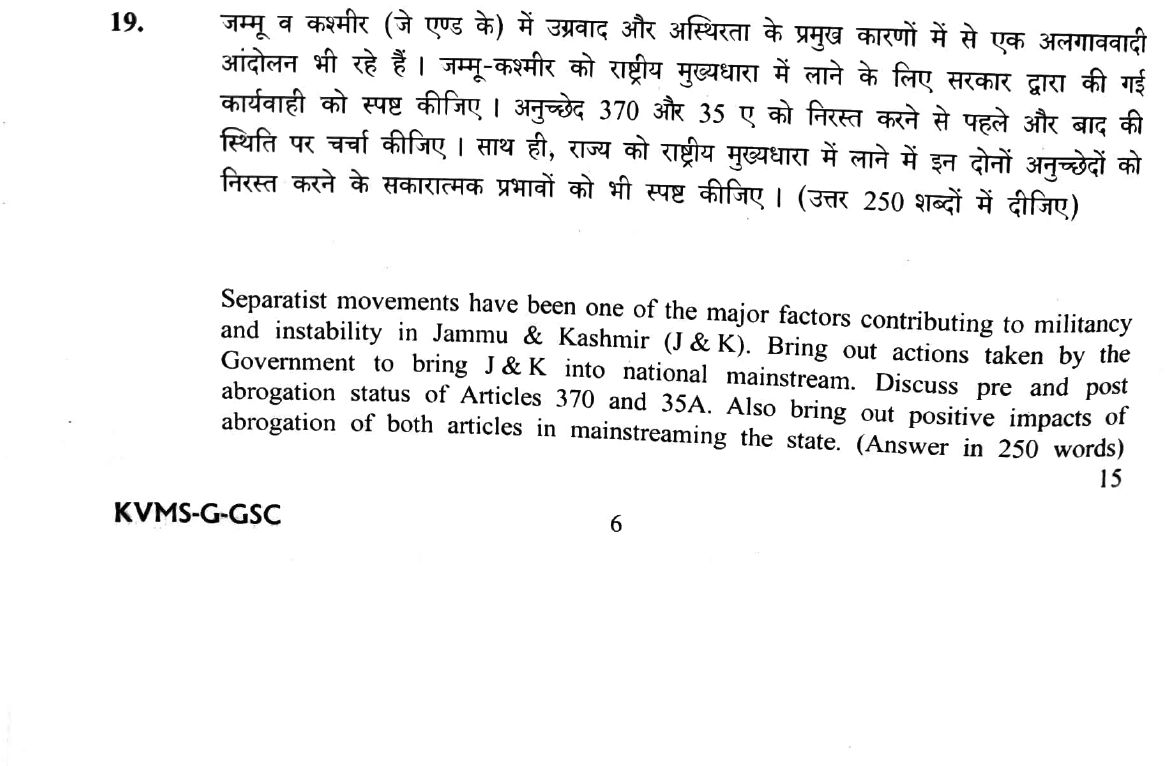
Separatist movements have been one of the major factors contributing to militancy and instability in Jammu & Kashmir (J&K). Bring out actions taken by the Government to bring J&K into national mainstream. Discuss pre and post abrogation status of Articles 370 and 35A. Also bring out positive impacts of abrogation of both articles in mainstreaming the state. (Answer in 250 words) 15 marks
हिंदी में प्रश्न पढ़ें
जम्मू व कश्मीर (जे एण्ड के) में उग्रवाद और अस्थिरता के प्रमुख कारणों में से एक अलगाववादी आंदोलन भी रहे हैं। जम्मू-कश्मीर को राष्ट्रीय मुख्यधारा में लाने के लिए सरकार द्वारा की गई कार्यवाही को स्पष्ट कीजिए। अनुच्छेद 370 और 35 ए को निरस्त करने से पहले और बाद की स्थिति पर चर्चा कीजिए। साथ ही, राज्य को राष्ट्रीय मुख्यधारा में लाने में इन दोनों अनुच्छेदों को निरस्त करने के सकारात्मक प्रभावों को भी स्पष्ट कीजिए। (उत्तर 250 शब्दों में दीजिए)
Model answer
Written by UPSC Answer Check against this question's marking rubric, to the 250-word length. UPSC does not publish answers for Mains — this is one way to score well, not an official key.
Separatist militancy in Jammu & Kashmir (J&K) has been primarily sustained by a cross-border proxy war and Pakistan-sponsored radicalisation, which alienated local populations and destabilised the region for decades.
Government Actions for Mainstreaming The Government adopted a dual strategy of firm security measures and socio-political outreach. Security forces executed 'Operation All Out' to dismantle terror networks alongside comprehensive surrender-cum-rehabilitation policies for local youth. Grassroots democracy was revived through the historic District Development Council (DDC) elections in 2020, culminating in the 2024 J&K Assembly elections that restored an elected government under the Union Territory framework.
Pre versus Post-Abrogation Status Prior to 5 August 2019, Article 370 granted J&K a special autonomous status with a separate constitution, while Article 35A restricted property purchase, government employment, and settlement rights strictly to 'permanent residents'.
Post-abrogation, the Jammu and Kashmir Reorganisation Act 2019 bifurcated the state into the Union Territories of J&K and Ladakh. This ended the state's asymmetric autonomy, bringing complete constitutional integration and extending all central laws, including the Right to Information (RTI) Act, the Right to Education (RTE) Act, and mandatory SC/ST reservations.
Positive Impacts of Abrogation The abrogation dismantled the separatist-sponsored strike and agitation apparatus, resulting in a dramatic reduction in stone-pelting incidents and civilian unrest. Long-marginalised groups, such as the Valmiki, Gorkha, and Pahari communities, have been granted long-denied domicile and reservation benefits. Economically, the region has attracted multi-crore industrial investment MoUs and achieved record tourist footfalls, fostering broad-based local prosperity.
Consolidating these security and developmental gains remains essential to permanently anchor J&K within India's democratic and economic mainstream.
What "Highlight" is asking you to do
Bring the notable features of the named material forward and make their weight visible — what each feature is, and what gives it importance. Highlight expects substantive coverage of the features, not a thin selection from them.
Structure that answers it
The material and what makes a feature notable within it → feature, with the point that gives it weight → the same for each further feature → the composite picture they form
Where marks are lost
Naming features flatly as a list and never showing why any one of them signifies.
How this answer will be evaluated
Approach
Framework: GS3 Security/Polity: Situation > Analysis > Measures > Assessment. discuss: intro > 3-4 dimensions > example > balanced close Full marks: Precise legal definitions, specific government actions, and clear positive impacts with examples.
Key points expected
- Define pre-abrogation status of Article 370 (special status)
- Define pre-abrogation status of Article 35A (permanent residency)
- List specific government actions for mainstreaming (e.g., CAA, 5G, land sales)
- Explain positive impacts of abrogation (e.g., economic integration, security)
Evaluation rubric
Each sub-part is marked on its own, against the marks and word limit printed on the paper.
- The answer Analyze government actions, pre/post status of Articles 370/35A, and positive impacts of abrogation. 15 marks · 250 words
discuss— intro → 3-4 dimensions → example → balanced close
Must cover
- Define pre-abrogation status of Article 370 (special status)
- Define pre-abrogation status of Article 35A (permanent residency)
- List specific government actions for mainstreaming (e.g., CAA, 5G, land sales)
- Explain positive impacts of abrogation (e.g., economic integration, security)
Loses marks
- Focusing only on separatism without addressing government actions
- Ignoring the specific legal status of Article 35A
- Vague generalities without specific examples of mainstreaming
Earns more
- Mention J&K Reorganisation Act, 2019
- Reference specific developmental schemes (e.g., PM Awas Yojana)
- Mention Article 35A's role in land/employment restrictions
- Cite specific security measures (e.g., AFSPA status changes)
Extra mark
- Mention specific economic data (e.g., FDI inflow post-2019)
- Reference specific legal instruments (e.g., CAA 2019)
Practice this exact question
Write your answer and it is marked point by point against the model answer above — what you covered, what you missed, what you got wrong.
Evaluate my answer →More from General Studies 2026 GS Paper III
- Q16 What is agentic Artificial Intelligence (AI)? Explain its working. Describe its applicati…
- Q17 What are the challenges to solid waste management in India? Discuss the governmental poli…
- Q18 "Community participation is the cornerstone of effective disaster management." Analyse th…
- Q19 Separatist movements have been one of the major factors contributing to militancy and ins…
- Q20 Discuss counterfeit currency and money laundering as major sources of terror funding in I…