GS Paper III — Q16
What is agentic Artificial Intelligence (AI)? Explain its working. Describe its applications with suitable examples. Discuss the…
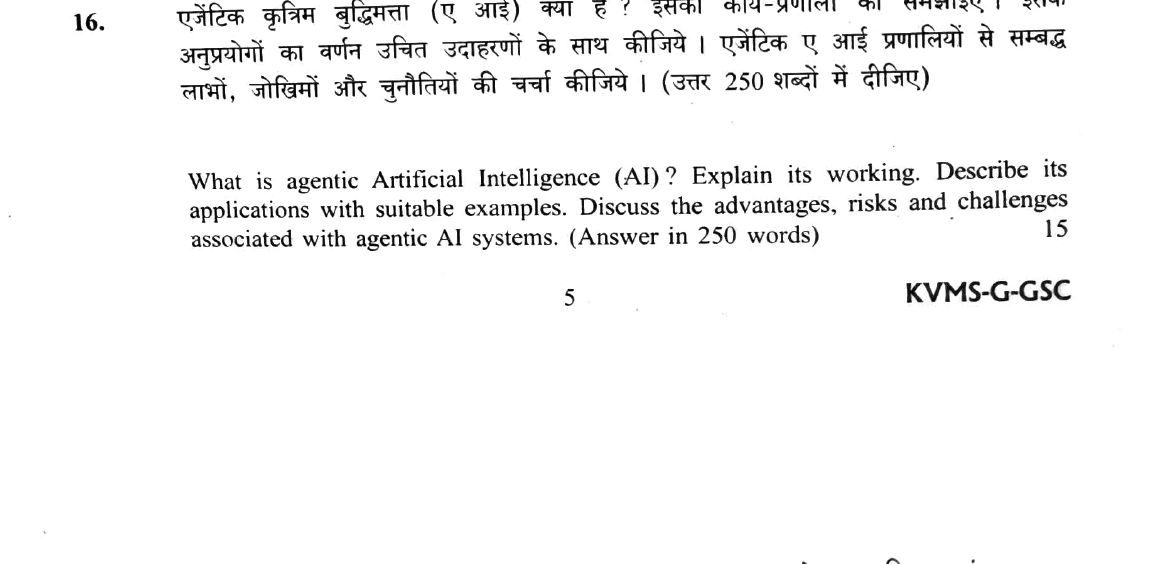
What is agentic Artificial Intelligence (AI)? Explain its working. Describe its applications with suitable examples. Discuss the advantages, risks and challenges associated with agentic AI systems. (Answer in 250 words) 15 marks
हिंदी में प्रश्न पढ़ें
एजेंटिक कृत्रिम बुद्धिमत्ता (ए आई) क्या है? इसकी कार्य-प्रणाली को समझाइए। इसके अनुप्रयोगों का वर्णन उचित उदाहरणों के साथ कीजिये। एजेंटिक ए आई प्रणालियों से सम्बद्ध लाभों, जोखिमों और चुनौतियों की चर्चा कीजिये। (उत्तर 250 शब्दों में दीजिए)
Model answer
Written by UPSC Answer Check against this question's marking rubric, to the 250-word length. UPSC does not publish answers for Mains — this is one way to score well, not an official key.
Agentic Artificial Intelligence (AI) refers to autonomous, goal-directed systems capable of planning multi-step actions, utilizing external tools, and dynamically adapting to environmental feedback without continuous, step-by-step human prompting.
Working of Agentic AI Its functioning relies on a core reasoning and planning engine powered by Large Language Models (LLMs), operating through iterative think-act-observe cycles (such as ReAct frameworks). By integrating short- and long-term memory modules with external APIs and computational tools, the agent decomposes complex goals into sub-tasks, interacts with software environments, perceives outcomes, and self-corrects its execution path in real time.
Applications Key applications include autonomous coding assistants that write, test, and debug software; customer-service agents capable of executing end-to-end financial transactions; and autonomous research agents that aggregate and synthesize complex datasets. In India, supported by initiatives under the IndiaAI Mission, agentic systems are seeing enterprise adoption in fintech for automated fraud mitigation and underwriting, as well as in healthcare diagnostics for workflow automation and clinical triaging.
Advantages, Risks, and Challenges Agentic AI offers immense advantages, notably exponential efficiency gains, reduced human cognitive workload on repetitive multi-step processes, and accelerated decision-making cycles.
However, it introduces critical risks. Hallucination cascades can occur when an initial reasoning error compounds across autonomous sub-tasks, leading to catastrophic system failures. Furthermore, agentic systems remain vulnerable to prompt-injection attacks, create structural challenges around white-collar job displacement, and significantly weaken human oversight and legal accountability in autonomous decision chains.
Way Forward Navigating agentic AI requires establishing robust human-in-the-loop governance architectures, verifiable safety guardrails, and rigorous technical standards to balance autonomous productivity with institutional accountability.
What "What" is asking you to do
What is an interrogative rather than a command word. It opens a multi-part stem — what the thing is, then its causes, risks or remedies — and the definitional clause is the gate rather than the answer, with the marks spread across the clauses that follow it.
Structure that answers it
What it is, in two or three lines → the second clause of the stem, at length → the third clause, at length → a closing line only if room remains
Where marks are lost
Spending half the answer establishing the object and leaving the later clauses, which carry most of the marks, thinly answered.
How this answer will be evaluated
Approach
Framework: Technology: why it matters, use, benefit, risk, policy. discuss: intro > 3-4 dimensions > example > balanced close Full marks: Precise definition, clear working mechanism, specific examples, and balanced risk analysis.
Key points expected
- Define agentic AI as autonomous goal-oriented systems
- Explain working: perception, planning, tool use, action loop
- Provide specific application examples (e.g., autonomous coding, logistics)
- Discuss risks: hallucinations, security, loss of human control
Evaluation rubric
Each sub-part is marked on its own, against the marks and word limit printed on the paper.
- The answer Define agentic AI, explain its autonomous working, and evaluate its applications, benefits, and risks. · 250 words
discuss— intro → 3-4 dimensions → example → balanced close
Must cover
- Define agentic AI as autonomous goal-oriented systems
- Explain working: perception, planning, tool use, action loop
- Provide specific application examples (e.g., autonomous coding, logistics)
- Discuss risks: hallucinations, security, loss of human control
Loses marks
- Confusing agentic AI with standard chatbots
- Vague, aspirational solutions without technical grounding
- Ignoring the 'working' mechanism entirely
Earns more
- Mention specific frameworks (e.g., LangChain, AutoGPT)
- Distinguish agentic AI from traditional reactive AI
- Reference specific policy or regulatory frameworks
- Mention specific industry use-cases with impact
Extra mark
- Simple flowchart of the agentic loop
- Reference to a specific recent incident or report
Practice this exact question
Write your answer and it is marked point by point against the model answer above — what you covered, what you missed, what you got wrong.
Evaluate my answer →More from General Studies 2026 GS Paper III
- Q13 How Indian agriculture has been transformed from food scarcity to food surplus level? Exp…
- Q14 Discuss the different types of subsidies and supports provided by the Government of India…
- Q15 Mention salient features of 'Mission Drishti'. Discuss the imaging techniques used in the…
- Q16 What is agentic Artificial Intelligence (AI)? Explain its working. Describe its applicati…
- Q17 What are the challenges to solid waste management in India? Discuss the governmental poli…
- Q18 "Community participation is the cornerstone of effective disaster management." Analyse th…
- Q19 Separatist movements have been one of the major factors contributing to militancy and ins…