GS Paper III — Q15
Mention salient features of 'Mission Drishti'. Discuss the imaging techniques used in the satellite launched on 3rd May 2026. Why…
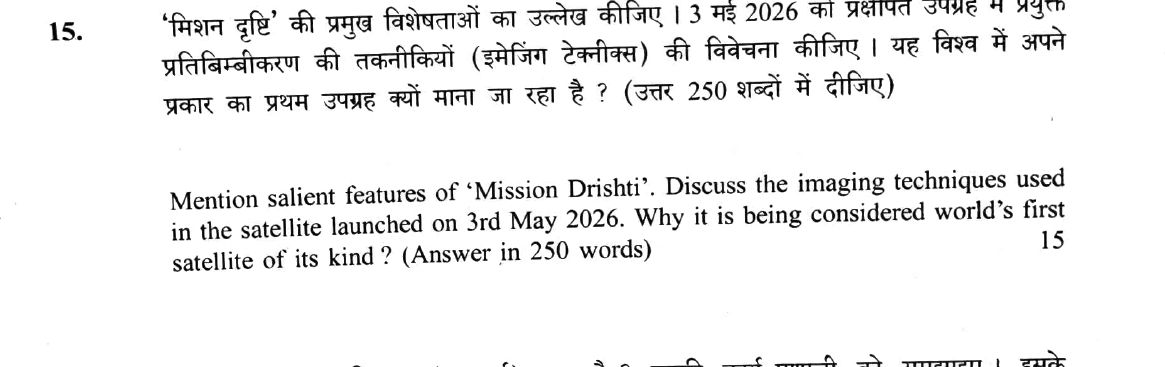
Mention salient features of 'Mission Drishti'. Discuss the imaging techniques used in the satellite launched on 3rd May 2026. Why it is being considered world's first satellite of its kind? (Answer in 250 words) 15 marks
हिंदी में प्रश्न पढ़ें
'मिशन दृष्टि' की प्रमुख विशेषताओं का उल्लेख कीजिए। 3 मई 2026 को प्रक्षेपित उपग्रह में प्रयुक्त प्रतिबिम्बीकरण की तकनीकियों (इमेजिंग टेक्नीक्स) की विवेचना कीजिए। यह विश्व में अपने प्रकार का प्रथम उपग्रह क्यों माना जा रहा है? (उत्तर 250 शब्दों में दीजिए)
Model answer
Written by UPSC Answer Check against this question's marking rubric, to the 250-word length. UPSC does not publish answers for Mains — this is one way to score well, not an official key.
Mission Drishti is the flagship Earth-observation satellite of GalaxEye Space, an IIT-Madras incubated Indian private space start-up, launched on 3 May 2026 as a rideshare on an Indian launch vehicle. Its salient features are a compact advanced Earth-observation platform, a hybrid dual-sensor payload, and on-board data fusion that converts raw radar and optical observations into usable geospatial products. The mission is significant because it brings advanced Earth-observation capability into India’s private space ecosystem.
The imaging techniques are the defining feature. The satellite carries a Synthetic Aperture Radar (SAR) for all-weather, day-and-night imaging, together with a high-resolution optical/multispectral imager for detailed mapping of land, water and vegetation. On-board fusion combines the two data streams, allowing radar to penetrate cloud cover while optical imagery provides fine spatial detail. The dual-sensor design is especially useful where optical missions are limited by clouds or night, and where radar alone lacks fine visual context. This hybrid approach supports disaster early-warning, agricultural crop-health monitoring, forestry, urban and infrastructure planning, defence and surveillance, and maritime domain awareness.
It is considered the world’s first satellite of its kind because it is positioned as the first platform to carry both SAR and optical sensors together and fuse their outputs on-board, rather than relying on separate missions or ground-based processing. This gives a single satellite the ability to deliver continuous, all-weather, high-resolution monitoring. In doing so, Mission Drishti extends India’s Earth-observation continuum alongside Cartosat, RISAT and the EOS series, while demonstrating private-sector capability in advanced space-based sensing.
What "Mention" is asking you to do
Put specific factual content on record — the names, features, targets or instances the stem asks for. Mention is usually the subordinate half of a larger question, so it must be done fully but quickly, leaving room for the part that carries the main directive.
Structure that answers it
The items named directly, without preamble → one qualifying detail against each → straight on to the part of the stem the marks actually sit in
Where marks are lost
Gesturing at the category instead of naming the particulars, or expanding it until the analytical half of the question is squeezed.
How this answer will be evaluated
Approach
Framework: Technology: why it matters, use, benefit, risk, policy. discuss: intro > 3-4 dimensions > example > balanced close Full marks: Precise technical details on imaging and clear justification of its unique status.
Key points expected
- Mission Drishti's specific mission parameters
- Technical details of the imaging payload
- The specific innovation making it 'world's first'
- Strategic or scientific significance of the launch
Evaluation rubric
Each sub-part is marked on its own, against the marks and word limit printed on the paper.
- The answer Identify Mission Drishti's features, imaging techniques, and its unique global status. 15 marks · 250 words
discuss— intro → 3-4 dimensions → example → balanced close
Must cover
- Define Mission Drishti's primary objective
- List specific imaging techniques used
- Explain the 'world's first' technical distinction
- Mention the launch date (3 May 2026)
Loses marks
- Vague generalities about 'space technology'
- Ignoring the specific 'world's first' claim
- Confusing with other ISRO missions
Earns more
- Mention specific sensor types (e.g., SAR, optical)
- Link features to strategic or developmental utility
- Compare with existing satellite capabilities
Extra mark
- Simple flowchart of imaging process
- Specific resolution or orbit parameters
Practice this exact question
Write your answer and it is marked point by point against the model answer above — what you covered, what you missed, what you got wrong.
Evaluate my answer →More from General Studies 2026 GS Paper III
- Q12 How are startups in India promoting entrepreneurship, innovation and employment? Discuss…
- Q13 How Indian agriculture has been transformed from food scarcity to food surplus level? Exp…
- Q14 Discuss the different types of subsidies and supports provided by the Government of India…
- Q15 Mention salient features of 'Mission Drishti'. Discuss the imaging techniques used in the…
- Q16 What is agentic Artificial Intelligence (AI)? Explain its working. Describe its applicati…
- Q17 What are the challenges to solid waste management in India? Discuss the governmental poli…
- Q18 "Community participation is the cornerstone of effective disaster management." Analyse th…