GS Paper III — Q13
How Indian agriculture has been transformed from food scarcity to food surplus level? Explain the various government policies…
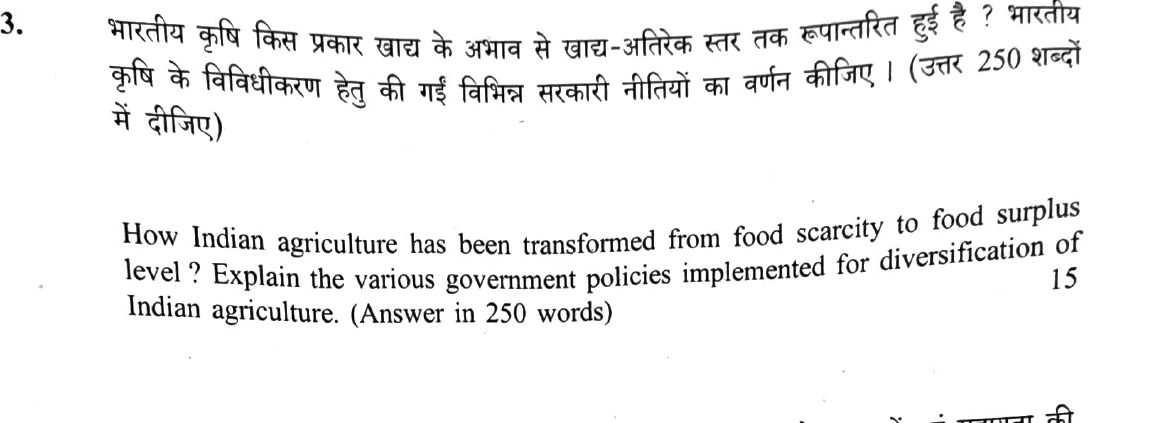
How Indian agriculture has been transformed from food scarcity to food surplus level? Explain the various government policies implemented for diversification of Indian agriculture. (Answer in 250 words) 15 marks
हिंदी में प्रश्न पढ़ें
भारतीय कृषि किस प्रकार खाद्य के अभाव से खाद्य-अतिरेक स्तर तक रूपान्तरित हुई है? भारतीय कृषि के विविधीकरण हेतु की गई विभिन्न सरकारी नीतियों का वर्णन कीजिए। (उत्तर 250 शब्दों में दीजिए)
Model answer
Written by UPSC Answer Check against this question's marking rubric, to the 250-word length. UPSC does not publish answers for Mains — this is one way to score well, not an official key.
India’s transition from a "ship-to-mouth" vulnerability under PL-480 to a net food exporter was driven by technological adoption and institutional support.
Transformation from Food Scarcity to Surplus
The turnaround began with the Green Revolution in the late 1960s, which combined High Yielding Variety (HYV) seeds, expanded chemical fertilizers, and assured canal and tube-well irrigation to drastically boost wheat and rice yields. This production surge was sustained by institutional price incentives, specifically Minimum Support Price (MSP) backed open-ended procurement and buffer stocking by the Food Corporation of India (FCI), insulating farmers against price crashes and securing food availability. Alongside cereals, the White Revolution (Operation Flood) transformed India into the largest milk producer, while the Blue Revolution scaled inland and marine fisheries, turning a baseline food-grain deficit into a diversified food surplus.
Government Policies for Diversification
To correct the ecological imbalances of cereal-centric farming and ensure nutritional security, key policies have been implemented:
The Crop Diversification Programme (CDP), a sub-scheme under RKVY, targets original Green Revolution states like Punjab and Haryana to encourage farmers to shift away from water-intensive paddy monoculture toward alternative crops like maize, cotton, and pulses.
The National Food Security Mission (NFSM) along with the PM-AASHA (Pradhan Mantri Annadata Aay Sanraksan Abhiyan) framework provides input support and price assurance for pulses and oilseeds, incentivising their cultivation to reduce critical import dependency.
Nutritional diversification has gained impetus through the promotion of millets as ‘Shree Anna’ following the International Year of Millets 2023, integrating climate-resilient nutri-cereals into procurement systems, public distribution, and mid-day meal schemes.
Aligning institutional support, market infrastructure, and MSP structures with ecologically viable crops will allow India to transition from mere food security to sustainable nutritional security.
What "How" is asking you to do
Set out the route by which the outcome comes about, step by step. Many how stems ask how one thing affects another, and there the channel of transmission is precisely what is being marked.
Structure that answers it
Starting condition → step → step → outcome reached → the conditions the route depends on
Where marks are lost
Answering why it happens instead of how, the commonest single misread in the paper. An answer full of causes and significance that never traces the mechanism has answered a different question.
How this answer will be evaluated
Approach
Framework: Situation > Analysis > Measures > Assessment. explain: definition/context > points in order > small example > short close Full marks: Precise policy names linked to diversification outcomes with data.
Key points expected
- Identify Green Revolution as the driver of surplus
- List specific diversification policies (e.g., PM-KISAN, Mission Organic)
- Link policy to specific agricultural outcome
- Mention shift from food grains to high-value crops
Evaluation rubric
Each sub-part is marked on its own, against the marks and word limit printed on the paper.
- The answer Trace the shift from scarcity to surplus and detail policies for diversification. · 250 words
explain— definition/context → points in order → small example → short close
Must cover
- Identify Green Revolution as the driver of surplus
- List specific diversification policies (e.g., PM-KISAN, Mission Organic)
- Link policy to specific agricultural outcome
- Mention shift from food grains to high-value crops
Loses marks
- Focusing only on MSP without diversification
- Vague generalities without naming specific schemes
- Ignoring the 'scarcity' starting point
Earns more
- Reference to National Food Security Act
- Mention of e-NAM for market diversification
- Discussion of post-harvest infrastructure
- Reference to PM-FAAS for agri-services
Extra mark
- Specific production data (e.g., wheat/food grain tonnage)
- Simple flowchart of policy to outcome
Practice this exact question
Write your answer and it is marked point by point against the model answer above — what you covered, what you missed, what you got wrong.
Evaluate my answer →More from General Studies 2026 GS Paper III
- Q10 Ladakh is strategically located between China and Pakistan. As a measure to win hearts an…
- Q11 Explain the key challenges for India's energy security. What measures do you suggest for…
- Q12 How are startups in India promoting entrepreneurship, innovation and employment? Discuss…
- Q13 How Indian agriculture has been transformed from food scarcity to food surplus level? Exp…
- Q14 Discuss the different types of subsidies and supports provided by the Government of India…
- Q15 Mention salient features of 'Mission Drishti'. Discuss the imaging techniques used in the…
- Q16 What is agentic Artificial Intelligence (AI)? Explain its working. Describe its applicati…