Paper II — Q1
(a) A piston-cylinder contains 2 kg of argon at T₁ = 300 K and V₁ = 1 m³ (state 1). Argon is heated by an electric heater of 10…
A piston-cylinder contains 2 kg of argon at T₁ = 300 K and V₁ = 1 m³ (state 1). Argon is heated by an electric heater of 10 A, 220 volts for 10 seconds at constant volume; during the process, 20% heat is lost (state 2). The gas is now allowed to expand from pressure P₂ to a final state with temperature T₃ = 40 °C and final pressure P₃ = 0·5P₂ (state 3). The process 2–3 follows PVⁿ = constant. Find the index of expansion n for the process 2–3. Take for argon R = 0·2081 kJ/kg-K and C_v = 0·312 kJ/kg-K. 10 marks
A gas turbine plant operates on ideal Brayton cycle between T_min = 300 K and T_max = 1200 K. Find the maximum work done per kg of air and the corresponding cycle efficiency. Assume C_p of air as 1·005 kJ/kg-K. 10 marks
An air jet (γ = 1·4, R = 287 J/kg-K) at 425 K has sonic velocity. Determine the (i) velocity of sound at the stagnation condition, (ii) maximum velocity of the jet and (iii) Crocco number. 10 marks
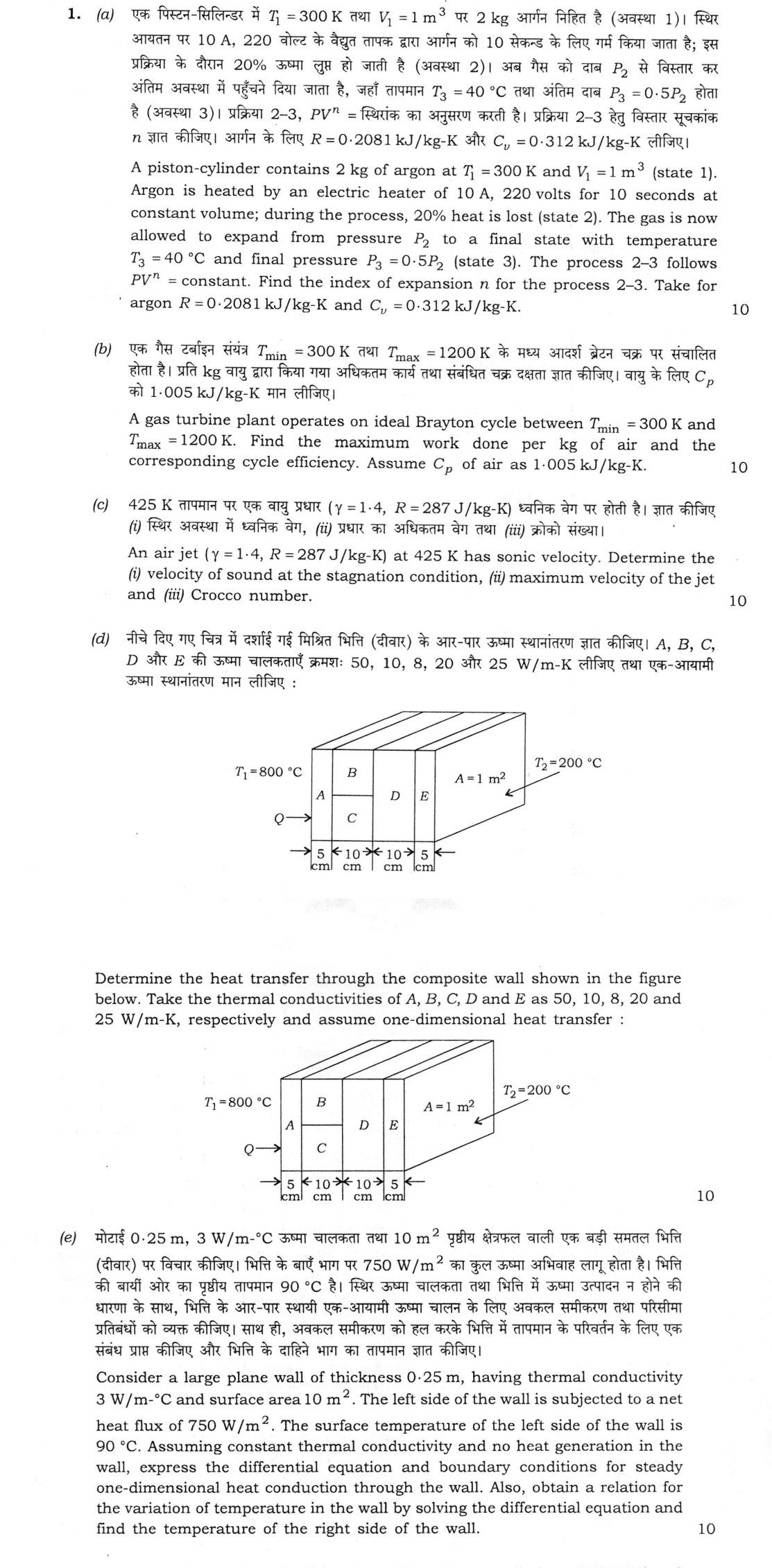
Determine the heat transfer across the composite wall shown in the figure given below. Take the thermal conductivities of A, B, C, D and E as 50, 10, 8, 20 and 25 W/m-K respectively and assume one-dimensional heat transfer : Determine the heat transfer through the composite wall shown in the figure below. Take the thermal conductivities of A, B, C, D and E as 50, 10, 8, 20 and 25 W/m-K, respectively and assume one-dimensional heat transfer : 10 marks
Consider a large plane wall of thickness 0·25 m, having thermal conductivity 3 W/m-°C and surface area 10 m². The left side of the wall is subjected to a net heat flux of 750 W/m². The surface temperature of the left side of the wall is 90 °C. Assuming constant thermal conductivity and no heat generation in the wall, express the differential equation and boundary conditions for steady one-dimensional heat conduction through the wall. Also, obtain a relation for the variation of temperature in the wall by solving the differential equation and find the temperature of the right side of the wall. 10 marks
हिंदी में प्रश्न पढ़ें
एक पिस्टन-सिलिण्डर में T₁ = 300 K तथा V₁ = 1 m³ पर 2 kg आर्गन निहित है (अवस्था 1)। स्थिर आयतन पर 10 A, 220 वोल्ट के वैद्युत तापक द्वारा आर्गन को 10 सेकण्ड के लिए गर्म किया जाता है; इस प्रक्रिया के दौरान 20% ऊष्मा लुप्त हो जाती है (अवस्था 2)। अब गैस को दाब P₂ से विस्तार कर अंतिम अवस्था में पहुँचने दिया जाता है, जहाँ तापमान T₃ = 40 °C तथा अंतिम दाब P₃ = 0·5P₂ होता है (अवस्था 3)। प्रक्रिया 2–3, PVⁿ = स्थिरांक का अनुसरण करती है। प्रक्रिया 2–3 हेतु विस्तार सूचकांक n ज्ञात कीजिए। आर्गन के लिए R = 0·2081 kJ/kg-K तथा C_v = 0·312 kJ/kg-K लीजिए। (10 अंक)
एक गैस टर्बाइन संयंत्र T_min = 300 K तथा T_max = 1200 K के मध्य आदर्श ब्रेटन चक्र पर संचालित होता है। प्रति kg वायु द्वारा किया गया अधिकतम कार्य तथा संबंधित चक्र दक्षता ज्ञात कीजिए। वायु के लिए C_p को 1·005 kJ/kg-K मान लीजिए। (10 अंक)
425 K तापमान पर एक वायु प्रधार (γ = 1·4, R = 287 J/kg-K) ध्वनिक वेग पर होती है। ज्ञात कीजिए (i) स्थिर अवस्था में ध्वनिक वेग, (ii) प्रधार का अधिकतम वेग तथा (iii) क्रोको संख्या। (10 अंक)
निचे दिए गए चित्र में दर्शाई गई मिश्रित भित्ति (दीवार) के आर-पार ऊष्मा स्थानांतरण ज्ञात कीजिए। A, B, C, D और E की ऊष्मा चालकताएँ क्रमश: 50, 10, 8, 20 और 25 W/m-K लीजिए तथा एक-आयामी ऊष्मा स्थानांतरण मान लीजिए : (10 अंक)
मोटाई 0·25 m, 3 W/m-°C ऊष्मा चालकता तथा 10 m² पृष्ठीय क्षेत्रफल वाली एक बड़ी समतल भित्ति (दीवार) पर विचार कीजिए। भित्ति के बाएँ भाग पर 750 W/m² का कुल ऊष्मा अभिवाह लागू होता है। भित्ति की बाईं ओर का पृष्ठीय तापमान 90 °C है। स्थिर ऊष्मा चालकता तथा भित्ति में ऊष्मा उत्पादन न होने की धारणा के साथ, भित्ति के आर-पार स्थायी एक-आयामी ऊष्मा चालन के लिए अवकल समीकरण तथा परिसीमा प्रतिबंधों को व्यक्त कीजिए। साथ ही, अवकल समीकरण को हल करके भित्ति में तापमान के परिवर्तन के लिए एक संबंध प्राप्त कीजिए और भित्ति के दाहिने भाग का तापमान ज्ञात कीजिए। (10 अंक)
Model answer
Drafted with AI by UPSC Answer Check against this question's marking rubric, to the expected length. UPSC does not publish answers for Mains — this is one way to score well, not an official key. How we build rubrics and answers.
(a) Index of expansion for argon (10 marks)
Data: m = 2 kg, T₁ = 300 K, V₁ = 1 m³, R = 0.2081 kJ/kg·K and C_v = 0.312 kJ/kg·K.
State 1. P₁ = mRT₁/V₁ = 2 × 0.2081 × 300/1 = 124.9 kPa.
Process 1–2 (constant volume heating). The electrical energy supplied is W = VIt = 220 × 10 × 10 = 22 000 J = 22 kJ. With 20% lost as heat, the energy reaching the gas is 0.8 × 22 = 17.6 kJ. Since the volume is constant, no boundary work is done and
Q = m C_v (T₂ − T₁): 17.6 = 2 × 0.312 × (T₂ − 300)
T₂ = 300 + 28.2 = 328.2 K.
P₂ = P₁ T₂/T₁ = 124.86 × 328.2/300 = 136.6 kPa.
State 3. T₃ = 40 °C = 313.15 K and P₃ = 0.5 P₂ = 68.3 kPa.
Process 2–3 (PVⁿ = constant). For a polytropic process, T₃/T₂ = (P₃/P₂)^((n−1)/n):
313.15/328.2 = (0.5)^((n−1)/n)
ln(0.9541) = ((n − 1)/n) ln 0.5, so −0.04696 = ((n − 1)/n)(−0.6931)
(n − 1)/n = 0.06774, so n = 1/(1 − 0.06774) = 1.073.
The index is close to 1, that is, the expansion is nearly isothermal (heat is added to the gas during it), and it is well below γ = 1.667 for argon.
(b) Maximum work of an ideal Brayton cycle (10 marks)
Data: T₁ = T_min = 300 K, T₃ = T_max = 1200 K and C_p = 1.005 kJ/kg·K.
Condition for maximum work. The net work per kg is w = C_p (T₃ − T₄) − C_p (T₂ − T₁). With T₂ = T₁ r^((γ−1)/γ) and T₄ = T₃/r^((γ−1)/γ), the work is greatest when d w/d r = 0, which gives
T₂ = T₄ = √(T_min T_max) = √(300 × 1200) = 600 K.
The corresponding pressure ratio is r_p = (T₂/T₁)^(γ/(γ−1)) = 2^3.5 = 11.3 (with γ = 1.4).
Maximum net work.
w_max = C_p (T₃ − T₄ − T₂ + T₁) = 1.005 (1200 − 600 − 600 + 300) = 301.5 kJ/kg
This is the same as C_p (√T_max − √T_min)² = 1.005 × (34.64 − 17.32)² = 301.5 kJ/kg.
Efficiency at that condition.
η = 1 − T₁/T₂ = 1 − 300/600 = 50%
This is the ideal Brayton efficiency 1 − 1/r_p^((γ−1)/γ) at the optimum pressure ratio, and it is well below the Carnot efficiency between the same limits, 1 − 300/1200 = 75%.
(c) Air jet at sonic velocity (10 marks)
Data: γ = 1.4, R = 287 J/kg·K, and the temperature at sonic velocity (M = 1) is T* = 425 K.
At M = 1, T*/T₀ = 2/(γ + 1) = 1/1.2, so T₀ = 1.2 × 425 = 510 K.
(i) Speed of sound at the stagnation state.
a₀ = √(γ R T₀) = √(1.4 × 287 × 510) = 452.7 m/s
(ii) Maximum velocity. Isentropic expansion to absolute zero temperature converts all the enthalpy into kinetic energy. With C_p = γR/(γ − 1) = 1004.5 J/kg·K:
V_max = √(2 C_p T₀) = √(2 × 1004.5 × 510) = 1012 m/s
(Also V_max = a₀ √(2/(γ − 1)) = 452.7 × √5 = 1012 m/s.)
(iii) Crocco number. Ca = V/V_max. At sonic condition, V = a* = √(γ R T*) = √(1.4 × 287 × 425) = 413.2 m/s, so
Ca = 413.2/1012.2 = 0.408
This equals √((γ − 1)/(γ + 1)) = √(0.4/2.4) = 0.408, the value at M = 1.
(d) Heat transfer through the composite wall (10 marks)
Thermal circuit. Heat flows through A, then through B and C in parallel, then through D, then through E, so the resistances A, (B ∥ C), D and E are in series. Take the one-dimensional flow, area 1 m² overall, with B and C each taking half the height (0.5 m² each), as drawn. R = L/(kA):
- R_A = 0.05/(50 × 1) = 0.0010 K/W
- R_B = 0.10/(10 × 0.5) = 0.0200 K/W
- R_C = 0.10/(8 × 0.5) = 0.0250 K/W
- R_D = 0.10/(20 × 1) = 0.0050 K/W
- R_E = 0.05/(25 × 1) = 0.0020 K/W
B and C in parallel: 1/R_BC = 1/0.02 + 1/0.025 = 50 + 40 = 90, so R_BC = 0.01111 K/W.
Total resistance: R_total = 0.0010 + 0.01111 + 0.0050 + 0.0020 = 0.01911 K/W.
Heat transfer.
Q = (T₁ − T₂)/R_total = (800 − 200)/0.01911 = 31 400 W ≈ 31.4 kW
(e) Steady one-dimensional conduction in a plane wall (10 marks)
Data: L = 0.25 m, k = 3 W/m·°C, area 10 m², heat flux at the left face q₀ = 750 W/m² into the wall, and left surface temperature T(0) = 90 °C.
Governing equation. For steady one-dimensional conduction with constant k and no generation, the heat equation d/dx(k dT/dx) + ė = 0 becomes
d²T/dx² = 0
Boundary conditions.
- At x = 0 (specified heat flux): −k dT/dx |ₓ₌₀ = q₀ = 750 W/m².
- At x = 0 (specified temperature): T(0) = 90 °C.
Solution. Integrating twice, T(x) = C₁x + C₂. The flux condition gives −k C₁ = 750, so C₁ = −750/3 = −250 °C/m. The temperature condition gives C₂ = 90 °C. Hence
T(x) = 90 − 250 x (°C, with x in m)
The temperature falls linearly in the direction of the heat flow.
Right side. At x = L = 0.25 m: T(L) = 90 − 250 × 0.25 = 27.5 °C.
The total heat transferred is 750 × 10 = 7500 W, and the temperature difference across the wall is 62.5 °C, which agrees with q L/k = 750 × 0.25/3 = 62.5 °C.
How this answer will be evaluated
Evaluation rubric
Each sub-part is marked on its own, against the marks and word limit printed on the paper.
- (a) Find the index of expansion n for process 2–3 for 2 kg of argon heated electrically at constant volume with 20% heat loss and then expanded to 40 °C and half the pressure (10 marks). 10 marks
Must cover
- P₁ = mRT₁/V₁ = 124.9 kPa
- Net energy 17.6 kJ from 22 kJ electrical input less 20%, giving T₂ = 328.2 K and P₂ = 136.6 kPa
- State 3: T₃ = 313.15 K and P₃ = 0.5P₂
- n from T₃/T₂ = (P₃/P₂)^((n−1)/n), giving n ≈ 1.07
Loses marks
- Using the full 22 kJ.
- Using the celsius temperature in the polytropic relation.
Earns more
- Constant-volume energy balance Q = mC_v ΔT used.
- Temperature converted to kelvin.
Extra mark
- Comment that the index is near isothermal and below γ
- (b) Find the maximum work per kg and the corresponding cycle efficiency for an ideal Brayton cycle between 300 K and 1200 K (10 marks). 10 marks
Must cover
- Optimum condition T₂ = T₄ = √(T_min T_max) = 600 K
- Pressure ratio (T₂/T₁)^(γ/(γ−1)) ≈ 11.3
- Maximum work = 301.5 kJ/kg
- Efficiency 1 − T₁/T₂ = 50%
Loses marks
- Giving the Carnot efficiency as the answer.
- Using the pressure ratio for maximum efficiency.
Earns more
- Work expression C_p(T₃ − T₄ − T₂ + T₁) shown.
- Cross-check with C_p(√T_max − √T_min)².
Extra mark
- Comparison with Carnot efficiency of 75%
- (c) An air jet at 425 K has sonic velocity: find (i) speed of sound at stagnation, (ii) maximum jet velocity, (iii) Crocco number (10 marks). 10 marks
Must cover
- M = 1 at 425 K so T* = 425 K and T₀ = 1.2T* = 510 K
- a₀ = 452.7 m/s
- V_max = √(2C_pT₀) ≈ 1012 m/s
- Crocco number = V/V_max ≈ 0.408
Loses marks
- Taking 425 K as the stagnation temperature.
- Using the stagnation speed of sound for the Crocco number.
Earns more
- C_p = γR/(γ−1) computed.
- Sonic velocity 413.2 m/s used in the Crocco number.
Extra mark
- Crocco number equals √((γ−1)/(γ+1)) at M = 1
- (d) Determine the heat transfer across the composite wall with A, B ∥ C, D and E in series between 800 °C and 200 °C (10 marks). 10 marks
Must cover
- Series-parallel resistance network with B and C in parallel
- Individual resistances R = L/kA with the correct areas
- R_BC = 0.01111 and R_total = 0.01911 K/W
- Q = 600/0.01911 ≈ 31.4 kW
Loses marks
- Adding B and C in series.
- Using thickness in cm.
Earns more
- Equal areas for B and C stated as an assumption.
- Units of thickness converted to metres.
Extra mark
- Interface temperatures
- (e) Write the governing equation and boundary conditions for steady 1-D conduction in the wall, solve for T(x) and find the right-face temperature (10 marks). 10 marks
Must cover
- d²T/dx² = 0 for steady one-dimensional conduction with constant k and no generation
- Boundary conditions −k dT/dx = 750 W/m² and T(0) = 90 °C
- T(x) = 90 − 250x
- Right face T(0.25) = 27.5 °C
Loses marks
- Using the wrong sign so the right face is hotter.
- Writing the equation with a generation term.
Earns more
- Sign of the flux boundary condition explained.
- Cross-check with qL/k = 62.5 °C.
Extra mark
- Total heat 7500 W
What "State" is asking you to do
Give the formulation itself — the theorem, rule, statutory provision or position — worded accurately. Precision of wording is the whole of the mark; no background or justification is being asked for.
Structure that answers it
The statement in full, complete in itself → the conditions under which it holds → an illustration only where the stem asks for one
Where marks are lost
Approximating the wording. A theorem or a provision stated loosely forfeits the mark that exact statement would have carried.
Practice this exact question
Write your answer and it is marked point by point against the model answer above — what you covered, what you missed, what you got wrong.
Evaluate my answer →More from Mechanical Engineering 2026 Paper II
- Q1 (a) A piston-cylinder contains 2 kg of argon at T₁ = 300 K and V₁ = 1 m³ (state 1). Argon…
- Q2 (a) (i) During a heat transfer process, the entropy change of incompressible substances,…
- Q3 (a) Steam at 40 °C is condensed in a power plant using cooling water available at 12 °C.…
- Q4 (a) (i) What does the NTU of a heat exchanger represent? Is a heat exchanger with a very…