Paper II — Q4
(a) (i) What does the NTU of a heat exchanger represent? Is a heat exchanger with a very large NTU necessarily a good one? (10…
What does the NTU of a heat exchanger represent? Is a heat exchanger with a very large NTU necessarily a good one? 10 marks
Consider an oil-to-oil double-pipe heat exchanger, whose flow arrangement is not known. The temperature measurements indicate that the cold oil enters at 18 °C and leaves at 50 °C, while the hot oil enters at 75 °C and leaves at 40 °C. Assuming the mass flow rates of both the oils to be identical, determine the effectiveness and flow configuration of this heat exchanger. 10 marks
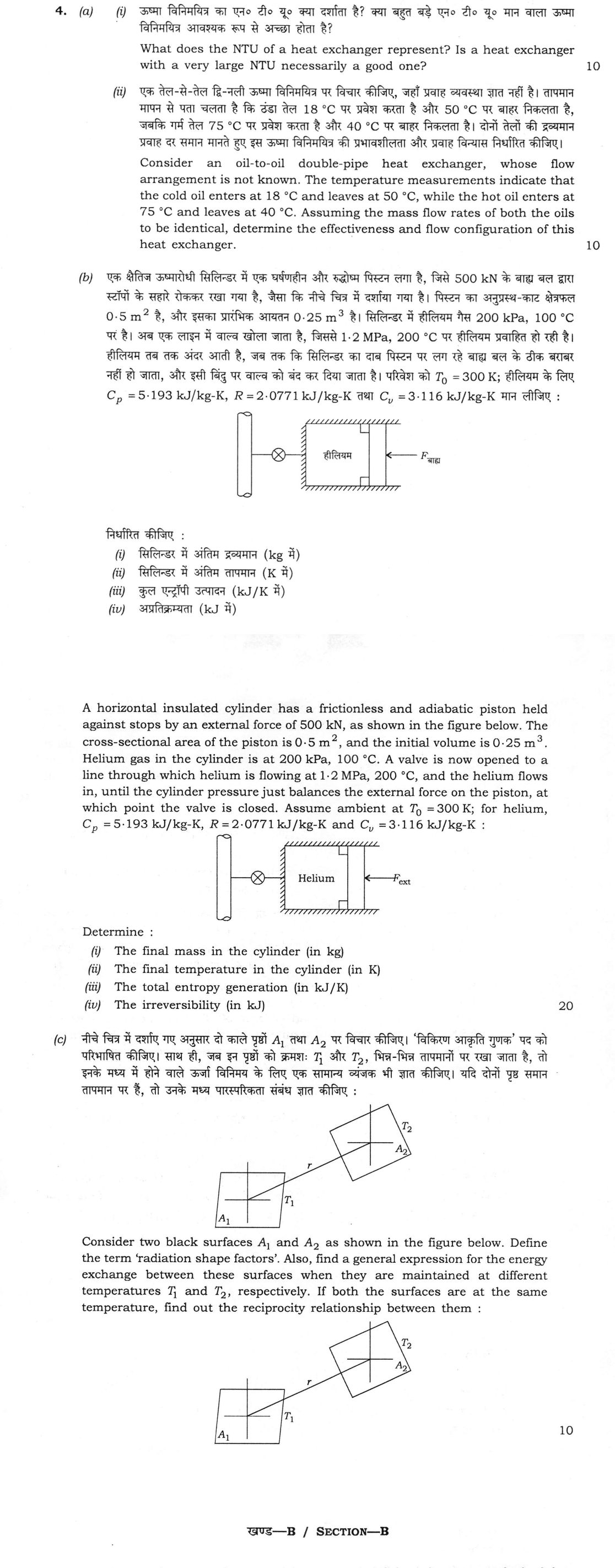
A frictionless and adiabatic piston is fitted in a horizontal insulated cylinder, held against stops by an external force of 500 kN, as shown in the figure below. The cross-sectional area of the piston is 0·5 m², and its initial volume is 0·25 m³. The helium gas in the cylinder is at 200 kPa, 100 °C. Now a valve in a line is opened, through which helium at 1·2 MPa, 200 °C flows. The helium enters until the pressure in the cylinder becomes exactly equal to the external force acting on the piston, and at this point the valve is closed. Take surroundings at T₀ = 300 K; for helium C_p = 5·193 kJ/kg-K, R = 2·0771 kJ/kg-K and C_v = 3·116 kJ/kg-K :
Determine : Final mass in the cylinder (in kg)
Final temperature in the cylinder (in K)
Total entropy production (in kJ/K)
Irreversibility (in kJ) 20 marks
Consider two black surfaces A₁ and A₂ as shown in the figure below. Define the term ‘radiation shape factors’. Also, find a general expression for the energy exchange between these surfaces when they are maintained at different temperatures T₁ and T₂, respectively. If both the surfaces are at the same temperature, find out the reciprocity relationship between them : 10 marks
हिंदी में प्रश्न पढ़ें
ऊष्मा विनिमयित्र का एन० टी० यू० क्या दर्शाता है? क्या बहुत बड़े एन० टी० यू० मान वाला ऊष्मा विनिमयित्र आवश्यक रूप से अच्छा होता है? (10 अंक)
एक तेल-से-तेल द्वि-नली ऊष्मा विनिमयित्र पर विचार कीजिए, जहाँ प्रवाह व्यवस्था ज्ञात नहीं है। तापमान मापन से पता चलता है कि ठंडा तेल 18 °C पर प्रवेश करता है और 50 °C पर बाहर निकलता है, जबकि गर्म तेल 75 °C पर प्रवेश करता है और 40 °C पर बाहर निकलता है। दोनों तेलों की द्रव्यमान प्रवाह दर समान मानते हुए इस ऊष्मा विनिमयित्र की प्रभावशीलता और प्रवाह विन्यास निर्धारित कीजिए। (10 अंक)
एक क्षैतिज ऊष्मारोधी सिलिन्डर में एक घर्षणहीन और रुद्धोष्म पिस्टन लगा है, जिसे 500 kN के बाह्य बल द्वारा स्टॉपों के सहारे रोककर रखा गया है, जैसा कि नीचे चित्र में दर्शाया गया है। पिस्टन का अनुप्रस्थ-काट क्षेत्रफल 0·5 m² है, और इसका प्रारंभिक आयतन 0·25 m³ है। सिलिन्डर में हीलियम गैस 200 kPa, 100 °C पर है। अब एक लाइन में वाल्व खोला जाता है, जिससे 1·2 MPa, 200 °C पर हीलियम प्रवाहित हो रही है। हीलियम तब तक अंदर आती है, जब तक कि सिलिन्डर का दाब पिस्टन पर लगे बाह्य बल के ठीक बराबर नहीं हो जाता, और इसी बिंदु पर वाल्व को बंद कर दिया जाता है। परिवेश को T₀ = 300 K; हीलियम के लिए C_p = 5·193 kJ/kg-K, R = 2·0771 kJ/kg-K तथा C_v = 3·116 kJ/kg-K मान लीजिए :
निर्धारित कीजिए : सिलिन्डर में अंतिम द्रव्यमान (kg में)
सिलिन्डर में अंतिम तापमान (K में)
कुल एन्ट्रॉपी उत्पादन (kJ/K में)
अप्रतिक्रम्यता (kJ में) (20 अंक)
नीचे चित्र में दर्शाए गए अनुसार दो काले पृष्ठों A₁ तथा A₂ पर विचार कीजिए। ‘विकिरण आकृति गुणक’ पद को परिभाषित कीजिए। साथ ही, जब इन पृष्ठों को क्रमश: T₁ और T₂, भिन्न-भिन्न तापमानों पर रखा जाता है, तो इनके मध्य में होने वाले ऊर्जा विनिमय के लिए एक सामान्य व्यंजक भी ज्ञात कीजिए। यदि दोनों पृष्ठ समान तापमान पर हैं, तो उनके मध्य पारस्परिक संबंध ज्ञात कीजिए : (10 अंक)
Model answer
Drafted with AI by UPSC Answer Check against this question's marking rubric, to the expected length. UPSC does not publish answers for Mains — this is one way to score well, not an official key. How we build rubrics and answers.
(a)(i) Meaning of NTU, and whether a very large NTU is good (10 marks)
What NTU represents. The number of transfer units, NTU = UA/C_min, is the ratio of the heat exchanger's thermal conductance (overall coefficient times area) to the smaller heat capacity rate of the two fluids. It is a dimensionless measure of the heat transfer size of the exchanger: how much heat the exchanger can move per kelvin of temperature difference compared with how much the weaker stream can absorb per kelvin. It also equals the temperature change of the C_min fluid divided by the mean temperature difference between the fluids, so a large NTU means a small mean driving temperature difference is enough to give a large temperature change.
Is a very large NTU good? No, not necessarily.
- Effectiveness rises with NTU but flattens. For a counterflow exchanger with Cᵣ = 1, ε = NTU/(1 + NTU), so ε = 0.5 at NTU = 1, 0.75 at NTU = 3 and only 0.91 at NTU = 10. Beyond about NTU = 3 the extra area buys very little.
- The gain has a ceiling. For a parallel-flow exchanger, ε cannot exceed 1/(1 + Cᵣ), whatever the NTU, and for Cᵣ = 1 ε reaches 1 only as NTU → ∞ even in counterflow.
- A large NTU needs a large area or a long, large exchanger. That raises capital cost, weight, space, fouling area and the tube-side pressure drop, and therefore pumping power.
- So the design is a compromise between effectiveness and cost, and an economically sound design usually has an NTU of about 1–3.
(a)(ii) Effectiveness and flow configuration of the oil-to-oil exchanger (10 marks)
Data: cold oil 18 °C to 50 °C, hot oil 75 °C to 40 °C, equal mass flow rates.
Flow configuration. The cold fluid leaves at 50 °C, which is higher than the hot fluid outlet of 40 °C. In a parallel-flow exchanger both fluids approach the same final temperature from opposite sides, so the cold outlet can never exceed the hot outlet. Therefore the exchanger must be counterflow.
Effectiveness. The temperature changes are ΔTₕ = 75 − 40 = 35 °C and ΔT_c = 50 − 18 = 32 °C. With no heat loss, Cₕ ΔTₕ = C_c ΔT_c, so
Cₕ/C_c = 32/35 = 0.914
The hot stream has the smaller capacity rate, so C_min = Cₕ and Cᵣ = 0.914. The maximum possible heat transfer is C_min (Tₕ,in − T_c,in) = Cₕ (75 − 18) = 57 Cₕ. Then
ε = Q/Q_max = Cₕ (35)/(Cₕ × 57) = 35/57 = 0.614 (about 61%)
Check. The greatest effectiveness a parallel-flow exchanger can give with Cᵣ = 0.914 is 1/(1 + Cᵣ) = 0.52, which is lower than 0.614, and this confirms that the exchanger is counterflow.
(b) Charging of an insulated cylinder with helium (20 marks)
Data: A = 0.5 m², F_ext = 500 kN, V₁ = 0.25 m³, initial state 200 kPa and 100 °C (373.15 K), supply line at 1.2 MPa and 200 °C (473.15 K), T₀ = 300 K, Cₚ = 5.193, Cᵥ = 3.116 and R = 2.0771 kJ/kg·K.
Final pressure. The external force balances a gas pressure of P₂ = F_ext/A = 500/0.5 = 1000 kPa. The initial pressure (200 kPa) is below this, so the piston stays against its stops and the volume remains 0.25 m³ throughout, with no boundary work. The valve is closed when P₂ reaches 1000 kPa.
(i) Final mass. The initial mass is m₁ = P₁V/(RT₁) = 200 × 0.25/(2.0771 × 373.15) = 0.06451 kg.
The system is insulated with no work, so the unsteady energy balance for the filling process is
m₂u₂ − m₁u₁ = (m₂ − m₁) h_in, that is Cᵥ (m₂T₂ − m₁T₁) = (m₂ − m₁) Cₚ T_in
From the gas law at constant volume, m₂T₂ = P₂V/R = 1000 × 0.25/2.0771 = 120.36 kg·K, and m₁T₁ = P₁V/R = 24.07 kg·K. Then
3.116 (120.36 − 24.07) = (m₂ − m₁) × 5.193 × 473.15
300.03 = 2457.0 (m₂ − m₁), so m₂ − m₁ = 0.1221 kg
m₂ = 0.06451 + 0.1221 = 0.1866 kg
(ii) Final temperature.
T₂ = P₂V/(m₂R) = 120.36/0.18662 = 644.9 K
(iii) Entropy generation. The cylinder is insulated, so the entropy generated is the entropy increase of the contents less the entropy carried in by the mass:
S_gen = m₂s₂ − m₁s₁ − (m₂ − m₁) s_in = m₁ (s₂ − s₁) + (m₂ − m₁)(s₂ − s_in)
- s₂ − s₁ = Cₚ ln(T₂/T₁) − R ln(P₂/P₁) = 5.193 ln(644.9/373.15) − 2.0771 ln(1000/200) = 2.8358 − 3.3430 = −0.5014 kJ/kg·K.
- s₂ − s_in = Cₚ ln(T₂/T_in) − R ln(P₂/P_in) = 5.193 ln(644.9/473.15) − 2.0771 ln(1000/1200) = 1.6108 + 0.3787 = 1.9872 kJ/kg·K.
S_gen = 0.06451 × (−0.5014) + 0.1221 × 1.9872 = −0.03235 + 0.24267 = 0.2103 kJ/K
(iv) Irreversibility.
I = T₀ S_gen = 300 × 0.2103 = 63.1 kJ
The entropy generation is positive, as required, and the irreversibility comes from throttling of the helium into the cylinder and mixing of the incoming gas with the gas already inside.
(c) Radiation shape factor and exchange between black surfaces (10 marks)
Definition. The radiation shape factor (view or configuration factor) F₁₂ is the fraction of the radiation leaving surface 1 in all directions that falls directly on surface 2. It depends only on the geometry (sizes, orientations and separation) and not on temperature. For two diffuse surfaces at distance r, with θ₁ and θ₂ the angles between the line joining the elements and the normals to dA₁ and dA₂,
F₁₂ = (1/A₁) ∫_A₁ ∫_A₂ (cos θ₁ cos θ₂/(π r²)) dA₂ dA₁
Net exchange at T₁ and T₂. A black surface emits E_b = σT⁴ and absorbs all incident radiation.
- Energy leaving 1 and reaching 2: Q₁₂ = A₁ F₁₂ σ T₁⁴.
- Energy leaving 2 and reaching 1: Q₂₁ = A₂ F₂₁ σ T₂⁴.
Net exchange from 1 to 2:
Q_net = A₁ F₁₂ σ T₁⁴ − A₂ F₂₁ σ T₂⁴
Reciprocity. If both surfaces are at the same temperature T₁ = T₂ = T, there is no net exchange, Q_net = 0, so
A₁ F₁₂ σ T⁴ = A₂ F₂₁ σ T⁴, that is A₁ F₁₂ = A₂ F₂₁
The shape factors are purely geometric, so this reciprocity relation holds for any temperatures, and the same result follows from the double integral above, which is symmetric in the two surfaces. Using it, the general exchange becomes
Q_net = A₁ F₁₂ σ (T₁⁴ − T₂⁴) = A₂ F₂₁ σ (T₁⁴ − T₂⁴)
How this answer will be evaluated
Evaluation rubric
Each sub-part is marked on its own, against the marks and word limit printed on the paper.
- (a)(i) (a)(i) What does the NTU of a heat exchanger represent? Is a heat exchanger with a very large NTU necessarily good? (10 marks) 10 marks
Must cover
- NTU = UA/C_min as a dimensionless measure of the thermal size of the exchanger
- Effectiveness increases with NTU but with diminishing returns, with a ceiling
- Large NTU means large area, higher cost, weight and pressure drop
- Conclusion: not necessarily good, and the design is a cost–effectiveness trade-off
Loses marks
- Saying that a larger NTU is always better.
- Defining NTU without C_min.
Earns more
- Numerical illustration such as ε = NTU/(1 + NTU) for counterflow.
- Parallel-flow limit 1/(1 + C_r) mentioned.
Extra mark
- Typical economic range of NTU
- (a)(ii) (a)(ii) For the oil-to-oil exchanger (cold 18 to 50 °C, hot 75 to 40 °C, equal mass flow rates), determine the effectiveness and flow configuration (10 marks). 10 marks
Must cover
- Counterflow identified because T_c,out = 50 °C exceeds T_h,out = 40 °C
- Hot stream has the larger temperature change, so C_min = C_h
- Q_max = C_min(T_h,in − T_c,in) = 57 C_h
- ε = 35/57 ≈ 0.614
Loses marks
- Using the cold-stream temperature change with C_min = C_c.
- Declaring parallel flow.
Earns more
- Energy balance C_h/C_c = 32/35.
- Check against the parallel-flow limit 1/(1 + C_r).
Extra mark
- Corresponding NTU of about 1.5
- (b) (b) For helium charging an insulated cylinder held by 500 kN, find (i) final mass, (ii) final temperature, (iii) total entropy generation, (iv) irreversibility (20 marks). 20 marks
Must cover
- Final pressure P₂ = F/A = 1000 kPa with the piston on the stops, V = 0.25 m³ throughout
- Initial mass 0.0645 kg and unsteady energy balance C_v(m₂T₂ − m₁T₁) = (m₂ − m₁)C_pT_in
- m₂ ≈ 0.1866 kg and T₂ ≈ 645 K
- S_gen ≈ 0.210 kJ/K and irreversibility T₀S_gen ≈ 63.1 kJ
Loses marks
- Assuming the piston moves against the external force.
- Using T₀ = 300 K for the inlet enthalpy.
Earns more
- Entropy balance m₂s₂ − m₁s₁ − (m₂ − m₁)s_in with no heat transfer.
- Temperatures in kelvin.
Extra mark
- Explanation that mixing and throttling cause the irreversibility
- (c) Define the radiation shape factor; find the general net exchange between black surfaces at T₁ and T₂; and derive the reciprocity relation when they are at the same temperature (10 marks). 10 marks
Must cover
- Shape factor as the fraction of radiation leaving one surface that reaches the other, depending only on geometry
- Double-integral expression with cosθ₁ cosθ₂/(πr²)
- Net exchange A₁F₁₂σ(T₁⁴ − T₂⁴)
- Reciprocity A₁F₁₂ = A₂F₂₁ from zero net exchange at equal temperatures
Loses marks
- Confusing the shape factor with emissivity.
- Writing exchange without both directional terms.
Earns more
- Emission E_b = σT⁴ and complete absorption for black surfaces stated.
- Reciprocity noted as purely geometric.
Extra mark
- Symmetry of the double integral
What "Explain" is asking you to do
Make the working of something clear — what sets it off, what follows from what, and what it produces. Explain is the Commission's mechanism word: it dominates the technical papers and the “explain why” stems, where the marks sit in the causal chain and not in the label.
Structure that answers it
State what it is → the initiating condition → the chain of cause, step by step → an instance where it plays out → what the chain produces
Where marks are lost
Describing what something looks like instead of why it works that way. Naming the stages without linking them reads as description too.
Practice this exact question
Write your answer and it is marked point by point against the model answer above — what you covered, what you missed, what you got wrong.
Evaluate my answer →More from Mechanical Engineering 2026 Paper II
- Q1 (a) A piston-cylinder contains 2 kg of argon at T₁ = 300 K and V₁ = 1 m³ (state 1). Argon…
- Q2 (a) (i) During a heat transfer process, the entropy change of incompressible substances,…
- Q3 (a) Steam at 40 °C is condensed in a power plant using cooling water available at 12 °C.…
- Q4 (a) (i) What does the NTU of a heat exchanger represent? Is a heat exchanger with a very…
- Q5 (a) The air-fuel ratio of an SI engine varies under different operating conditions. Write…
- Q6 (a) In an Otto cycle, the pressure and temperature at the beginning of compression are 1…
- Q7 (a) In a cogeneration plant, the net power output is 6 MW and the heating load is 1·5 MW.…