Paper II — Q5
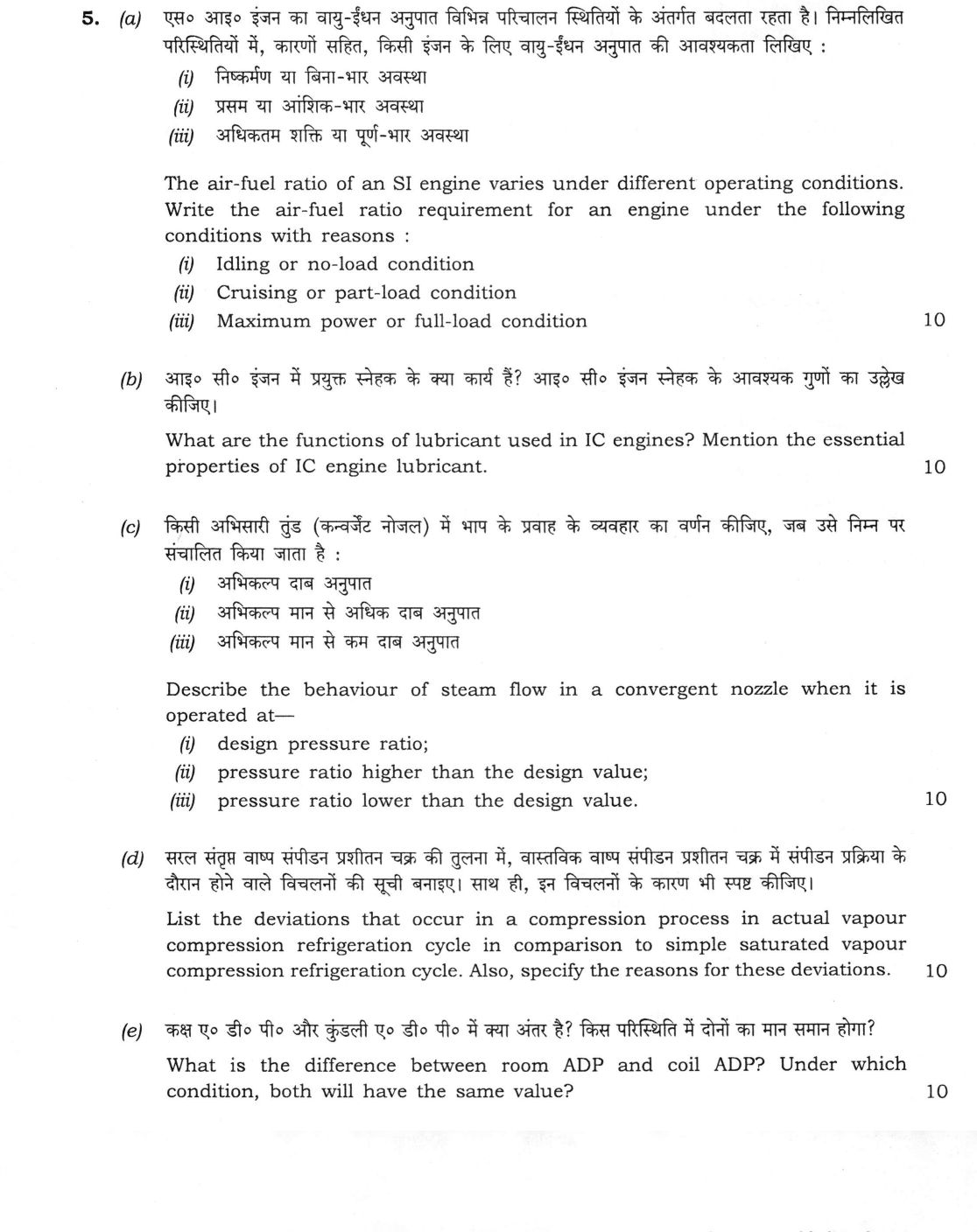
(a) The air-fuel ratio of an SI engine varies under different operating conditions. Write the air-fuel ratio requirement for an…
The air-fuel ratio of an SI engine varies under different operating conditions. Write the air-fuel ratio requirement for an engine under the following conditions with reasons : Idling or no-load condition
Cruising or part-load condition
Maximum power or full-load condition 10 marks
What are the functions of lubricant used in IC engines? Mention the essential properties of IC engine lubricant. 10 marks
Describe the behaviour of steam flow in a convergent nozzle when it is operated at— design pressure ratio;
pressure ratio higher than the design value;
pressure ratio lower than the design value. 10 marks
List the deviations that occur in a compression process in actual vapour compression refrigeration cycle in comparison to simple saturated vapour compression refrigeration cycle. Also, specify the reasons for these deviations. 10 marks
What is the difference between room ADP and coil ADP? Under which condition, both will have the same value? 10 marks
हिंदी में प्रश्न पढ़ें
एस० आई० इंजन का वायु-ईंधन अनुपात विभिन्न परिचालन स्थितियों के अंतर्गत बदलता रहता है। निम्नलिखित परिस्थितियों में, कारणों सहित, किसी इंजन के लिए वायु-ईंधन अनुपात की आवश्यकता लिखिए : निष्क्रमण या बिना-भार अवस्था
प्रसम या आंशिक-भार अवस्था
अधिकतम शक्ति या पूर्ण-भार अवस्था (10 अंक)
आई० सी० इंजन में प्रयुक्त स्नेहक के क्या कार्य हैं? आई० सी० इंजन स्नेहक के आवश्यक गुणों का उल्लेख कीजिए। (10 अंक)
किसी अभिसारी तुंड (कन्वर्जेंट नोजल) में भाप के प्रवाह के व्यवहार का वर्णन कीजिए, जब उसे निम्न पर संचालित किया जाता है : अभिकल्प दाब अनुपात
अभिकल्प मान से अधिक दाब अनुपात
अभिकल्प मान से कम दाब अनुपात (10 अंक)
सरल संतृप्त वाष्प संपीडन प्रशीतन चक्र की तुलना में, वास्तविक वाष्प संपीडन प्रशीतन चक्र में संपीडन प्रक्रिया के दौरान होने वाले विचलनों की सूची बनाइए। साथ ही, इन विचलनों के कारण भी स्पष्ट कीजिए। (10 अंक)
कक्ष ए० डी० पी० और कुंडली ए० डी० पी० में क्या अंतर है? किस परिस्थिति में दोनों का मान समान होगा? (10 अंक)
Model answer
Drafted with AI by UPSC Answer Check against this question's marking rubric, to the expected length. UPSC does not publish answers for Mains — this is one way to score well, not an official key. How we build rubrics and answers.
(a) Air-fuel ratio requirement of an SI engine (10 marks)
The chemically correct (stoichiometric) air-fuel ratio for petrol is about 14.7:1. The engine needs a different mixture strength in each regime.
- Idling or no-load: a rich mixture of about 11:1 to 13:1. With the throttle almost closed, the manifold pressure is low, so the fresh charge is small and is diluted by a large fraction of residual exhaust gas. Fuel also vaporises and mixes poorly at low air speed. A rich mixture gives a flammable, easily ignited charge, a stable idle, and no misfire.
- Cruising or part-load: a lean mixture of about 15:1 to 17:1 (about 16:1). Here the aim is economy, not maximum power. Excess air ensures that all the fuel burns completely, giving the highest thermal efficiency and lowest specific fuel consumption, with low CO. (An engine with a three-way catalyst is instead held at 14.7:1 by closed-loop control, to keep CO, HC and NOₓ low.)
- Maximum power or full-load: a rich mixture of about 12:1 to 13:1 (10–20% rich). Maximum power occurs at this strength, because the flame speed is highest and all the oxygen in the air is used. The extra fuel also cools the charge as it vaporises, which lowers the tendency to knock and the exhaust valve temperature, at the cost of higher fuel consumption.
(b) Functions and properties of engine lubricating oil (10 marks)
Functions.
- Lubrication: it forms a film between moving surfaces, so friction and wear fall, and less power is lost.
- Cooling: it carries heat away from the piston, bearings and cylinder walls, to the sump.
- Sealing: it fills the gap between piston rings and liner, so it reduces gas leakage (blow-by) and keeps compression.
- Cleaning: it carries wear particles, soot and carbon to the filter, and its detergent and dispersant additives keep them suspended, preventing sludge and deposits.
- Corrosion protection: it forms a protective film and neutralises the acids from combustion (alkaline reserve).
- Cushioning: it damps shock loads on bearings and gears.
Essential properties.
- Suitable viscosity, and a high viscosity index, so it changes little with temperature.
- Oiliness (film strength) and anti-wear character under boundary lubrication.
- Low pour point for cold starting, and high flash and fire points for safety.
- Thermal and oxidation stability, so it does not thicken, form sludge or varnish at high temperature.
- Low volatility and low carbon-residue tendency.
- Detergency and dispersancy, an alkaline reserve (TBN), and corrosion and rust inhibition.
- Anti-foaming, water-separating ability, and compatibility with seals and metals.
(c) Steam flow in a convergent nozzle at different pressure ratios (10 marks)
Let the pressure ratio be back pressure to inlet pressure, p_b/p₁. The critical pressure ratio at the throat is p*/p₁ = (2/(n + 1))^(n/(n−1)), that is 0.546 for superheated steam (n = 1.3) and 0.577 for dry saturated steam (n = 1.135). For a convergent nozzle, the design condition is p_b/p₁ equal to this critical ratio.
- (i) At the design (critical) ratio: the steam expands from p₁ to p* exactly at the exit, so the exit pressure equals the back pressure. The exit velocity is sonic (M = 1), and the mass flow rate is at its maximum value (the nozzle is just choked). The expansion is complete inside the nozzle.
- (ii) At a pressure ratio higher than design (back pressure above the critical value): the flow is subsonic throughout. The exit pressure equals the back pressure, exit M < 1, the exit velocity is lower than sonic, and the mass flow rate is less than the maximum. It rises as the back pressure is lowered towards the critical value.
- (iii) At a pressure ratio lower than design (back pressure below the critical value): the flow is choked. The steam expands only to the critical pressure p* at the exit, where M = 1, and the exit pressure stays above the back pressure. The remaining expansion (p* to p_b) takes place outside the nozzle, in the jet, and it is uncontrolled and gives no extra velocity in the nozzle. The velocity and mass flow rate remain at their maximum values and do not change with further lowering of the back pressure.
A convergent nozzle can never give supersonic exit flow, since M = 1 is reached at the throat at most. A convergent–divergent nozzle is needed to expand to a lower pressure with supersonic velocity.
(d) Deviations in the compression process of an actual vapour-compression cycle (10 marks)
The simple saturated cycle assumes that the vapour enters the compressor as dry saturated vapour at the evaporator pressure, and is compressed isentropically to the condenser pressure. In an actual cycle:
- Superheated suction vapour. The refrigerant enters the compressor with some superheat, since it picks up heat in the evaporator outlet and suction line. This is deliberate, to ensure that no liquid enters the compressor (liquid slugging), and it also raises the discharge temperature.
- Suction pressure drop. The pressure at the compressor inlet is lower than the evaporator pressure, because of frictional pressure drop in the suction line and suction valves, which lowers the density and mass flow.
- Non-isentropic compression. The path is polytropic, with rising entropy, due to friction, heat exchange with the cylinder walls and internal irreversibilities, so the work input is larger than the isentropic work and the discharge temperature is higher for the same pressure ratio (isentropic efficiency below 1).
- Higher discharge pressure. The pressure at the compressor discharge is above the condenser pressure, to overcome the pressure drop in the discharge valves, line and condenser.
- Heat loss. Some heat is lost from the compressor and discharge line to the surroundings, so the discharge enthalpy is a little lower than in adiabatic compression.
- Volumetric and mechanical losses. Clearance volume, and leakage past piston rings and valves, reduce the mass delivered, and mechanical friction in the compressor adds to the power input.
(e) Room ADP and coil ADP (10 marks)
Coil ADP (apparatus dew point). On the psychrometric chart, the coil process line is the line joining the state of the air entering the cooling coil (usually a mixture of fresh and return air) with the state of the air leaving it, and this line is extended to the saturation curve. Its intersection with the saturation curve is the coil ADP. It represents the effective mean surface temperature of the cooling coil, which the air would reach if the coil were of infinite size and the air fully contacted it. Its slope corresponds to the grand sensible heat factor (GSHF), which includes the ventilation load.
Room ADP. It is found by drawing the room sensible heat factor (RSHF) line through the room state, and extending it to the saturation curve. It represents the lowest effective surface temperature that would just meet the room's sensible and latent load, that is the ADP needed if the air passed over the coil were the room air alone.
Condition for equality. The two are the same when the RSHF line and the coil process line coincide, that is when GSHF = RSHF. That happens when the coil handles only the room load: 100% recirculated air with no fresh (outside) air load entering the coil and no other loads such as duct gain or reheat. The state entering the coil is then the room state itself. Any ventilation air makes the coil line steeper (GSHF < RSHF), and the coil ADP then lies below the room ADP.
How this answer will be evaluated
Evaluation rubric
Each sub-part is marked on its own, against the marks and word limit printed on the paper.
- (a) Write the air-fuel ratio requirement of an SI engine with reasons for idling, cruising and full-load conditions (10 marks). 10 marks
Must cover
- Idling: rich mixture about 11:1–13:1 because of low charge and high residual gas
- Cruising: lean mixture about 15:1–17:1 for economy and complete combustion
- Full load: rich mixture about 12:1–13:1 for maximum power and charge cooling against knock
- Reference to the stoichiometric ratio about 14.7:1
Loses marks
- Giving lean mixture for idling.
- Giving numerical ranges without reasons.
Earns more
- A numerical A/F range and a reason given for each regime.
- Closed-loop stoichiometric operation with a three-way catalyst mentioned.
Extra mark
- Acceleration enrichment
- (b) What are the functions of lubricant used in IC engines? Mention the essential properties of IC engine lubricant (10 marks). 10 marks
Must cover
- Functions: lubrication, cooling, sealing, cleaning and corrosion protection
- Additional functions such as shock absorption
- Properties: viscosity, viscosity index, oiliness, flash point and pour point
- Properties: oxidation stability, detergency and dispersancy, low volatility and anti-foaming
Loses marks
- Listing only functions or only properties.
- Confusing viscosity index with viscosity.
Earns more
- Both halves of the question covered.
- Reason or brief explanation with each item.
Extra mark
- Alkaline reserve (TBN) and seal compatibility
- (c) Describe the behaviour of steam flow in a convergent nozzle at the design pressure ratio, at a higher ratio and at a lower ratio (10 marks). 10 marks
Must cover
- Critical pressure ratio and choking at the throat (0.546 for superheated steam)
- At the design ratio: exit at critical pressure, M = 1 and maximum mass flow
- Above the design ratio (higher back pressure): subsonic, exit pressure equal to back pressure, lower mass flow
- Below the design ratio: choked with exit pressure above the back pressure, expansion outside, mass flow unchanged
Loses marks
- Saying that the mass flow keeps rising as back pressure falls below critical.
- Predicting supersonic exit in a convergent nozzle.
Earns more
- Definition of the pressure ratio used stated.
- Statement that a convergent nozzle cannot give supersonic exit flow.
Extra mark
- Convergent–divergent nozzle as the remedy
- (d) List the deviations in the compression process of an actual vapour compression refrigeration cycle from the simple saturated cycle, with reasons (10 marks). 10 marks
Must cover
- Superheated suction vapour, to avoid liquid entering the compressor
- Suction-line and valve pressure drop
- Non-isentropic (polytropic) compression with friction and heat exchange
- Higher discharge pressure from valve and line losses, plus heat loss and volumetric and mechanical losses
Loses marks
- Discussing deviations in the condenser or evaporator only.
- Listing deviations without reasons.
Earns more
- Reason paired with every deviation.
- Effect on work input or discharge temperature stated.
Extra mark
- Isentropic efficiency of the compressor
- (e) What is the difference between room ADP and coil ADP? Under which condition will both have the same value? (10 marks). 10 marks
Must cover
- Coil ADP from the coil process line (entering to leaving state) extended to the saturation curve, the effective coil surface temperature
- Room ADP from the RSHF line through the room state extended to the saturation curve
- GSHF against RSHF distinction with the ventilation load
- Equal when RSHF = GSHF, that is 100% recirculation with no outside-air load into the coil
Loses marks
- Defining ADP as the dry-bulb temperature of the room.
- Stating that the two are always equal.
Earns more
- Physical meaning of ADP explained.
- Effect of ventilation air on the coil line.
Extra mark
- Bypass factor link
What "Describe" is asking you to do
Give a full, ordered account of the thing named — its parts, stages or mechanism — in the sequence in which it actually exists or occurs. Most describe questions come from the science optionals, where the marks sit in correct technical detail and, where the stem says so, a labelled diagram.
Structure that answers it
One-line identification of the subject → the parts or stages in their real order, each with its defining detail → labelled diagram where the subject is structural → closing line on function or significance
Where marks are lost
Loose general prose where the examiner is ticking named parts, correct terminology and their sequence; and in the General Studies papers, turning to evaluation before the description is finished.
Practice this exact question
Write your answer and it is marked point by point against the model answer above — what you covered, what you missed, what you got wrong.
Evaluate my answer →More from Mechanical Engineering 2026 Paper II
- Q2 (a) (i) During a heat transfer process, the entropy change of incompressible substances,…
- Q3 (a) Steam at 40 °C is condensed in a power plant using cooling water available at 12 °C.…
- Q4 (a) (i) What does the NTU of a heat exchanger represent? Is a heat exchanger with a very…
- Q5 (a) The air-fuel ratio of an SI engine varies under different operating conditions. Write…
- Q6 (a) In an Otto cycle, the pressure and temperature at the beginning of compression are 1…
- Q7 (a) In a cogeneration plant, the net power output is 6 MW and the heating load is 1·5 MW.…
- Q8 (a) An air-conditioned space is maintained at 25 °C DBT and 50% RH. The outside condition…