Paper II — Q7
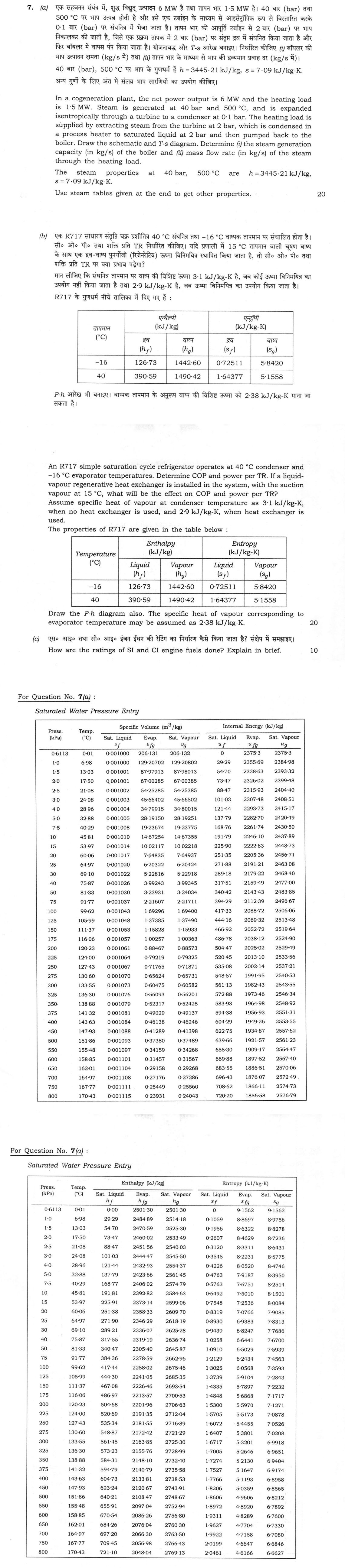
(a) In a cogeneration plant, the net power output is 6 MW and the heating load is 1·5 MW. Steam is generated at 40 bar and 500…
In a cogeneration plant, the net power output is 6 MW and the heating load is 1·5 MW. Steam is generated at 40 bar and 500 °C, and is expanded isentropically through a turbine to a condenser at 0·1 bar. The heating load is supplied by extracting steam from the turbine at 2 bar, which is condensed in a process heater to saturated liquid at 2 bar and then pumped back to the boiler. Draw the schematic and T-s diagram. Determine (i) the steam generation capacity (in kg/s) of the boiler and (ii) mass flow rate (in kg/s) of the steam through the heating load. The steam properties at 40 bar, 500 °C are h = 3445·21 kJ/kg, s = 7·09 kJ/kg-K. Use steam tables given at the end to get other properties.
For Question No. 7(a) : Saturated Water Pressure Entry
Press. (kPa) | Temp. (°C) | Enthalpy (kJ/kg): Sat. Liquid h_f | Evap. h_fg | Sat. Vapour h_g | Entropy (kJ/kg-K): Sat. Liquid s_f | Evap. s_fg | Sat. Vapour s_g 0·6113 | 0·01 | 0·00 | 2501·30 | 2501·30 | 0 | 9·1562 | 9·1562 1·0 | 6·98 | 29·29 | 2484·89 | 2514·18 | 0·1059 | 8·8697 | 8·9756 1·5 | 13·03 | 54·70 | 2470·59 | 2525·30 | 0·1956 | 8·6322 | 8·8278 2·0 | 17·50 | 73·47 | 2460·02 | 2533·49 | 0·2607 | 8·4629 | 8·7236 2·5 | 21·08 | 88·47 | 2451·56 | 2540·03 | 0·3120 | 8·3311 | 8·6431 3·0 | 24·08 | 101·03 | 2444·47 | 2545·50 | 0·3545 | 8·2231 | 8·5775 4·0 | 28·96 | 121·44 | 2432·93 | 2554·37 | 0·4226 | 8·0520 | 8·4746 5·0 | 32·88 | 137·79 | 2423·66 | 2561·45 | 0·4763 | 7·9187 | 8·3950 7·5 | 40·29 | 168·77 | 2406·02 | 2574·79 | 0·5763 | 7·6751 | 8·2514 10 | 45·81 | 191·81 | 2392·82 | 2584·63 | 0·6492 | 7·5010 | 8·1501 15 | 53·97 | 225·91 | 2373·14 | 2599·06 | 0·7548 | 7·2536 | 8·0084 20 | 60·06 | 251·38 | 2358·33 | 2609·70 | 0·8319 | 7·0766 | 7·9085 25 | 64·97 | 271·90 | 2346·29 | 2618·19 | 0·8930 | 6·9383 | 7·8313 30 | 69·10 | 289·21 | 2336·07 | 2625·28 | 0·9439 | 6·8247 | 7·7686 40 | 75·87 | 317·55 | 2319·19 | 2636·74 | 1·0258 | 6·6441 | 7·6700 50 | 81·33 | 340·47 | 2305·40 | 2645·87 | 1·0910 | 6·5029 | 7·5939 75 | 91·77 | 384·36 | 2278·59 | 2662·96 | 1·2129 | 6·2434 | 7·4563 100 | 99·62 | 417·44 | 2258·02 | 2675·46 | 1·3025 | 6·0568 | 7·3593 125 | 105·99 | 444·30 | 2241·05 | 2685·35 | 1·3739 | 5·9104 | 7·2843 150 | 111·37 | 467·08 | 2226·46 | 2693·54 | 1·4335 | 5·7897 | 7·2232 175 | 116·06 | 486·97 | 2213·57 | 2700·53 | 1·4848 | 5·6868 | 7·1717 200 | 120·23 | 504·68 | 2201·96 | 2706·63 | 1·5300 | 5·5970 | 7·1271 225 | 124·00 | 520·69 | 2191·35 | 2712·04 | 1·5705 | 5·5173 | 7·0878 250 | 127·43 | 535·34 | 2181·55 | 2716·89 | 1·6072 | 5·4455 | 7·0526 275 | 130·60 | 548·87 | 2172·42 | 2721·29 | 1·6407 | 5·3801 | 7·0208 300 | 133·55 | 561·45 | 2163·85 | 2725·30 | 1·6717 | 5·3201 | 6·9918 325 | 136·30 | 573·23 | 2155·76 | 2728·99 | 1·7005 | 5·2646 | 6·9651 350 | 138·88 | 584·31 | 2148·10 | 2732·40 | 1·7274 | 5·2130 | 6·9404 375 | 141·32 | 594·79 | 2140·79 | 2735·58 | 1·7527 | 5·1647 | 6·9174 400 | 143·63 | 604·73 | 2133·81 | 2738·53 | 1·7766 | 5·1193 | 6·8958 450 | 147·93 | 623·24 | 2120·67 | 2743·91 | 1·8206 | 5·0359 | 6·8565 500 | 151·86 | 640·21 | 2108·47 | 2748·67 | 1·8606 | 4·9606 | 6·8212 550 | 155·48 | 655·91 | 2097·04 | 2752·94 | 1·8972 | 4·8920 | 6·7892 600 | 158·85 | 670·54 | 2086·26 | 2756·80 | 1·9311 | 4·8289 | 6·7600 650 | 162·01 | 684·26 | 2076·04 | 2760·30 | 1·9627 | 4·7704 | 6·7330 700 | 164·97 | 697·20 | 2066·30 | 2763·50 | 1·9922 | 4·7158 | 6·7080 750 | 167·77 | 709·45 | 2056·98 | 2766·43 | 2·0199 | 4·6647 | 6·6846 800 | 170·43 | 721·10 | 2048·04 | 2769·13 | 2·0461 | 4·6166 | 6·6627
KVMS–B–MCH/7 15 [ P.T.O.
[Table printed on page 14] For Question No. 7(a) : Saturated Water Pressure Entry
Press. (kPa) | Temp. (°C) | Specific Volume (m³/kg): Sat. Liquid v_f | Evap. v_fg | Sat. Vapour v_g | Internal Energy (kJ/kg): Sat. Liquid u_f | Evap. u_fg | Sat. Vapour u_g 0·6113 | 0·01 | 0·001000 | 206·131 | 206·132 | 0 | 2375·3 | 2375·3 1·0 | 6·98 | 0·001000 | 129·20702 | 129·20802 | 29·29 | 2355·69 | 2384·98 1·5 | 13·03 | 0·001001 | 87·97913 | 87·98013 | 54·70 | 2338·63 | 2393·32 2·0 | 17·50 | 0·001001 | 67·00285 | 67·00385 | 73·47 | 2326·02 | 2399·48 2·5 | 21·08 | 0·001002 | 54·25285 | 54·25385 | 88·47 | 2315·93 | 2404·40 3·0 | 24·08 | 0·001003 | 45·66402 | 45·66502 | 101·03 | 2307·48 | 2408·51 4·0 | 28·96 | 0·001004 | 34·79915 | 34·80015 | 121·44 | 2293·73 | 2415·17 5·0 | 32·88 | 0·001005 | 28·19150 | 28·19251 | 137·79 | 2282·70 | 2420·49 7·5 | 40·29 | 0·001008 | 19·23674 | 19·23775 | 168·76 | 2261·74 | 2430·50 10 | 45·81 | 0·001010 | 14·67254 | 14·67355 | 191·79 | 2246·10 | 2437·89 15 | 53·97 | 0·001014 | 10·02117 | 10·02218 | 225·90 | 2222·83 | 2448·73 20 | 60·06 | 0·001017 | 7·64835 | 7·64937 | 251·35 | 2205·36 | 2456·71 25 | 64·97 | 0·001020 | 6·20322 | 6·20424 | 271·88 | 2191·21 | 2463·08 30 | 69·10 | 0·001022 | 5·22816 | 5·22918 | 289·18 | 2179·22 | 2468·40 40 | 75·87 | 0·001026 | 3·99243 | 3·99345 | 317·51 | 2159·49 | 2477·00 50 | 81·33 | 0·001030 | 3·23931 | 3·24034 | 340·42 | 2143·43 | 2483·85 75 | 91·77 | 0·001037 | 2·21607 | 2·21711 | 394·29 | 2112·39 | 2496·67 100 | 99·62 | 0·001043 | 1·69296 | 1·69400 | 417·33 | 2088·72 | 2506·06 125 | 105·99 | 0·001048 | 1·37385 | 1·37490 | 444·16 | 2069·32 | 2513·48 150 | 111·37 | 0·001053 | 1·15828 | 1·15933 | 466·92 | 2052·72 | 2519·64 175 | 116·06 | 0·001057 | 1·00257 | 1·00363 | 486·78 | 2038·12 | 2524·90 200 | 120·23 | 0·001061 | 0·88467 | 0·88573 | 504·47 | 2025·02 | 2529·49 225 | 124·00 | 0·001064 | 0·79219 | 0·79325 | 520·45 | 2013·10 | 2533·56 250 | 127·43 | 0·001067 | 0·71765 | 0·71871 | 535·08 | 2002·14 | 2537·21 275 | 130·60 | 0·001070 | 0·65624 | 0·65731 | 548·57 | 1991·95 | 2540·53 300 | 133·55 | 0·001073 | 0·60475 | 0·60582 | 561·13 | 1982·43 | 2543·55 325 | 136·30 | 0·001076 | 0·56093 | 0·56201 | 572·88 | 1973·46 | 2546·34 350 | 138·88 | 0·001079 | 0·52317 | 0·52425 | 583·93 | 1964·98 | 2548·92 375 | 141·32 | 0·001081 | 0·49029 | 0·49137 | 594·38 | 1956·93 | 2551·31 400 | 143·63 | 0·001084 | 0·46138 | 0·46246 | 604·29 | 1949·26 | 2553·55 450 | 147·93 | 0·001088 | 0·41289 | 0·41398 | 622·75 | 1934·87 | 2557·62 500 | 151·86 | 0·001093 | 0·37380 | 0·37489 | 639·66 | 1921·57 | 2561·23 550 | 155·48 | 0·001097 | 0·34159 | 0·34268 | 655·30 | 1909·17 | 2564·47 600 | 158·85 | 0·001101 | 0·31457 | 0·31567 | 669·88 | 1897·52 | 2567·40 650 | 162·01 | 0·001104 | 0·29158 | 0·29268 | 683·55 | 1886·51 | 2570·06 700 | 164·97 | 0·001108 | 0·27176 | 0·27286 | 696·43 | 1876·07 | 2572·49 750 | 167·77 | 0·001111 | 0·25449 | 0·25560 | 708·62 | 1866·11 | 2574·73 800 | 170·43 | 0·001115 | 0·23931 | 0·24043 | 720·20 | 1856·58 | 2576·79
KVMS–B–MCH/7 14 20 marks
An R717 simple saturation cycle refrigerator operates at 40 °C condenser and –16 °C evaporator temperatures. Determine COP and power per TR. If a liquid-vapour regenerative heat exchanger is installed in the system, with the suction vapour at 15 °C, what will be the effect on COP and power per TR? Assume specific heat of vapour at condenser temperature as 3·1 kJ/kg-K, when no heat exchanger is used, and 2·9 kJ/kg-K, when heat exchanger is used. The properties of R717 are given in the table below : Temperature (°C) | Enthalpy (kJ/kg) Liquid (h_f) | Enthalpy (kJ/kg) Vapour (h_g) | Entropy (kJ/kg-K) Liquid (s_f) | Entropy (kJ/kg-K) Vapour (s_g) –16 | 126·73 | 1442·60 | 0·72511 | 5·8420 40 | 390·59 | 1490·42 | 1·64377 | 5·1558 Draw the P-h diagram also. The specific heat of vapour corresponding to evaporator temperature may be assumed as 2·38 kJ/kg-K. 20 marks
How are the ratings of SI and CI engine fuels done? Explain in brief. 10 marks
हिंदी में प्रश्न पढ़ें
एक सहजनन संयंत्र में, शुद्ध विद्युत् उत्पादन 6 MW है तथा तापन भार 1·5 MW है। 40 bar (bar) तथा 500 °C पर भाप उत्पन्न होती है और इसे एक टर्बाइन के माध्यम से आइसेंट्रॉपिक रूप से विस्तारित करके 0·1 bar (bar) पर संघनित्र में भेजा जाता है। तापन भार की आपूर्ति टर्बाइन से 2 bar (bar) पर भाप निकालकर की जाती है, जिसे एक प्रक्रम तापक में 2 bar (bar) पर संतृप्त द्रव में संघनित किया जाता है और फिर बॉयलर में वापस पंप किया जाता है। योजनाबद्ध और T-s आरेख बनाइए। निर्धारित कीजिए (i) बॉयलर की भाप उत्पादन क्षमता (kg/s में) तथा (ii) तापन भार के माध्यम से भाप की द्रव्यमान प्रवाह दर (kg/s में)।
40 bar (bar), 500 °C पर भाप के गुणधर्म हैं h = 3445·21 kJ/kg, s = 7·09 kJ/kg-K.
अन्य गुणों के लिए अंत में संलग्न भाप सारणियों का उपयोग कीजिए।
प्रश्न संख्या 7(a) के लिए : संतृप्त जल दाब प्रविष्टि
[Table printed on page 14] For Question No. 7(a) : Saturated Water Pressure Entry
Press. (kPa) | Temp. (°C) | Specific Volume (m³/kg): Sat. Liquid v_f | Evap. v_fg | Sat. Vapour v_g | Internal Energy (kJ/kg): Sat. Liquid u_f | Evap. u_fg | Sat. Vapour u_g 0·6113 | 0·01 | 0·001000 | 206·131 | 206·132 | 0 | 2375·3 | 2375·3 1·0 | 6·98 | 0·001000 | 129·20702 | 129·20802 | 29·29 | 2355·69 | 2384·98 1·5 | 13·03 | 0·001001 | 87·97913 | 87·98013 | 54·70 | 2338·63 | 2393·32 2·0 | 17·50 | 0·001001 | 67·00285 | 67·00385 | 73·47 | 2326·02 | 2399·48 2·5 | 21·08 | 0·001002 | 54·25285 | 54·25385 | 88·47 | 2315·93 | 2404·40 3·0 | 24·08 | 0·001003 | 45·66402 | 45·66502 | 101·03 | 2307·48 | 2408·51 4·0 | 28·96 | 0·001004 | 34·79915 | 34·80015 | 121·44 | 2293·73 | 2415·17 5·0 | 32·88 | 0·001005 | 28·19150 | 28·19251 | 137·79 | 2282·70 | 2420·49 7·5 | 40·29 | 0·001008 | 19·23674 | 19·23775 | 168·76 | 2261·74 | 2430·50 10 | 45·81 | 0·001010 | 14·67254 | 14·67355 | 191·79 | 2246·10 | 2437·89 15 | 53·97 | 0·001014 | 10·02117 | 10·02218 | 225·90 | 2222·83 | 2448·73 20 | 60·06 | 0·001017 | 7·64835 | 7·64937 | 251·35 | 2205·36 | 2456·71 25 | 64·97 | 0·001020 | 6·20322 | 6·20424 | 271·88 | 2191·21 | 2463·08 30 | 69·10 | 0·001022 | 5·22816 | 5·22918 | 289·18 | 2179·22 | 2468·40 40 | 75·87 | 0·001026 | 3·99243 | 3·99345 | 317·51 | 2159·49 | 2477·00 50 | 81·33 | 0·001030 | 3·23931 | 3·24034 | 340·42 | 2143·43 | 2483·85 75 | 91·77 | 0·001037 | 2·21607 | 2·21711 | 394·29 | 2112·39 | 2496·67 100 | 99·62 | 0·001043 | 1·69296 | 1·69400 | 417·33 | 2088·72 | 2506·06 125 | 105·99 | 0·001048 | 1·37385 | 1·37490 | 444·16 | 2069·32 | 2513·48 150 | 111·37 | 0·001053 | 1·15828 | 1·15933 | 466·92 | 2052·72 | 2519·64 175 | 116·06 | 0·001057 | 1·00257 | 1·00363 | 486·78 | 2038·12 | 2524·90 200 | 120·23 | 0·001061 | 0·88467 | 0·88573 | 504·47 | 2025·02 | 2529·49 225 | 124·00 | 0·001064 | 0·79219 | 0·79325 | 520·45 | 2013·10 | 2533·56 250 | 127·43 | 0·001067 | 0·71765 | 0·71871 | 535·08 | 2002·14 | 2537·21 275 | 130·60 | 0·001070 | 0·65624 | 0·65731 | 548·57 | 1991·95 | 2540·53 300 | 133·55 | 0·001073 | 0·60475 | 0·60582 | 561·13 | 1982·43 | 2543·55 325 | 136·30 | 0·001076 | 0·56093 | 0·56201 | 572·88 | 1973·46 | 2546·34 350 | 138·88 | 0·001079 | 0·52317 | 0·52425 | 583·93 | 1964·98 | 2548·92 375 | 141·32 | 0·001081 | 0·49029 | 0·49137 | 594·38 | 1956·93 | 2551·31 400 | 143·63 | 0·001084 | 0·46138 | 0·46246 | 604·29 | 1949·26 | 2553·55 450 | 147·93 | 0·001088 | 0·41289 | 0·41398 | 622·75 | 1934·87 | 2557·62 500 | 151·86 | 0·001093 | 0·37380 | 0·37489 | 639·66 | 1921·57 | 2561·23 550 | 155·48 | 0·001097 | 0·34159 | 0·34268 | 655·30 | 1909·17 | 2564·47 600 | 158·85 | 0·001101 | 0·31457 | 0·31567 | 669·88 | 1897·52 | 2567·40 650 | 162·01 | 0·001104 | 0·29158 | 0·29268 | 683·55 | 1886·51 | 2570·06 700 | 164·97 | 0·001108 | 0·27176 | 0·27286 | 696·43 | 1876·07 | 2572·49 750 | 167·77 | 0·001111 | 0·25449 | 0·25560 | 708·62 | 1866·11 | 2574·73 800 | 170·43 | 0·001115 | 0·23931 | 0·24043 | 720·20 | 1856·58 | 2576·79
KVMS–B–MCH/7 14 (20 अंक)
एक R717 साधारण संतृप्ति चक्र प्रशीतक 40 °C कंडेन्सर तथा –16 °C वाष्पित्र तापमानों पर संचालित होता है। COP तथा शक्ति प्रति TR निर्धारित कीजिए। यदि निकाय में द्रव-वाष्प पुनर्योजी ऊष्मा विनिमयक स्थापित किया जाए, जिसमें चूषण वाष्प 15 °C पर हो, तो COP तथा शक्ति प्रति TR पर क्या प्रभाव पड़ेगा? कंडेन्सर तापमान पर वाष्प की विशिष्ट ऊष्मा 3·1 kJ/kg-K मानिए, जब कोई ऊष्मा विनिमयक प्रयुक्त नहीं होता, तथा 2·9 kJ/kg-K, जब ऊष्मा विनिमयक प्रयुक्त होता है। R717 के गुण नीचे तालिका में दिए गए हैं : तापमान (°C) | एन्थैल्पी (kJ/kg) द्रव (h_f) | एन्थैल्पी (kJ/kg) वाष्प (h_g) | एन्ट्रॉपी (kJ/kg-K) द्रव (s_f) | एन्ट्रॉपी (kJ/kg-K) वाष्प (s_g) –16 | 126·73 | 1442·60 | 0·72511 | 5·8420 40 | 390·59 | 1490·42 | 1·64377 | 5·1558 P-h आरेख भी बनाइए। वाष्पित्र तापमान के संगत वाष्प की विशिष्ट ऊष्मा 2·38 kJ/kg-K मानी जा सकती है। (20 अंक)
एस० आई० तथा सी० आई० इंजन ईंधन की रेटिंग का निर्धारण कैसे किया जाता है? संक्षेप में समझाइए। (10 अंक)
Model answer
Drafted with AI by UPSC Answer Check against this question's marking rubric, to the expected length. UPSC does not publish answers for Mains — this is one way to score well, not an official key. How we build rubrics and answers.
(a) Cogeneration plant (20 marks)
The plant is drawn below: the boiler supplies steam at 1 (40 bar, 500 °C) to the turbine; a part ṁ_e is extracted at 2 bar (state 2) and condensed in the process heater, and the rest expands to 0.1 bar (state 3) and condenses. Both condensates are pumped back to the boiler.


Properties from the tables (h in kJ/kg, s in kJ/kg·K).
- State 1: h₁ = 3445.21, s₁ = 7.09.
- At 2 bar: h_f = 504.68, h_fg = 2201.96, s_f = 1.5300, s_fg = 5.5970, s_g = 7.1271, v_f = 0.001061 m³/kg.
- At 0.1 bar (10 kPa): h_f = 191.81, h_fg = 2392.82, s_f = 0.6492, s_fg = 7.5010, v_f = 0.001010 m³/kg.
Isentropic expansion. Since s₁ = 7.09 is below s_g at 2 bar, the steam is wet at state 2:
x₂ = (7.09 − 1.5300)/5.5970 = 0.9934, so h₂ = 504.68 + 0.9934 × 2201.96 = 2692.08 kJ/kg.
At 0.1 bar, x₃ = (7.09 − 0.6492)/7.5010 = 0.8587, so h₃ = 191.81 + 0.8587 × 2392.82 = 2246.43 kJ/kg.
(ii) Extraction flow to the heater. The heating load is the heat given up as the extracted steam condenses to saturated liquid at 2 bar:
ṁ_e (h₂ − h_f2) = 1500 kW, so ṁ_e = 1500/(2692.08 − 504.68) = 1500/2187.40 = 0.686 kg/s.
(i) Boiler steam generation capacity. The pump work is small: w_P1 = v_f(p₁ − 0.1 bar) = 0.001010 × (4000 − 10) = 4.03 kJ/kg for the condenser stream, and w_P2 = 0.001061 × (4000 − 200) = 4.03 kJ/kg for the heater stream, so both pumps take the same 4.03 kJ/kg. With the boiler flow ṁ, the net power is
W_net = ṁ (h₁ − h₂) + (ṁ − ṁ_e)(h₂ − h₃) − (ṁ − ṁ_e) w_P1 − ṁ_e w_P2 = 6000 kW.
Substituting, with h₁ − h₂ = 753.13 and h₂ − h₃ = 445.65 kJ/kg: 753.13 ṁ + 445.65 (ṁ − 0.686) − 4.03 ṁ = 6000, that is 1194.75 ṁ − 305.6 = 6000, so
ṁ = 5.28 kg/s.
Neglecting pump work gives 5.26 kg/s, practically the same. The condenser flow is ṁ − ṁ_e = 4.59 kg/s, and the turbine develops about 6021 kW, of which 21 kW drives the pumps.
(b) R717 refrigerator with and without the heat exchanger (20 marks)
Data: T_c = 40 °C = 313.15 K, T_e = −16 °C = 257.15 K. At −16 °C: h_g = 1442.60, s_g = 5.8420. At 40 °C: h_f = 390.59, h_g = 1490.42, s_g = 5.1558. 1 TR = 3.5167 kW.
Simple saturation cycle (no heat exchanger).
- State 1: saturated vapour at −16 °C, h₁ = 1442.60, s₁ = 5.8420.
- State 2 (isentropic compression to 40 °C pressure): s₂ = s₁ = 5.8420, which exceeds s_g at 40 °C (5.1558), so the vapour is superheated. With c_p = 3.1: s₂ = s_g + c_p ln(T₂/T_c), so ln(T₂/313.15) = 0.6862/3.1 = 0.2214 and T₂ = 390.7 K.
- h₂ = h_g + c_p (T₂ − T_c) = 1490.42 + 3.1 × 77.6 = 1730.94 kJ/kg.
- State 3: saturated liquid at 40 °C, h₃ = 390.59 = h₄ (throttling).
- Refrigerating effect q_e = h₁ − h₄ = 1442.60 − 390.59 = 1052.01 kJ/kg.
- Compressor work w = h₂ − h₁ = 1730.94 − 1442.60 = 288.34 kJ/kg.
COP = 1052.01/288.34 = 3.65, and the power per TR = 3.5167/3.648 = 0.964 kW/TR.
Cycle with the liquid-vapour heat exchanger. The vapour leaves the evaporator at −16 °C (h_g = 1442.60) and is heated to 15 °C in the exchanger. With c_p = 2.38:
- h₁′ = 1442.60 + 2.38 × 31 = 1516.38 kJ/kg.
- s₁′ = 5.8420 + 2.38 ln(288.15/257.15) = 5.8420 + 0.2709 = 6.1129.
- Heat exchanger balance: the liquid is cooled by the same amount, so h₄′ = 390.59 − (1516.38 − 1442.60) = 316.81 kJ/kg.
- Isentropic compression from 1′, with c_p = 2.9: ln(T₂′/313.15) = (6.1129 − 5.1558)/2.9 = 0.3300, so T₂′ = 435.6 K.
- h₂′ = 1490.42 + 2.9 × (435.6 − 313.15) = 1845.51 kJ/kg.
- q_e = h₁ − h₄′ = 1442.60 − 316.81 = 1125.79 kJ/kg (the heat absorbed in the evaporator, from the cooled liquid at 4′ to saturated vapour at 1).
- w = h₂′ − h₁′ = 1845.51 − 1516.38 = 329.13 kJ/kg.
COP = 1125.79/329.13 = 3.42, and the power per TR = 3.5167/3.420 = 1.028 kW/TR.
Effect. The heat exchanger raises the refrigerating effect by about 7%, but the compressor work rises by about 14%, since the vapour enters hotter and less dense and ammonia has a high isentropic exponent. Hence COP falls from 3.65 to 3.42 (about 6%), and the power per TR increases from 0.964 to 1.028 kW/TR (about 7%). The discharge temperature also rises from about 118 °C to about 162 °C. So for ammonia a suction-liquid heat exchanger is not beneficial (it is used for R12 or R134a, and to avoid liquid entering the compressor).

(c) Rating of SI and CI engine fuels (10 marks)
SI engine fuels: octane number (5 marks). The rating measures the resistance of a fuel to knock. Two reference fuels are used: iso-octane (2,2,4-trimethylpentane), which is highly knock-resistant and is assigned an octane number of 100, and n-heptane, which knocks readily and is assigned 0. The octane number of a fuel is the percentage by volume of iso-octane in a blend with n-heptane that matches the knock intensity of the test fuel. The test is done in the standard CFR (Cooperative Fuel Research) engine, a single-cylinder, variable-compression-ratio engine, at constant speed. The compression ratio is raised until standard knock intensity is measured with a knockmeter, and the fuel is then bracketed between two reference blends. Two conditions are used: the Research Octane Number (RON, ASTM D2699, 600 rpm, mild inlet temperature) and the Motor Octane Number (MON, ASTM D2700, 900 rpm, heated mixture), where MON is lower by about 8–10 units. Typical values are RON of about 91–95 for petrol in India, and above 100 for aviation and racing fuels, which are quoted on a performance-number scale. Tetraethyl lead was formerly used to raise it; today ethanol and aromatics are used.
CI engine fuels: cetane number (5 marks). The rating measures the ease of self-ignition, that is a short ignition delay. The reference fuels are n-cetane (hexadecane), which ignites readily and is assigned 100, and α-methylnaphthalene, which ignites poorly and is assigned 0 (now often replaced by heptamethylnonane, cetane number 15). The cetane number is the percentage by volume of cetane in the blend that has the same ignition delay as the test fuel. The test uses the standard CFR diesel engine (ASTM D613, 900 rpm), with injection fixed at 13° before top dead centre. The compression ratio is varied until ignition takes place at top dead centre for the test fuel, and it is then bracketed between two reference blends that need slightly higher and lower compression ratios. Typical values are 40–55 for automobile diesel, with a minimum of 51 for Indian BS-VI diesel; a higher value gives easier starting, smoother combustion and less diesel knock.
The two scales run in opposite senses: a good SI fuel resists autoignition, while a good CI fuel readily undergoes it, so petrol has a low cetane number and diesel a low octane number.
How this answer will be evaluated
Evaluation rubric
Each sub-part is marked on its own, against the marks and word limit printed on the paper.
- (a) Cogeneration plant, 6 MW net power and 1.5 MW heating load, extraction at 2 bar, 40 bar/500 °C, condenser 0.1 bar: draw the schematic and T–s diagram; find (i) boiler steam generation and (ii) extraction flow (20 marks). 20 marks
Must cover
- Schematic and T–s diagram with the extraction point, process heater, both pumps and condenser
- Isentropic expansion at s = 7.09: x₂ = 0.9934, h₂ ≈ 2692 kJ/kg and x₃ = 0.8587, h₃ ≈ 2246 kJ/kg from the tables
- (ii) ṁ_e = 1500/(h₂ − h_f2) ≈ 0.686 kg/s
- (i) Net power balance giving ṁ ≈ 5.28 kg/s (5.26 kg/s without pump work)
Loses marks
- Treating the steam at 2 bar as dry saturated.
- Using 1.5 MW as the flow-independent enthalpy rise without the h_f term.
- Diagram missing the extraction or the T–s expansion line.
Earns more
- Every property read correctly from the printed tables at 2 bar and 0.1 bar.
- Pump work included or explicitly neglected with justification.
Extra mark
- Condenser flow 4.59 kg/s and turbine output about 6021 kW
- (b) R717 cycle between −16 °C and 40 °C: find COP and power per TR, then with a liquid-vapour heat exchanger giving 15 °C suction, and state the effect; draw the P–h diagram (20 marks). 20 marks
Must cover
- Simple cycle: T₂ ≈ 390.7 K from s₂ = s₁ with c_p = 3.1, h₂ ≈ 1730.9; COP ≈ 3.65 and about 0.964 kW/TR
- Heat exchanger: h₁′ = 1516.4, s₁′ ≈ 6.113, h₄′ ≈ 316.8, T₂′ ≈ 435.6 K (c_p = 2.9), h₂′ ≈ 1845.5
- COP ≈ 3.42 and about 1.028 kW/TR; refrigerating effect 1125.8 against work 329.1 kJ/kg
- Effect stated: COP falls and power per TR rises, and a correct P–h diagram of both cycles
Loses marks
- Using isentropic ideal-gas relations instead of the given entropy balance.
- Taking the effect as beneficial without calculating.
- Wrong TR conversion.
Earns more
- Discharge enthalpy found from the entropy balance as required.
- Heat exchanger balance used for the liquid temperature drop, with 1 TR = 3.5167 kW.
Extra mark
- Discharge temperatures of about 118 °C and 162 °C and the reason ammonia does not benefit
- (c) How are the ratings of SI and CI engine fuels done? Explain in brief (10 marks). 10 marks
Must cover
- Octane number: iso-octane 100 and n-heptane 0, CFR variable compression ratio engine, knock intensity matching
- RON and MON test conditions (600 and 900 rpm) with typical values
- Cetane number: n-cetane 100 and α-methylnaphthalene 0 (or heptamethylnonane 15), ignition-delay matching in a CFR diesel engine
- Typical cetane values 40–55 and the opposite trend of the two scales
Loses marks
- Reversing the reference fuels or the sense of the two scales.
- Covering only one of the two ratings.
Earns more
- Both halves covered with reference fuels, test engine and procedure.
- Definition as a percentage by volume of the reference blend.
Extra mark
- Performance number, cetane index, or the role of additives
What "Calculate" is asking you to do
Apply the standard formula or schedule to data the question has already supplied — a table of readings, cost records, a balance sheet — and produce the number. The method is rarely in doubt; the marks sit in the named intermediate quantities, each of which has to appear as a labelled line.
Structure that answers it
Data as given → formula or standard treatment, named → substitution → each intermediate, labelled → result with units
Where marks are lost
Omitting an intermediate the marking scheme pays for separately, or rounding at an intermediate line so the final figure drifts. In commerce and accountancy, any figure in a statement that no numbered working note supports is treated as unearned.
Practice this exact question
Write your answer and it is marked point by point against the model answer above — what you covered, what you missed, what you got wrong.
Evaluate my answer →More from Mechanical Engineering 2026 Paper II
- Q4 (a) (i) What does the NTU of a heat exchanger represent? Is a heat exchanger with a very…
- Q5 (a) The air-fuel ratio of an SI engine varies under different operating conditions. Write…
- Q6 (a) In an Otto cycle, the pressure and temperature at the beginning of compression are 1…
- Q7 (a) In a cogeneration plant, the net power output is 6 MW and the heating load is 1·5 MW.…
- Q8 (a) An air-conditioned space is maintained at 25 °C DBT and 50% RH. The outside condition…