Paper II — Q6
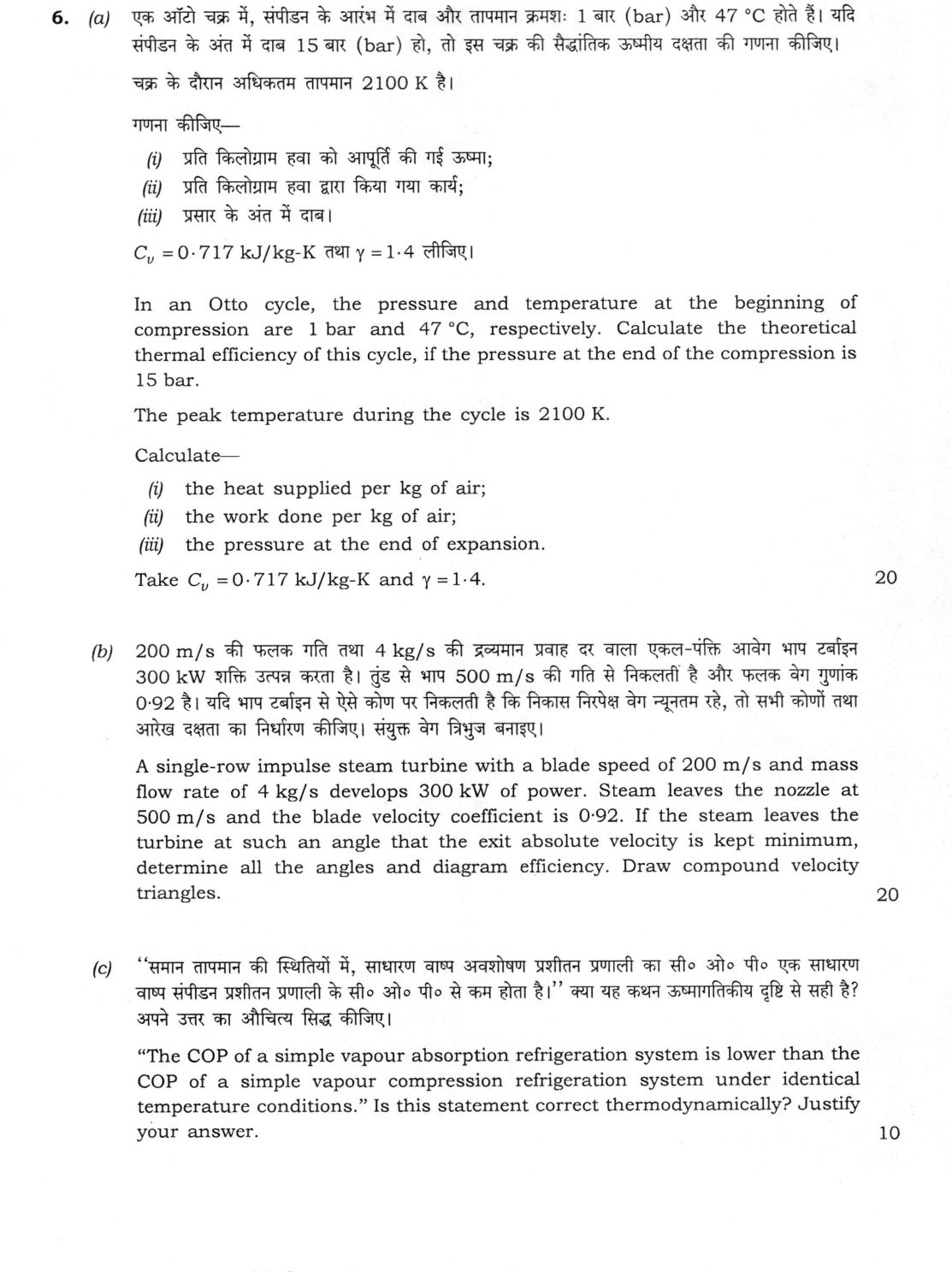
(a) In an Otto cycle, the pressure and temperature at the beginning of compression are 1 bar and 47 °C, respectively. Calculate…
In an Otto cycle, the pressure and temperature at the beginning of compression are 1 bar and 47 °C, respectively. Calculate the theoretical thermal efficiency of this cycle, if the pressure at the end of the compression is 15 bar.
The peak temperature during the cycle is 2100 K.
Calculate—
the heat supplied per kg of air;
the work done per kg of air;
the pressure at the end of expansion.
Take Cv = 0·717 kJ/kg-K and γ = 1·4. 20 marks
A single-row impulse steam turbine with a blade speed of 200 m/s and mass flow rate of 4 kg/s develops 300 kW of power. Steam leaves the nozzle at 500 m/s and the blade velocity coefficient is 0·92. If the steam leaves the turbine at such an angle that the exit absolute velocity is kept minimum, determine all the angles and diagram efficiency. Draw compound velocity triangles. 20 marks
“The COP of a simple vapour absorption refrigeration system is lower than the COP of a simple vapour compression refrigeration system under identical temperature conditions.” Is this statement correct thermodynamically? Justify your answer. 10 marks
हिंदी में प्रश्न पढ़ें
एक ऑटो चक्र में, संपीडन के आरंभ में दाब और तापमान क्रमशः 1 bar (bar) और 47 °C होते हैं। यदि संपीडन के अंत में दाब 15 bar (bar) हो, तो इस चक्र की सैद्धांतिक ऊष्मीय दक्षता की गणना कीजिए।
चक्र के दौरान अधिकतम तापमान 2100 K है।
गणना कीजिए—
प्रति किलोग्राम हवा को आपूर्ति की गई ऊष्मा;
प्रति किलोग्राम हवा द्वारा किया गया कार्य;
प्रसार के अंत में दाब।
Cv = 0·717 kJ/kg-K तथा γ = 1·4 लीजिए। (20 अंक)
200 m/s की फलक गति तथा 4 kg/s की द्रव्यमान प्रवाह दर वाला एकल-पंक्ति आवेग भाप टर्बाइन 300 kW शक्ति उत्पन्न करता है। टुंड से भाप 500 m/s की गति से निकलती है और फलक वेग गुणांक 0·92 है। यदि भाप टर्बाइन से ऐसे कोण पर निकलती है कि निकास निरपेक्ष वेग न्यूनतम रहे, तो सभी कोणों तथा आरेख दक्षता का निर्धारण कीजिए। संयुक्त वेग त्रिभुज बनाइए। (20 अंक)
“समान तापमान की स्थितियों में, साधारण वाष्प अवशोषण प्रशीतन प्रणाली का सी० ओ० पी० एक साधारण वाष्प संपीडन प्रशीतन प्रणाली के सी० ओ० पी० से कम होता है।” क्या यह कथन ऊष्मागतिकीय दृष्टि से सही है? अपने उत्तर का औचित्य सिद्ध कीजिए। (10 अंक)
Model answer
Drafted with AI by UPSC Answer Check against this question's marking rubric, to the expected length. UPSC does not publish answers for Mains — this is one way to score well, not an official key. How we build rubrics and answers.
(a) Otto cycle calculations (20 marks)
State 1 is p₁ = 1 bar and T₁ = 47 + 273 = 320 K. The compression is isentropic, so with p₂ = 15 bar
r^γ = p₂/p₁ = 15, so r = 15^(1/1.4) = 6.92.
The temperature after compression is T₂ = T₁ (p₂/p₁)^((γ−1)/γ) = 320 × 15^0.2857 = 320 × 2.1678 = 693.7 K.
Theoretical thermal efficiency.
η = 1 − 1/r^(γ−1) = 1 − 1/2.1678 = 1 − 0.4613 = 0.5387, that is 53.9%.
(i) Heat supplied per kg of air. Heat is added at constant volume from T₂ to T₃ = 2100 K:
Q₁ = C_v (T₃ − T₂) = 0.717 × (2100 − 693.7) = 1008.3 kJ/kg.
(ii) Work done per kg of air. The temperature at the end of expansion is T₄ = T₃/2.1678 = 968.7 K, since the expansion ratio equals r. The heat rejected at constant volume is
Q₂ = C_v (T₄ − T₁) = 0.717 × (968.7 − 320) = 465.1 kJ/kg.
W_net = Q₁ − Q₂ = 1008.3 − 465.1 = 543.2 kJ/kg.
Check: η Q₁ = 0.5387 × 1008.3 = 543.2 kJ/kg.
(iii) Pressure at the end of expansion. Process 4–1 is constant volume, so p₄/p₁ = T₄/T₁:
p₄ = 1 × 968.7/320 = 3.03 bar.
Check: the pressure after heat addition is p₃ = p₂ T₃/T₂ = 15 × 2100/693.7 = 45.4 bar, and p₄ = p₃/r^γ = 45.4/15 = 3.03 bar.
(b) Single-row impulse steam turbine (20 marks)
Given: u = 200 m/s, ṁ = 4 kg/s, P = 300 kW, V₁ = 500 m/s (nozzle exit) and blade velocity coefficient k = V_r2/V_r1 = 0.92.
Whirl velocities. The power is P = ṁ u ΔV_w, so
ΔV_w = 300 000/(4 × 200) = 375 m/s.
The exit absolute velocity V₂ is least when it is axial, so V_w2 = 0 and α₂ = 90°. Then V_w1 = ΔV_w = 375 m/s.
Inlet triangle.
- Nozzle angle: cos α₁ = V_w1/V₁ = 375/500 = 0.75, so α₁ = 41.4°.
- Flow velocity: V_f1 = 500 sin 41.4° = 330.7 m/s.
- Relative velocity: V_r1 = √(330.7² + (375 − 200)²) = √(109 359 + 30 625) = 374.2 m/s.
- Blade inlet angle: tan β₁ = V_f1/(V_w1 − u) = 330.7/175, so β₁ = 62.1°.
Outlet triangle.
- Relative velocity: V_r2 = 0.92 × 374.2 = 344.2 m/s.
- The whirl is zero, so V_r2 cos β₂ = u, that is cos β₂ = 200/344.2 = 0.581, and the blade outlet angle is β₂ = 54.5°.
- Flow velocity at exit: V_f2 = V_r2 sin β₂ = 344.2 × 0.814 = 280.2 m/s, which is also the absolute exit velocity V₂, at α₂ = 90° (axial).
Diagram efficiency.
η_d = 2 u ΔV_w/V₁² = 2 × 200 × 375/500² = 0.60 (60%).
Check: the power divided by the kinetic energy at nozzle exit, 300 000/(½ × 4 × 500²) = 0.60.
Combined velocity triangles. The two triangles share the blade velocity u as their common base. The inlet triangle sits above it, with V₁ at α₁ = 41.4° to the direction of motion and V_r1 at β₁ = 62.1°. The outlet triangle sits below it, with V₂ = 280.2 m/s perpendicular to u and V_r2 at β₂ = 54.5° to the reverse direction.

(c) COP of vapour absorption and vapour compression systems (10 marks)
Verdict. As a statement about the numbers, it is correct: for the same evaporator and condenser temperatures the COP of a simple vapour absorption system (about 0.5–0.8) is well below that of a vapour compression system (about 3–5). It is even true for ideal reversible cycles. But the statement is not a fair thermodynamic comparison, because the two COPs are defined on different kinds of energy input.
Why the COP is lower. The compression system consumes work W, which is pure high-grade energy (available energy), so COP_VC = Q_e/W. The absorption system consumes heat Q_g in the generator, low-grade energy at a modest temperature T_g, so COP_VA = Q_e/Q_g. Only a fraction of Q_g, at most the Carnot factor (1 − T₀/T_g), is convertible into work. For reversible operation between the evaporator temperature T_e, the ambient (condenser and absorber) temperature T₀ and T_g,
COP_ideal,VA = (1 − T₀/T_g) × T_e/(T₀ − T_e) = (Carnot engine efficiency) × COP_Carnot,VC,
which is less than COP_Carnot,VC by the factor (1 − T₀/T_g), always below 1. For example, T_e = 263 K, T₀ = 313 K and T_g = 393 K give COP_Carnot,VC = 5.26 and COP_ideal,VA = 5.26 × 0.203 = 1.07.
Why the comparison is not like for like. A heat-operated system can use waste heat, solar or process steam, energy that would otherwise be wasted or is cheap, whereas the compressor uses electricity, itself made from heat at a plant efficiency of only about 30–40%. On a primary-energy basis, a compression COP of 3.5 corresponds to about 3.5 × 0.35 ≈ 1.2 per unit of fuel heat, which is close to what an absorption system achieves. The right basis for comparison is the second-law (exergetic) efficiency, η_II = COP_actual/COP_ideal (or exergy input), which is comparable for good units of both kinds, roughly 0.6–0.7, since each system is judged against its own ideal.
Thus the numerical statement is correct, but a lower COP does not mean thermodynamic inferiority. Absorption systems are chosen when low-grade heat is available or electricity is scarce, and a numerical COP comparison alone is not a valid justification for preferring one system.
How this answer will be evaluated
Evaluation rubric
Each sub-part is marked on its own, against the marks and word limit printed on the paper.
- (a) Otto cycle with p₁ = 1 bar, T₁ = 47 °C, p₂ = 15 bar, T_max = 2100 K: find the theoretical efficiency, (i) heat supplied per kg, (ii) work per kg and (iii) pressure at the end of expansion (20 marks). 20 marks
Must cover
- T₁ = 320 K and T₂ = T₁(p₂/p₁)^((γ−1)/γ) ≈ 693.7 K, compression ratio r ≈ 6.92
- Efficiency η = 1 − 1/r^(γ−1) ≈ 53.9%
- (i) Q₁ = C_v(T₃ − T₂) ≈ 1008 kJ/kg; (ii) W = ηQ₁ ≈ 543 kJ/kg (T₄ ≈ 968.7 K)
- (iii) p₄ = p₁T₄/T₁ ≈ 3.03 bar
Loses marks
- Using 47 K or the Celsius value in the formulas.
- Using the Diesel or constant-pressure heat expression.
- Efficiency in terms of the wrong exponent.
Earns more
- Every step shown, including T₄ and Q₂ ≈ 465 kJ/kg as a check.
- Correct constant-volume reasoning for the heat and pressure at 4.
Extra mark
- Check of p₃ ≈ 45.4 bar
- (b) Single-row impulse steam turbine, u = 200 m/s, ṁ = 4 kg/s, P = 300 kW, V₁ = 500 m/s, k = 0.92, exit velocity minimum: find all angles and diagram efficiency, and draw the combined velocity triangles (20 marks). 20 marks
Must cover
- ΔV_w = P/(ṁu) = 375 m/s; minimum exit velocity means axial exit, V_w2 = 0, V_w1 = 375 m/s
- Nozzle angle α₁ = cos⁻¹(0.75) ≈ 41.4°; V_f1 ≈ 330.7 m/s; V_r1 ≈ 374.2 m/s; β₁ ≈ 62.1°
- V_r2 = 0.92 V_r1 ≈ 344.2 m/s; cos β₂ = u/V_r2, β₂ ≈ 54.5°; V₂ = V_f2 ≈ 280.2 m/s at 90°
- Diagram efficiency 2uΔV_w/V₁² = 60%, and a labelled combined triangle with shared base u
Loses marks
- Taking V_w2 ≠ 0 or the exit angle not 90°.
- Measuring β₂ or α₁ from the wrong reference.
- Omitting the triangles.
Earns more
- Explanation of why axial exit gives the minimum V₂.
- Triangles drawn with the correct sense of the whirl components.
Extra mark
- Cross-check of efficiency as power over ½ṁV₁²
- (c) Is the statement that the COP of a simple absorption system is lower than that of a simple compression system under identical temperatures thermodynamically correct? Justify (10 marks). 10 marks
Must cover
- Numerically correct: VAR COP about 0.5–0.8 against VCR about 3–5, also for ideal cycles
- Inputs differ: VCR uses work (high grade) while VAR uses heat (low grade), so COP_VA(ideal) = (1 − T₀/T_g) × COP_Carnot
- Fair comparison needs second-law (exergy) efficiency or primary energy, with waste-heat use noted
- Verdict that lower COP is not thermodynamic inferiority
Loses marks
- Saying the statement is simply true or false with no reasoning about input quality.
- Comparing a reversible with an actual cycle.
Earns more
- Numerical example of ideal COPs.
- Primary-energy argument with power-plant efficiency.
Extra mark
- Second-law efficiency of both systems is comparable
What "Calculate" is asking you to do
Apply the standard formula or schedule to data the question has already supplied — a table of readings, cost records, a balance sheet — and produce the number. The method is rarely in doubt; the marks sit in the named intermediate quantities, each of which has to appear as a labelled line.
Structure that answers it
Data as given → formula or standard treatment, named → substitution → each intermediate, labelled → result with units
Where marks are lost
Omitting an intermediate the marking scheme pays for separately, or rounding at an intermediate line so the final figure drifts. In commerce and accountancy, any figure in a statement that no numbered working note supports is treated as unearned.
Practice this exact question
Write your answer and it is marked point by point against the model answer above — what you covered, what you missed, what you got wrong.
Evaluate my answer →More from Mechanical Engineering 2026 Paper II
- Q3 (a) Steam at 40 °C is condensed in a power plant using cooling water available at 12 °C.…
- Q4 (a) (i) What does the NTU of a heat exchanger represent? Is a heat exchanger with a very…
- Q5 (a) The air-fuel ratio of an SI engine varies under different operating conditions. Write…
- Q6 (a) In an Otto cycle, the pressure and temperature at the beginning of compression are 1…
- Q7 (a) In a cogeneration plant, the net power output is 6 MW and the heating load is 1·5 MW.…
- Q8 (a) An air-conditioned space is maintained at 25 °C DBT and 50% RH. The outside condition…